
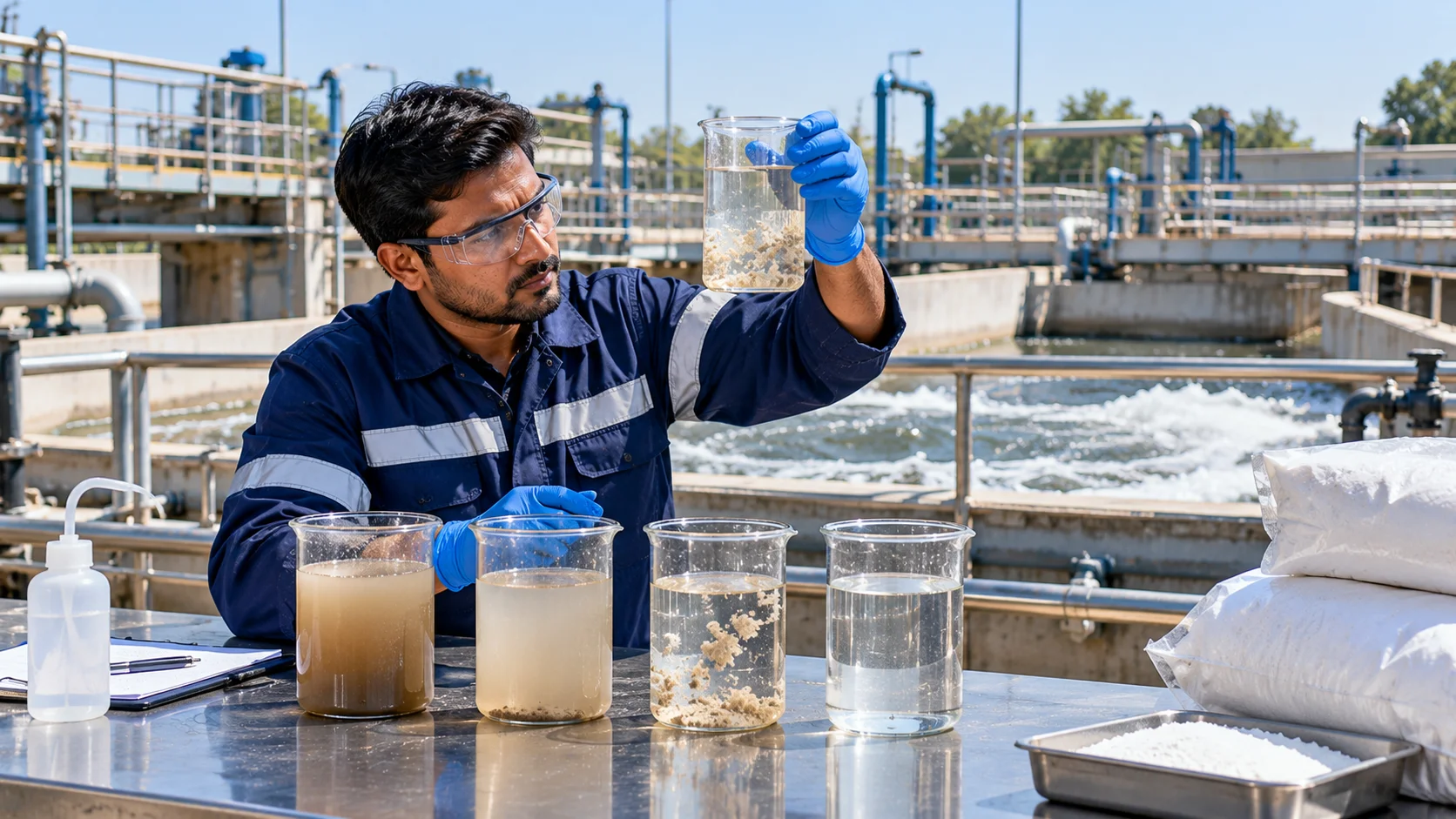
Anionic vs Cationic Polyelectrolyte: How to Choose for Wastewater Treatment
Anionic vs cationic polyelectrolyte is one of the most practical questions facing ETP and STP procurement teams. A polymer can improve suspended-solids separation and sludge handling, but choosing a product by name or price alone can create problems: poor floc formation, unclear treated water, excessive chemical use or wet filter-press cake.
The distinction starts with electrical charge. Anionic polymers carry negatively charged groups; cationic polymers carry positively charged groups. Those charges influence how each polymer interacts with suspended solids and sludge. This guide explains typical industrial uses, how to compare grades responsibly and what to ask an Indian bulk supplier before placing an order.
What Is a Polyelectrolyte Flocculant?
A polyelectrolyte flocculant is a water-soluble or water-dispersible polymer used to help fine particles combine into larger aggregates, or flocs, so that solids can be separated from water. Depending on the process, polymers may assist charge neutralisation, particle bridging, settling, flotation, thickening and mechanical dewatering.
Coagulation and flocculation are related—but different
Coagulation destabilises fine, often electrically charged particles, frequently using chemicals such as ferric salts, alum or poly aluminium chloride. Flocculation helps those destabilised particles form larger separable flocs. Polymers may be used as coagulants, coagulant aids or flocculants, depending on their chemistry and the plant's design.
Why polymer grade matters
Two products described simply as “anionic polyelectrolyte” may perform very differently. Important variables include molecular weight, charge density, product form, solution-preparation characteristics and the actual wastewater composition. A treatment program should specify the tested grade instead of assuming all polymers of the same charge are interchangeable.
Anionic vs Cationic Polyelectrolyte: Quick Comparison
This table describes typical starting points for evaluation, not fixed rules for every effluent. Real wastewaters can contain complex mixtures of organic and inorganic particles, so confirm selection through trials.
| Factor | Anionic polyelectrolyte | Cationic polyelectrolyte |
|---|---|---|
| Polymer charge | Negative | Positive |
| Common evaluation area | Mineral fines, clarification after coagulation, some inorganic sludges | Organic and biological sludge conditioning, some charge-neutralisation duties |
| Frequent application goal | Improve floc strength, settling and clarity | Improve sludge capture, dewatering and cake handling |
| Best grade | Depends on suspended solids, upstream chemistry and testing | Depends on sludge composition, equipment and testing |
| How to validate | Jar or settling trials with actual effluent | Jar screening plus equipment-relevant dewatering tests |
The US EPA Chemical Aids Manual for Wastewater Treatment Facilities notes that cationic polymers are commonly applied in waste-sludge dewatering, while anionic polymers can work well with particular mineral or chemically conditioned sludges. The correct choice still has to be established for the wastewater at hand.
When Might an Anionic Polyelectrolyte Be Suitable?
Anionic products are widely evaluated where the treatment process needs a bridging flocculant for suspended mineral particles or already-coagulated effluent. A plant's existing coagulant can change particle-charge behaviour, which is why looking only at the original wastewater is not enough.
ETP clarification after a coagulant
Industrial effluent treatment plants may apply ferric salts, alum or PAC to destabilise fine particles, then trial a compatible polymer to improve floc size and settleability. The preferred sequence and product grade depend on the process design; adding more polymer does not necessarily improve results.
Mineral processing and inorganic solids
Slurries with mineral fines and some chemically precipitated solids are common candidates for anionic flocculant screening. Performance varies with mineralogy, ionic composition, temperature and particle size.
What to assess in a settling trial
Observe whether flocs form consistently, remain intact during normal mixing, settle within the available clarification time and produce a suitable supernatant. Record how the grade behaves across the normal range of raw-water conditions.
When Might a Cationic Polyelectrolyte Be Suitable?
Cationic grades are frequently considered for sewage and biological-sludge conditioning because many organic solids have negatively charged surfaces. Their positive charge can support particle interaction, though actual performance still depends on grade and sludge characteristics.
Sludge thickening and dewatering
For filter presses, belt presses and centrifuges, polymer selection should focus on solids capture, filtrate or centrate clarity, cake dryness, throughput and operational stability. A polymer that produces large-looking flocs in a beaker may not be best under the shear conditions of full-scale equipment.
Mixed industrial and biological waste
Textile, food-processing, paper and other industrial facilities can generate mixed sludges. Cationic products are plausible candidates, but neither industry type nor sludge colour alone can determine the correct chemistry.
Why the lowest price per kilogram may mislead
A cheaper polymer can require more product to achieve acceptable performance or create downstream processing losses. Compare the total tested operating cost, including chemical consumption, water quality, disposal, equipment performance and labour.
How to Select a Flocculant for an ETP or STP
The most effective starting point is to define the treatment problem, collect representative samples and compare candidate grades under repeatable conditions. Screening tests are a decision tool, not a substitute for a qualified treatment engineer's plant-specific procedures.
1. Identify the process objective
Clarification, dissolved-air flotation, thickening and dewatering require different performance measures. State whether the priority is final-water turbidity, rapid settling, solids capture, reduced sludge moisture or operational reliability.
2. Document feed and process conditions
Useful background includes the effluent or sludge source, pH, suspended-solids loading, variability during production shifts, existing coagulant chemistry, mixing arrangements and receiving equipment. Record relevant treatment limits or quality specifications.
3. Screen representative samples
Use laboratory jar tests or appropriate dewatering screening trials to compare the selected grades. The US EPA Design Manual for Dewatering Municipal Wastewater Sludges discusses bench-scale conditioning evaluations, including jar tests, as a way to screen possible products.
4. Confirm under plant operating conditions
Before bulk procurement, have the site team confirm the candidate grade on actual process equipment at representative operating conditions. Trial results should be documented and approved before changes are made to full-scale dosing or chemical-handling procedures.

Common Mistakes When Buying Polyelectrolyte in Bulk
Procurement mistakes often originate from incomplete grade identification rather than from a supplier's lack of available stock.
- Ordering “polymer” without the grade: record ionic charge, specified product identity and supplier grade code.
- Comparing only unit price: evaluate performance per treated volume or dry tonne of solids, as appropriate for the application.
- Assuming one grade works for every plant: different sources and seasonal conditions can change treatment performance.
- Ignoring upstream treatment: a change in coagulant type or dose may affect polymer selection.
- Skipping traceability: request a batch-specific Certificate of Analysis (CoA) and the current Safety Data Sheet (SDS).
- Overlooking handling and storage: stored powders and prepared solutions have grade-specific instructions and wet polymer spills can create a serious slip hazard.
For further supplier-selection criteria, see BulkFineChem's bulk chemical supplier checklist and guide to reading a Certificate of Analysis.
Buying Polyelectrolyte in India: A Supplier Checklist
BulkFineChem lists Polyelectrolyte – Anionic and Cationic Flocculant, including anionic, cationic and non-ionic grade options. The product listing describes a granular powder, 25 kg HDPE-bag packing with an inner liner and a 25 kg minimum order quantity. Confirm the current grade, packing and commercial terms directly before placing an order.
Include these points in an enquiry:
- ETP, STP, mineral-processing or sludge-dewatering application
- Objective: clarity, settling speed, capture rate, cake dryness or another defined metric
- Current coagulant or conditioning chemicals, if any
- Relevant wastewater or sludge test information, including pH and solids content
- Preferred polymer form and any existing equipment limitations
- Monthly consumption, order quantity and delivery destination
- Requirement for a trial grade, batch CoA, TDS and SDS
Buyers should also verify any application-specific quality or regulatory conditions. Industrial-treatment suitability does not automatically establish approval for drinking-water use.
Frequently Asked Questions
1. What is the main difference between anionic and cationic polyelectrolyte?
Anionic polymers carry negative functional charge while cationic polymers carry positive charge. Their particle interactions differ, influencing suitability for clarification, sludge conditioning and other operations.
2. Which polymer is better for sludge dewatering?
Cationic grades are commonly evaluated for organic and biological sludges, but some sludges respond better to other polymer chemistries. Screening and equipment-relevant trials determine the appropriate grade.
3. Is anionic polyelectrolyte always best for ETP clarification?
No. It is one candidate for many clarification processes, particularly after coagulation. Water chemistry, suspended solids and upstream chemical treatment determine the best result.
4. Can polyelectrolyte replace alum or PAC?
Some polymers can act as primary coagulants, while others function mainly as coagulant aids or flocculants. Do not assume a particular grade can replace alum or PAC without a process assessment and trials.
5. How is a suitable polymer dose determined?
Qualified treatment personnel determine the dose through controlled trials on the real feed and subsequent plant validation. A fixed internet dosing figure cannot reliably account for varying solids and water chemistry.
6. What documents should I request with bulk polyelectrolyte?
Request the exact grade specification, batch-specific CoA, relevant TDS and current SDS. Confirm packaging, batch identification and any application-specific compliance evidence before dispatch.
Conclusion: Trial the Grade Before Committing to Bulk Supply
The practical answer to anionic vs cationic polyelectrolyte is not a universal winner. Anionic products often enter the shortlist for inorganic clarification and certain mineral sludges; cationic products are frequently screened for biological-sludge conditioning. The best-performing grade, however, is the one validated for your particular wastewater, process equipment and quality goals.
Need flocculants for an ETP or STP? Browse BulkFineChem's polyelectrolyte product page and send your intended application, plant location, grade requirements and estimated quantity. Ask for available grades and supporting documentation before ordering.
Technical background: US EPA discussion of coagulation and polymer aids; US EPA Chemical Aids Manual; US EPA Dewatering Manual.