
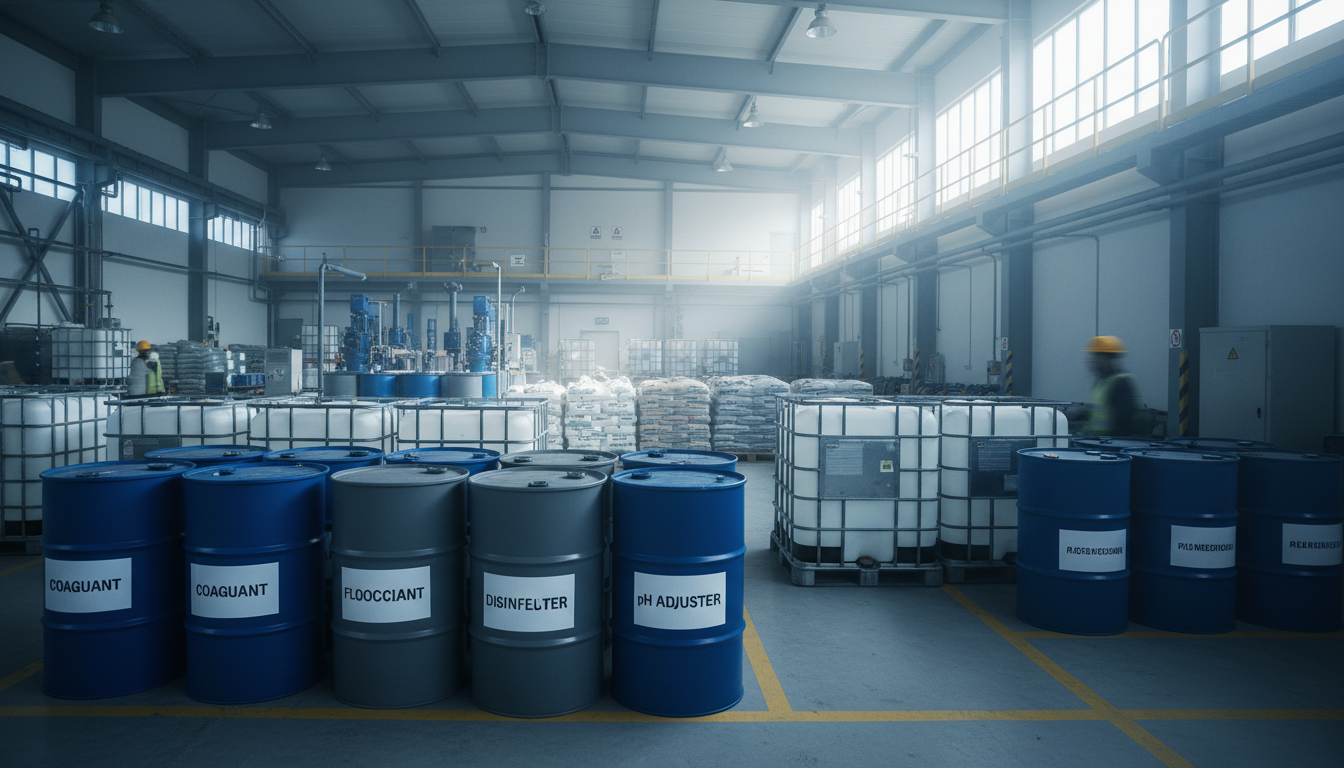
If you're sourcing water treatment chemicals in bulk, the hard part usually isn't finding a coagulant or a disinfectant — it's finding one supplier who stocks all of them, ships pan-India, and hands over a proper GST invoice and batch-wise Certificate of Analysis without you having to chase five different vendors for five different products. That's the gap BulkFineChem's Water Treatment Chemicals range closes: coagulants, flocculants, disinfectants, pH conditioners and filtration media, all sourced through one enquiry-to-dispatch process.
This guide walks through what actually falls under "water treatment chemicals," how the major coagulants compare, what documentation you should insist on before placing a bulk order, and how the sourcing process works when you're buying by the drum, tonner or MT rather than the bottle.
What Actually Falls Under "Water Treatment Chemicals"?
It's not one product — it's a working system. Raw or wastewater needs something to destabilize suspended particles (coagulation), something to bind those particles into settleable flocs, something to kill or oxidize pathogens, and often something to filter out whatever's still floating after all that. BulkFineChem's range is built around those four jobs, and most treatment plants end up buying from at least two or three of these groups at once.
Coagulants and Flocculants
These are the chemicals that do the actual "clean the water" work — they destabilize colloidal particles so they clump and settle instead of staying suspended. Get the coagulant choice wrong and everything downstream (filtration, disinfection, sludge handling) gets harder.
- Poly Aluminium Chloride (PAC) — works across a wider pH band, lower dosage needed
- Aluminium Sulphate (Alum) — the traditional, cost-effective coagulant
- Ferric Chloride — strong coagulant for effluents high in organics and phosphates
- Polyelectrolyte (anionic and cationic) — used as a flocculant aid to speed up settling
Disinfectants and Oxidizers
Once particles are out, you still have to deal with what's dissolved and what's alive in the water. This is where chlorine-based chemistry does most of the heavy lifting in Indian municipal and industrial setups.
- Liquid Chlorine (industrial grade, supplied in tonners) — high-volume disinfection
- Sodium Hypochlorite Solution (10–12%) — easier and safer to handle than gas chlorine
- Calcium Hypochlorite (bleaching powder, 65%) — solid form, longer shelf stability
pH Correction and Water Conditioning
Coagulation only works within a narrow pH window, and a lot of effluent doesn't sit there naturally. These chemicals correct that, and a couple do double duty as conditioning agents further down the line.
- Hydrated Lime (Calcium Hydroxide) — pH correction and softening
- Trisodium Phosphate — scale control and buffering
- Ferrous Sulphate Heptahydrate — used in both coagulation and iron-based treatment
Filtration Media and Adsorbents
Chemistry handles what's dissolved or suspended in the micron range; media handles the rest, plus taste, odor and color.
- Activated Carbon (granular and powdered) — adsorbs organics, chlorine residue, odor
- Water Filter Media (sand, gravel, anthracite) — multi-media filtration beds
PAC vs Alum vs Ferric Chloride: Which Coagulant Should You Buy in Bulk?
This is the question that comes up in almost every enquiry we get, and honestly, there's no single right answer — it depends on your raw water quality, your pH, and how much sludge disposal costs you downstream. Here's the practical comparison buyers actually use to shortlist.
| Factor | Poly Aluminium Chloride (PAC) | Alum (Aluminium Sulphate) | Ferric Chloride |
|---|---|---|---|
| Effective pH range | Wider — more forgiving | Narrower, needs closer control | Wide, works well on high-organic effluent |
| Dosage required | Generally lower per litre treated | Higher dosage for comparable clarity | Moderate, but corrosive to handle |
| Sludge volume | Lower | Higher | Moderate to high |
| Handling | Liquid or powder, less corrosive | Easy to handle, well understood | Corrosive, needs proper storage/PPE |
| Typical use case | Drinking water plants, textile effluent | General ETP/STP, cost-sensitive jobs | Industrial effluent high in phosphates/organics |
If you're not sure which one fits your effluent profile, that's a jar-test question, not a guessing one — ask for small trial quantities of two or three coagulants before committing to a bulk order. Most serious buyers do exactly that.
Grades, Documentation and What to Ask For Before You Order
Bulk water treatment chemicals aren't something you buy on price alone — the paperwork matters just as much, especially if your own plant answers to a pollution control board or an end client's quality team.
- Batch-wise Certificate of Analysis (CoA) from the manufacturer, not a generic spec sheet
- TDS/SDS (Technical and Safety Data Sheets) on request — essential for chlorine, ferric chloride and lime handling
- A proper GST tax invoice on every order, not a delivery challan alone
- E-way bill generated for larger consignments, especially tonner and MT-scale chlorine or PAC orders
- Clear MOQ stated per product — water treatment chemicals are priced and packed very differently by kg, drum, tonner or MT
How Bulk Sourcing Works with BulkFineChem
This isn't a shop-and-checkout model, and it isn't meant to be — bulk chemical procurement rarely is. Here's the actual flow.
- Send an enquiry for the specific chemical, grade and quantity you need, either from the product page or via Quick Order.
- Receive a quotation with pricing based on your quantity, packaging (drum/tonner/bag) and delivery location.
- Confirm the order with advance payment — typically 50–100% depending on the product and order size.
- Dispatch pan-India, with GST invoice, batch CoA, and TDS/SDS attached; e-way bill generated where the consignment size requires it.
Who Actually Buys Water Treatment Chemicals in Bulk?
This category is squarely B2B — BulkFineChem doesn't sell retail packs or serve individual households. The buyers we see are:
- ETP/STP/WTP operators and EPC contractors sourcing coagulants and disinfectants for ongoing plant operation
- Textile, dyeing and paper manufacturers treating process effluent in-house
- Industrial manufacturers needing boiler and cooling-tower water conditioning chemicals
- Institutional buyers — hospitality groups, large campuses — sourcing disinfectants and filter media for their own water systems
FAQs About Bulk Water Treatment Chemicals
What's the minimum order quantity for water treatment chemicals?
MOQ varies by product — some, like activated carbon or filter media, are ordered by the bag or MT; liquid chlorine and PAC solutions are typically ordered by drum or tonner. Send an enquiry with your required quantity and we'll confirm the applicable MOQ and packaging.
Do you provide a Certificate of Analysis with every batch?
Yes. Every dispatch comes with a batch-wise CoA from the manufacturer, and TDS/SDS are available on request — ask for them upfront if your plant's documentation process needs them before goods arrive.
Can I test a coagulant before committing to a bulk order?
That's a conversation worth having at the enquiry stage. Many buyers request smaller trial quantities of PAC, alum or ferric chloride to run jar tests on their specific effluent before scaling up to a full bulk order.
What's the real difference between liquid chlorine and sodium hypochlorite?
Liquid chlorine is a compressed gas supplied in tonners — it's cost-effective at high volumes but needs strict handling protocols. Sodium hypochlorite is a liquid solution that's easier and safer to store and dose, which is why a lot of smaller plants prefer it despite the slightly higher per-unit cost.
Do you deliver drums and tonners pan-India?
Yes, delivery is pan-India. For large or hazardous consignments (chlorine, ferric chloride, hydrochloric-type products), logistics and e-way bill documentation are arranged as part of the order process.
How is payment structured for a bulk order?
Typically 50–100% advance payment before dispatch, depending on the product and order value. Full terms are confirmed on the quotation before you place the order.
Can I get technical/safety data sheets before I finalize my chemical choice?
Yes — TDS and SDS are available on request, and it's worth asking for them at the quotation stage rather than after the order is confirmed, especially if your plant's safety team needs to sign off first.
The Bottom Line
Water treatment isn't a single-chemical job, and sourcing it shouldn't feel like managing five vendor relationships either. Whether you need PAC by the tonner, activated carbon by the tonne, or a one-time trial batch of ferric chloride to test against your effluent, the process is the same: send the enquiry, get a quotation with CoA and documentation confirmed upfront, and pay in advance for dispatch. Request a bulk quote for your water treatment chemical requirement, or browse the full range on the Water Treatment Chemicals category page.