
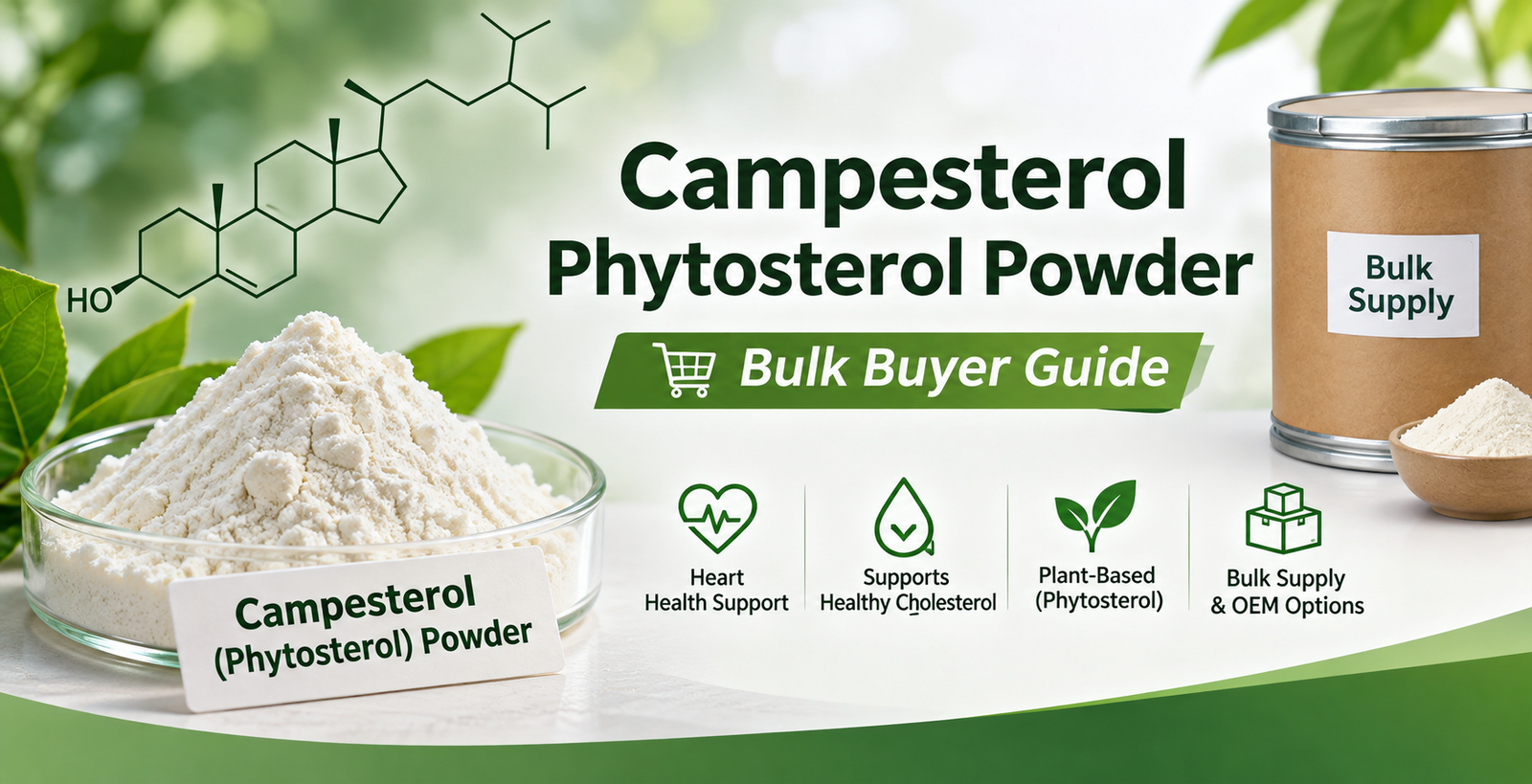
Campesterol phytosterol powder is a plant-sterol ingredient used in nutraceutical, functional-food and specialty formulation applications. For bulk buyers, the main challenge is not simply finding a phytosterol powder, but confirming exactly what the material contains, how it is standardized, how it is tested, and whether it fits the intended dosage form and finished-product specification.
This guide explains the practical sourcing points manufacturers, supplement brands, functional-food companies, traders and distributors should review before buying campesterol phytosterol powder in bulk.
What Is Campesterol?
Campesterol is one of the naturally occurring plant sterols, or phytosterols, found in plant-based raw materials. Commercial phytosterol ingredients can contain several sterols, and campesterol may be supplied as part of a broader phytosterol profile or as a standardized ingredient depending on the product specification.
BulkFineChem supplies CAMPASTROL Campesterol Phytosterol Powder for nutraceutical, functional-food, dietary-supplement and specialty formulation use.

Why Buyers Need to Look Beyond the Product Name
The phrase “campesterol phytosterol powder” does not by itself define the complete commercial specification. A buyer should confirm whether the material is a pure or enriched campesterol product, part of a mixed phytosterol system, or a branded formulation with a defined sterol profile.
Before approving a supplier, confirm:
- The exact ingredient name
- The stated campesterol or total phytosterol content
- Other sterols present in the material
- The analytical method used
- The physical form and particle characteristics
- Batch-specific COA results
Campesterol vs Total Phytosterols
Campesterol is one phytosterol, while “total phytosterols” refers to the combined sterol content of the ingredient. A phytosterol powder may contain campesterol together with sitosterol, stigmasterol and other related plant sterols.
This distinction matters when a formulation or customer specification calls for a particular campesterol level rather than a general phytosterol content.
What to clarify in the RFQ
Ask whether the quoted percentage refers to:
- Campesterol only
- Total phytosterols
- A defined sterol blend
- A minimum assay
- A typical value rather than a guaranteed specification
Key Buyer Factor 1: Composition Profile
A professional COA or specification should make the ingredient profile clear enough for the buyer to understand what is being purchased. If the formula depends on a particular sterol balance, composition should be verified rather than assumed.
Important questions
- What is the campesterol content?
- What is the total sterol content?
- Which other phytosterols are present?
- Are the values guaranteed minimums or typical results?
- Does the test method remain consistent from batch to batch?
Key Buyer Factor 2: Analytical Method
Plant sterols are commonly evaluated using chromatographic methods that separate and quantify individual sterols. For a commercial purchase, consistency in the analytical method is important because the buyer needs comparable results across different production lots.
If campesterol percentage is a critical specification, request the test method or method reference during supplier qualification.
Key Buyer Factor 3: Powder Properties
The chemical specification is only one part of ingredient selection. Powder handling can strongly affect manufacturing.
Depending on the final dosage form, buyers should evaluate:
- Particle size
- Bulk density
- Flow properties
- Dusting tendency
- Dispersibility
- Colour and odour
- Moisture sensitivity
Why this matters
A material that meets assay requirements may still create production problems if it flows poorly, separates during blending, causes dusting or does not disperse well in the intended system.
Key Buyer Factor 4: Dosage Form Compatibility
Campesterol phytosterol powder can be used in different product formats, but the manufacturing requirements can vary substantially.
Capsules
For hard capsules, formulators should evaluate flow, bulk density and fill-weight consistency.
Tablets
For tablets, compression behaviour, excipient compatibility and blend uniformity can be important.
Powder blends
For sachets and dry mixes, particle-size compatibility and segregation risk should be checked.
Functional foods
For food systems, dispersion, texture, taste impact and compatibility with fats or emulsifiers may be important depending on the formulation.
Key Buyer Factor 5: Regulatory Fit
Phytosterol rules, permitted uses, labeling requirements and maximum levels can vary by market and product category. A buyer should not assume that one raw material specification automatically fits every country or finished-product type.
Before commercial use, confirm the regulatory route for:
- The target country
- The product category
- The intended daily intake
- The ingredient form
- The planned label claims
The raw-material supplier can provide ingredient documentation, but final regulatory responsibility remains with the finished-product manufacturer.
What to Check on the COA
A batch Certificate of Analysis should match the actual delivered lot. Depending on the agreed specification, buyers may review:
- Product identity
- Batch number
- Campesterol content
- Total phytosterol content
- Related sterol profile
- Moisture or loss on drying
- Appearance
- Particle-size information where specified
- Heavy metals where required
- Microbiological limits where required
- Test date and release status
COA, TDS and SDS: Why All Three Matter
For controlled sourcing, buyers should separate the role of each document.
- COA: confirms batch-specific analytical results.
- TDS: describes the technical properties, typical composition and application guidance.
- SDS: provides handling, storage and safety information.
Using all three helps procurement, quality and production teams qualify the material more efficiently.
Storage and Packaging
Powdered phytosterol ingredients should be stored according to the supplier specification and protected from contamination, excessive heat and unsuitable humidity.
Receiving checklist
- Check container seals
- Confirm batch numbers
- Match the COA to the lot
- Inspect the powder appearance
- Review storage instructions
- Record expiry or retest information
Packaging should also suit the buyer's production scale and consumption rate so the material is not repeatedly exposed during storage.
How to Compare Two Campesterol Suppliers
Do not compare only the quoted price per kilogram. A better supplier comparison should include:
| Factor | Why It Matters |
|---|---|
| Campesterol specification | Confirms whether both suppliers are offering comparable material |
| Total phytosterol profile | Shows the broader sterol composition |
| COA consistency | Helps assess batch-to-batch control |
| Particle properties | Affects blending, filling and processing |
| Documentation | Supports QA and regulatory review |
| Packaging and MOQ | Affects inventory and commercial cost |
| Lead time | Impacts production planning |
Common Procurement Mistakes
- Buying on total phytosterol percentage without checking campesterol content
- Assuming all phytosterol powders have the same composition
- Using a sample COA instead of a batch-specific COA
- Ignoring particle-size and flow characteristics
- Comparing suppliers only on price per kilogram
- Failing to confirm regulatory suitability for the target market
- Changing suppliers without formulation or QA review
Frequently Asked Questions
What is campesterol?
Campesterol is a naturally occurring plant sterol found in plant-derived materials and used as part of phytosterol ingredient systems.
Is campesterol the same as phytosterol?
Campesterol is one type of phytosterol. A commercial phytosterol ingredient can contain campesterol together with other plant sterols.
What should a buyer check first?
Start with the exact composition specification, including campesterol and total phytosterol content.
Why is the COA important?
The COA confirms the analytical results for the actual production batch being supplied.
Does particle size matter?
Yes. Particle size can affect flow, blending, segregation and processing in capsules, tablets and powder formulations.
Can the same phytosterol material be used in every country?
Not automatically. Regulatory requirements and permitted uses can differ by market and product category.
Does BulkFineChem supply campesterol phytosterol powder?
Yes. BulkFineChem lists CAMPASTROL Campesterol Phytosterol Powder for nutraceutical, functional-food and specialty formulation buyers.
Conclusion
Campesterol phytosterol powder should be purchased against a clear technical specification rather than by product name alone. Buyers should compare composition, analytical method, powder properties, COA results, documentation, dosage-form compatibility and regulatory fit before approving a bulk supplier.
Need a bulk quote? Review BulkFineChem's CAMPASTROL Campesterol Phytosterol Powder product page and share your required quantity, specification, packaging and application with the BulkFineChem team.