
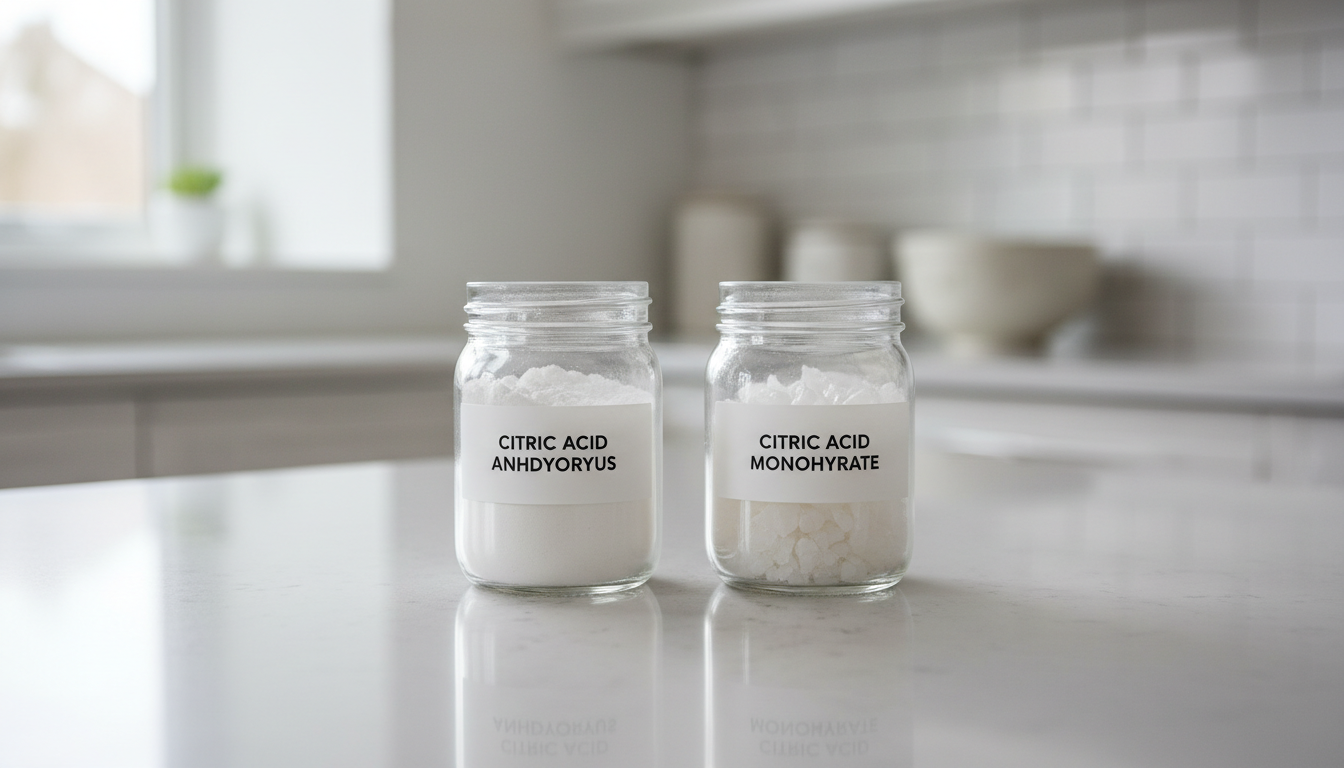
Your line supervisor calls at eleven in the morning. The citric acid that came in last week has set into a solid brick inside the bag, the effervescent blend is off spec, and nobody can say whether the problem is the material or the monsoon. Nine times out of ten, the real answer was decided at the purchase order stage — someone chose between citric acid anhydrous vs monohydrate without checking what the process actually needed.
These two products sit next to each other on almost every supplier's price list. Both look identical in the bag, carry the same E number, the same assay range on paper, and often the same packing. One water molecule separates them — and that molecule decides whether your dry blend stays free-flowing or turns into a lump you break with a hammer.
Here's what actually changes between the two forms, where each belongs, and the spec-sheet lines worth arguing about before you confirm an order.
What Citric Acid Is and Where It Comes From
Citric acid is a weak tribasic organic acid, formula C₆H₈O₇, and it does most of the sour work in the global food and beverage industry. Commercially it isn't squeezed out of lemons — hasn't been for over a century. Since 1917 the world has made it by feeding sugar to a mould called Aspergillus niger, and more than 90% of global output now comes from that fermentation route, roughly 80% of it run as submerged fermentation in stirred tanks.
The substrate is usually sucrose or glucose, and in India cane molasses is a common feedstock because it's cheap and locally abundant. After fermentation the broth is filtered, purified and crystallised — and it's that final crystallisation step where anhydrous and monohydrate part ways.
Scale matters when you negotiate. Annual global production sits near 2.8 million tonnes, with China supplying more than half. Beverages absorb over 50%, food about 20%, detergents another 20%, and cosmetics plus pharma the rest.
One Water Molecule, Two Different Products
Both forms are chemically the same acid. What differs is whether a water molecule is locked into the crystal lattice — what chemists call water of crystallisation — and that depends entirely on the temperature of the mother liquor when the crystal forms.
The switchover point is 36.6°C. Crystallise the hot concentrated solution above that temperature and you get anhydrous citric acid, C₆H₈O₇, molecular weight 192.12. Let it cool below 36.6°C and each molecule traps one water molecule, giving you the monohydrate, C₆H₈O₇·H₂O, molecular weight 210.14. That bound water works out to roughly 8.5% of the monohydrate's weight — BP and USP monographs set the window at 7.5% to 9.0%, and FCC caps it at 8.8%.
Now the part that catches out purchase teams. Both grades are assayed at 99.5% to 100.5%, but that figure is calculated on the anhydrous basis. Same number, different meaning. A 25 kg bag of anhydrous delivers about 25 kg of acid; the same bag of monohydrate delivers roughly 22.9 kg, because the rest is water you paid freight on.
Anhydrous vs Monohydrate: The Side-by-Side
Most technical datasheets bury these differences across four pages. Below is the short version — the one I'd want taped to the desk of whoever raises the indent. Assay reads identical in both columns, which is exactly why the comparison can't stop there.
| Property | Citric Acid Anhydrous | Citric Acid Monohydrate |
|---|---|---|
| Molecular formula | C₆H₈O₇ | C₆H₈O₇·H₂O |
| Molecular weight | 192.12 g/mol | 210.14 g/mol |
| Water of crystallisation | None | One molecule per acid molecule |
| Crystallises from solution | Above 36.6°C | Below 36.6°C |
| Typical water content | ≤ 0.5% (often 0.2% by KF) | 7.5% – 9.0% |
| Assay (anhydrous basis) | 99.5% – 100.5% | 99.5% – 100.5% |
| Actual acid per 100 kg | ~100 kg | ~91.4 kg |
| Behaviour in damp air | Picks up moisture, cakes faster | More stable, lower caking risk |
| Melting point | ~153–156°C | Loses water near 80°C, melts lower |
| Best suited to | Dry blends, effervescents, low-moisture powders | Liquid systems, syrups, general acidulation |
If you're swapping one for the other in an existing recipe, the conversion factor is the thing to remember: replacing anhydrous with monohydrate means dosing about 9.4% more by weight to hold the same acidity.
Moisture, Caking and the Indian Warehouse Problem
This is where theory meets a godown in Vadodara in July. Citric acid in either form is moisture-sensitive, but anhydrous has no bound water in the lattice, so it pulls ambient moisture in more readily. The mechanism is simple: surface moisture dissolves a thin skin of acid, the water evaporates, and the acid recrystallises as solid bridges between particles. Those bridges are your lumps.
What the data says about storage
Caking risk climbs sharply once relative humidity crosses roughly 75%. During a Gujarat monsoon, an open bag on a plant floor sits above that for days. Temperature swings between a hot truck and a cool store do similar damage, because condensation forms inside the liner.
- Store sealed in original packing at 10°C to 30°C, ideally below 65% RH
- Keep bags off the floor on pallets, away from external walls
- Reseal partially used bags the same shift — not the next morning
- Avoid rapid transfer between hot and cold areas to stop internal condensation
- Typical shelf life is 24 months sealed, and that clock assumes proper storage
Monohydrate isn't immune — it simply tolerates a sloppier warehouse. For plants without climate control, that difference alone can justify the form.
Mesh Size: The Spec Everybody Forgets to Quote
Buyers argue over assay and never mention granulation, then wonder why a blend segregates. Citric acid mesh size controls dissolution rate, dust, flow, and how well the acid stays mixed with the rest of the batch.
Common grades and where they fit
Suppliers usually offer three or four cuts. Matching the cut to your other dry ingredients matters more than picking the "finest" option — particles of very different size separate during handling.
- Fine powder: minimum 65% passing 75 µm (200 mesh) — fast dissolution, effervescent tablets, instant powders
- Fine granular (30–100 mesh): the workhorse for beverage premixes and dry seasoning blends
- Granular (150–2500 µm): good flow, low dust, suited to automated dosing
- Coarse granular (500–2500 µm): slow-dissolve applications and bulk liquid make-up tanks
- Finer cuts cake faster — a real consideration if you buy three months of stock at a time
Which Form Wins, Application by Application
The honest answer: either form works in most wet applications, because once the acid hits water the hydrate distinction vanishes. Where it truly matters is anything dry, anything effervescent, and anything where you're paying freight on water you don't want.
Beverages, syrups and liquid systems
Soft drinks, juices, RTD teas and syrups dissolve the acid immediately, so monohydrate is usually the sensible pick — easier to store and often cheaper per bag. Citric acid uses in food and industry here run from pH control to flavour sharpening to chelating trace metals that would otherwise catalyse oxidation and dull your colour.
Dry blends, effervescents and powders
Anhydrous is close to mandatory here. In an effervescent tablet or sachet, the acid sits alongside sodium bicarbonate or potassium bicarbonate, and any free water starts the reaction early — you'll see swelling, gas and dead product on the shelf. Instant drink powders, bakery premixes, seasoning blends and nutraceutical sticks follow the same logic.
Detergents, cosmetics and industrial cleaning
Citric acid chelates calcium, magnesium and iron, which is why it turns up in hard-water detergents, descalers and metal-cleaning formulations at roughly 0.1% to 2.0%. Powder detergents want anhydrous, for the same moisture reason as food blends. Liquid cleaners, shampoos and skincare pH adjusters take monohydrate happily.
Reading the Spec Sheet Before You Confirm the Order
Anyone buying citric acid food grade in India should read the COA, not the brochure. The relevant monographs — IP, BP, Ph. Eur., USP, FCC and the JECFA/Codex specifications behind E330 (INS 330 in Indian labelling) — converge on a similar set of limits, which makes deviations easy to spot.
The lines that actually matter
Assay tells you very little on its own, since both forms quote the same range. These are the citric acid specifications I'd check line by line on every batch.
- Water content (Karl Fischer): confirms you received the form you ordered
- Sulphated ash / residue on ignition: typically ≤ 0.05%
- Oxalates: usually ≤ 100 ppm, a fermentation-purity indicator
- Heavy metals: lead not more than 0.5 mg/kg under FCC
- Granulation: stated as a mesh range with over/undersize tolerances
One habit worth building: ask for the batch-wise COA before dispatch, not after. A mismatched water figure is far easier to sort out while the material is still on the supplier's floor.
Frequently Asked Questions
Can I substitute monohydrate for anhydrous in my formulation?
In wet systems, yes — adjust the dose upward by about 9.4% to compensate for the bound water. Dry blends and effervescent products are different: treat it as a formulation change rather than a swap, because that water will react with your bicarbonate over shelf life. Run a stability trial first.
Which form is better value per kilogram?
Compare cost per kilogram of actual acid, not per kilogram of bag. Monohydrate carries roughly 8.5% water, so a lower headline rate doesn't always win once you account for extra dosing and freight on water. Over long deliveries, that gap adds up faster than people expect.
Does anhydrous citric acid really cake more?
It does, and the reason is physical rather than chemical. With no water in the lattice, anhydrous readily takes on ambient moisture, dissolves at the particle surface and recrystallises into bridges between grains. Keep it sealed below 65% RH and the problem mostly disappears.
What mesh size should I order?
Match it to the other powders in your blend. A 30–100 mesh fine granular suits most beverage premixes and seasoning blends; go to a fine powder only when you need very fast dissolution, such as in effervescent or instant formats. Always write the mesh range into your purchase specification — otherwise you'll get whatever the plant is running.
Is citric acid from fermentation suitable for vegetarian and food-grade use?
Commercial citric acid comes from Aspergillus niger fermentation of sugar substrates, and food-grade material is made to E330 / INS 330 specifications recognised under Codex and Indian labelling. Confirm the grade and monograph on the COA for your application.
How long can I store it?
Sealed in original packing under recommended conditions, 24 months is the figure most producers quote. Poor storage shortens that — not because the acid degrades, but because caked material becomes unusable for automated dosing.
The Bottom Line
Pick anhydrous when water is your enemy: effervescent products, dry blends, instant powders, powder detergents, anything with a long shelf life sitting in a humid warehouse. Pick monohydrate when the acid is going straight into solution and your storage is decent — beverages, syrups, liquid cleaners, cosmetic pH adjustment. Then write the mesh range and the Karl Fischer limit into your purchase order, and check both on the batch COA.
BulkFineChem supplies Citric Acid in both anhydrous and monohydrate forms, in bulk packing — 25 kg bags and HDPE drums — with batch-wise COA, GST invoice and pan-India delivery from Vadodara, Gujarat. We also stock the ingredients that usually sit alongside it on the same indent: Sodium Citrate, Sodium Bicarbonate, Potassium Bicarbonate, Dextrose and Xanthan Gum for beverage, bakery and nutraceutical formulations. Tell us your application, target mesh and monthly volume, and we'll quote the right form the first time — visit bulkfinechem.com to send your enquiry.