
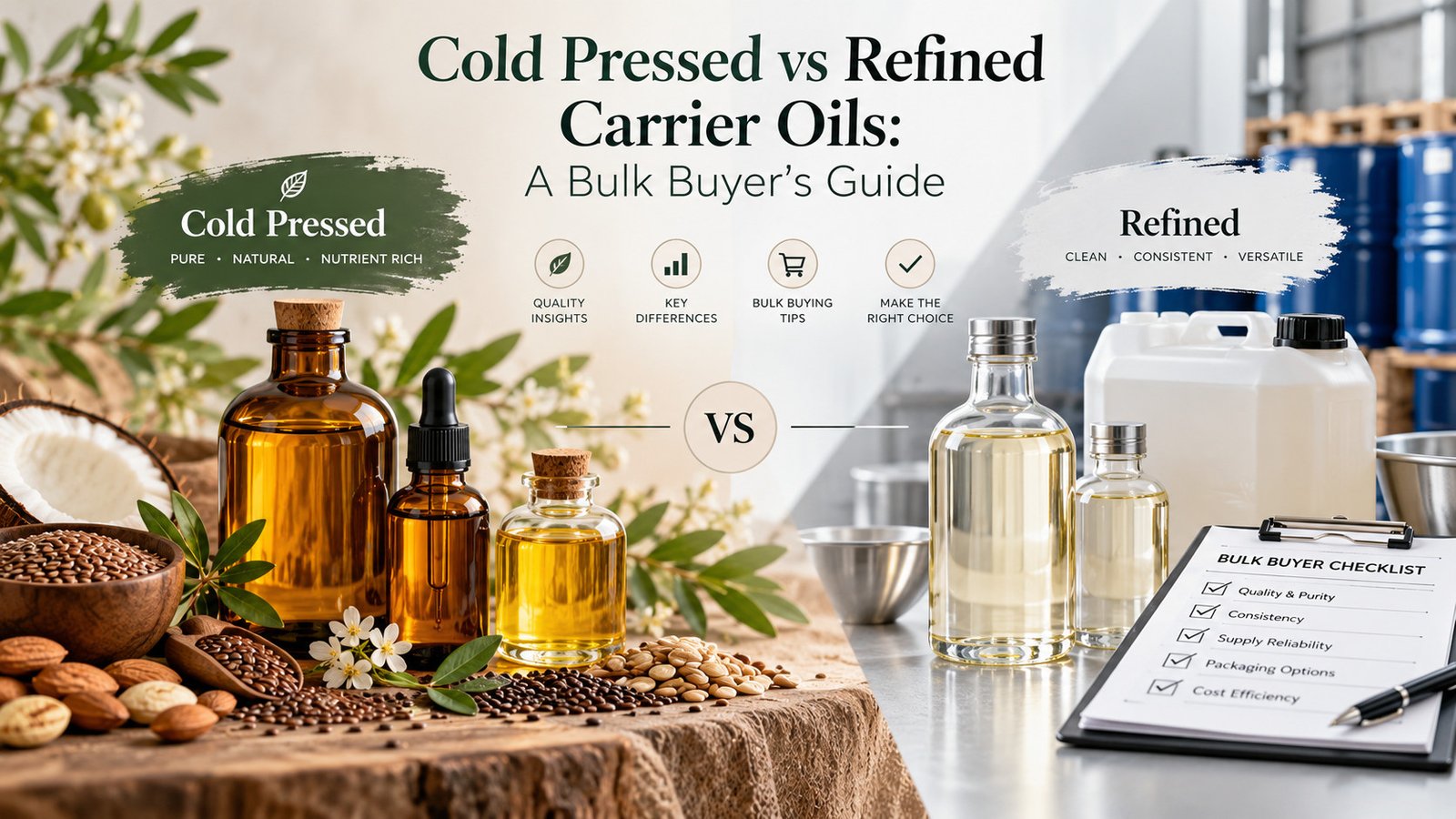
Cold pressed vs refined carrier oils is one of the first decisions a formulator or procurement team has to make, and it affects far more than the label. The same botanical source can arrive as a golden, seed-scented oil or as a pale, near-neutral one, and each behaves differently in a cream, a serum or a hair oil. Pick the wrong grade and the problem tends to show up late: a tinted emulsion, a smell that fights your fragrance, or a drum that goes off sooner than planned.
This guide explains what each grade means, compares them side by side, and lists the specifications to confirm before you place a bulk order.
What "Cold Pressed" and "Refined" Actually Mean
Both grades start from the same seed, kernel or fruit. The difference lies in what happens to the oil after it leaves the press.
Cold Pressed Carrier Oils
Cold pressed oils are extracted mechanically, by pressing the raw material with no heat applied, and are then filtered to remove solids. Because the processing is light, the oil keeps its natural colour, its characteristic aroma and more of its naturally occurring minor components. The trade-off is natural variation: crop, season and harvest can shift colour and scent from one lot to the next.
Refined Carrier Oils
Refined carrier oils go through additional treatment after extraction, typically degumming, neutralising, bleaching and deodorising. The result is a lighter, more neutral oil that is usually more uniform from lot to lot. Refining can also reduce some of the minor components that cold pressed oil retains, so refined is not simply "better" or "worse". It is built for a different job.
Where "Unrefined" and "Virgin" Fit In
Terms such as unrefined, virgin and extra virgin are not used the same way by every supplier, and "cold pressed" itself is used loosely in some places. Rather than relying on the label, ask for the process in plain words: how the oil was extracted, whether heat or solvent was involved, and whether any refining step was applied. Then check that the answer appears in the technical data sheet (TDS).
Cold Pressed vs Refined Carrier Oils: Side-by-Side Comparison
The table below summarises the typical differences. Individual oils vary, so treat it as a starting point and check the actual specification of the lot you are buying.
| Factor | Cold Pressed | Refined |
|---|---|---|
| Processing | Pressed mechanically with no heat applied, then filtered | Treated after extraction, typically degummed, neutralised, bleached and deodorised |
| Colour | Natural colour of the source, often deeper | Lighter and paler |
| Aroma | Characteristic scent of the plant | Little or no scent |
| Minor components | More of the naturally occurring components retained | Some reduced by processing |
| Lot-to-lot consistency | Can vary with crop and season | Usually more uniform |
| Stability | Depends on the oil's fatty acid profile, packaging and handling | Often more stable, although refining can remove some natural components |
| Typical fit | Products where the oil's character is part of the story | Neutral, lightly coloured or lightly scented products and larger runs |
How Processing Affects Your Formulation
Four practical differences matter most when you move from a lab sample to a production batch.
Colour and Aroma
A cold pressed oil can tint a white cream or add a seed or nutty note that competes with your fragrance. A refined oil stays out of the way. If colour and scent are part of the product story, cold pressed is the natural fit. If you need a neutral base, refined is easier to control.
Batch-to-Batch Consistency
Natural crops vary. With cold pressed oils, expect some movement in colour and scent between lots and write an acceptable range into your specification. Refined oils are usually tighter, which helps when you run large batches or need a repeatable appearance on the shelf.
Stability and Shelf Life
Stability depends on more than the grade. Oils rich in polyunsaturated fatty acids, such as grapeseed or hempseed oil, are generally more prone to oxidation than oils richer in monounsaturated fats, such as almond or olive oil. Jojoba is a special case: it is a liquid wax ester rather than a typical triglyceride oil, so general rules about oils do not always apply to it. Refining often improves stability, but it can also strip some natural components, so the net effect differs by oil. Ask for shelf-life guidance for the specific oil and pack size you plan to buy.
Cost and Sourcing
Price depends on the oil, the crop and the market, so compare quotes for the same oil at the same specification rather than assuming one grade costs more. Confirm lead time and available pack sizes for each grade before you plan a production run.
Which Grade Fits Your Application?
There is no universal winner. Start from the finished product and work backwards.
Facial Oils, Serums and Massage Blends
These products often put the oil front and centre, so natural colour, aroma and a minimally processed story can work in your favour. Oils such as almond oil, apricot oil and avocado oil are common choices here. Confirm the processing grade you need with your supplier before you commit.
Creams, Lotions and Light-Coloured Products
In emulsions where colour and scent must stay neutral, a refined grade is usually easier to work with. Lighter-feeling oils such as grapeseed oil and sunflower oil are frequently used in this kind of formulation, and a refined grade helps keep colour and odour in check.
Hair Oils and Essential Oil Dilution
A carrier oil used to dilute essential oils should not mask the aroma or add unwanted colour. For massage and aromatherapy blends, choose on skin feel, scent and shelf life. Cold pressed suits blends positioned as natural, while refined suits blends where the essential oil should lead.
Not Sure? Pilot Both
Order small quantities of both grades, run them through your actual formulation and stability checks, then lock the grade into your specification. Short pilot runs are far cheaper than reformulating after a full-scale batch.
Carrier Oil Specifications to Confirm Before a Bulk Order
Whichever grade you choose, get the details in writing. Ask the supplier for a technical data sheet and a certificate of analysis (COA) for each lot, and confirm the following:
- Botanical and common name: the exact oil, with the INCI name where your market requires it.
- Process grade in plain words: cold pressed, refined or otherwise, with the extraction method described.
- Appearance, colour and odour: the accepted range, so a lot that arrives darker or stronger than expected can be judged against the specification.
- Acid value (free fatty acids): an indicator of how much the oil has broken down.
- Peroxide value: an indicator of early oxidation. Ask for the limit in the specification and the result for your lot.
- Fatty acid profile: useful when your formulation depends on a particular balance, or when you are comparing two suppliers.
- Batch or lot number and manufacturing date: so shelf life is counted from the right date.
- Packaging and storage advice: the pack type and the recommended conditions.
For a closer look at reading these documents, see our guide to how to read a Certificate of Analysis before you accept a bulk order, and our checklist for choosing a bulk chemical supplier in India.
Storage and Handling for Bulk Carrier Oils
Oxidation is the main enemy of any carrier oil, whichever grade you buy. Light, heat and oxygen all speed it up, so good habits on the shop floor protect the quality you paid for.
- Store containers in a cool, dark place away from direct sunlight and heat sources.
- Keep containers tightly closed, and limit the air in partly used drums by moving the oil to a smaller container when practical.
- Use clean, dry, dedicated utensils and transfer equipment to avoid contamination, especially water.
- Use stock first-in, first-out, and write the opening date on partly used containers.
- Follow the supplier's storage guidance, since it can differ from one oil to another.
Carrier Oils Available from BulkFineChem
As a carrier oil supplier, BulkFineChem lists a wide range of oils for cosmetic, personal care, haircare and aromatherapy manufacturers, including almond oil, apricot oil, avocado oil, grapeseed oil, jojoba oil, hempseed oil, olive oil, moringa oil and wheatgerm oil.
Tell us which processing grade, pack size and documents you need, and we will confirm what is available for the oil you want. Call +91 95120 17161 or send an enquiry from any product page.
Frequently Asked Questions
Is cold pressed carrier oil always better than refined?
No. Cold pressed oil keeps its natural colour, aroma and more minor components, which suits products where the oil's character is part of the appeal. Refined oil suits neutral, lightly coloured or lightly scented products and larger runs. Which is better depends on the application.
Does refined mean lower quality?
Not necessarily. Refined describes how the oil was processed, not how pure or well made it is. A well-made refined oil with a clean COA can be the right choice, and a poorly stored cold pressed oil can perform worse than either.
Which lasts longer, cold pressed or refined carrier oil?
Refined oils are often more stable, but shelf life also depends on the oil's fatty acid profile, the packaging and how it is stored. Ask for guidance on the specific oil and pack size, and count shelf life from the manufacturing date on the COA.
What does "unrefined" or "virgin" mean on a carrier oil?
The meaning varies between suppliers. Ask for a plain-language description of the extraction method and any refining steps, and make sure it is written in the TDS.
Which documents should I ask for with a bulk carrier oil order?
Ask for the technical data sheet and a lot-wise COA that includes acid value and peroxide value, plus the supplier's packaging and storage guidance. Request a safety data sheet where applicable.
Is every carrier oil available in both grades?
Not always. Many carrier oils are sold in both forms, but some are mainly offered in one. Ask which grades of your chosen oil the supplier can provide and request the specification for each.
The Bottom Line
Choose cold pressed when natural colour, aroma and a minimally processed story are part of the product. Choose refined when you need a neutral, consistent base for lightly coloured or lightly scented formulations and larger production runs. In both cases the grade is only half the decision: a clear process description, a lot-wise COA and sensible storage matter just as much. If you are sourcing bulk carrier oils, share your application with the BulkFineChem team and we will help you match the oil, grade and documentation to your formulation.