

Creatine monohydrate solubility matters to supplement manufacturers because it affects dispersion, mixing behaviour and the user experience of powder products. But buyers should avoid treating “instant solubility” as the only sign of quality: identity, purity, particle size, moisture, contaminants and batch documentation are equally important.
Why Solubility Matters
Creatine monohydrate is widely used in sports-nutrition powders, pre-workout blends, capsules and tablets. In drink powders, poor dispersion can leave sediment or slow mixing. Finer particle size can improve dispersion speed, but it does not change the chemical identity of creatine monohydrate.
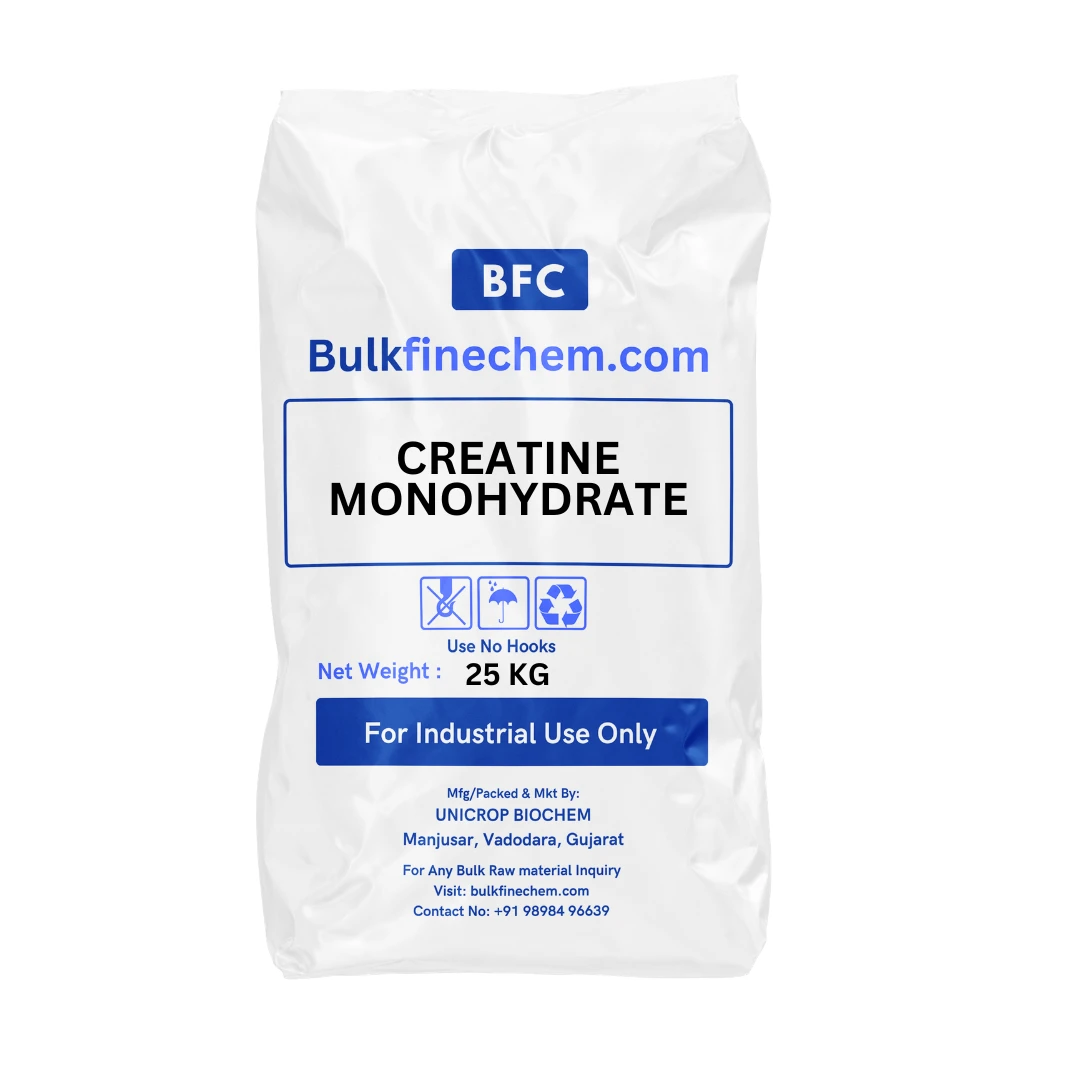
BulkFineChem Creatine Monohydrate
BulkFineChem supplies Creatine Monohydrate for sports nutrition, nutraceutical and supplement formulations.
Particle Size vs Solubility
Smaller particles generally wet and disperse faster because they present more surface area, but the formulation still depends on water volume, temperature, pH, other ingredients and mixing energy. Buyers should therefore distinguish between particle size, dispersion and true equilibrium solubility.
What to Check on the COA
- Identity
- Assay/purity
- Moisture or loss on drying
- Creatinine and other specified impurities where applicable
- Heavy metals and microbiological limits if required
- Particle-size specification when relevant
- Batch number and test date
Micronized vs Standard Material
Micronized creatine uses a finer particle-size distribution and may be chosen for drink mixes or products where rapid dispersion is important. Standard material may still be fully suitable for capsules, tablets or blends where particle size is less critical.
Buyer Testing
Before approving a new supplier, run the material in the actual formula. Check flow, dusting, blend uniformity, sedimentation, taste impact and packaging compatibility in addition to laboratory specifications.
Frequently Asked Questions
Does finer creatine mean higher purity?
No. Particle size and chemical purity are separate specifications.
Is micronized creatine chemically different?
No. Micronization changes particle size, not the identity of creatine monohydrate.
Why does creatine settle in water?
Limited solubility and dispersion conditions can leave undissolved material, especially at higher concentrations.
Should brands specify mesh size?
Yes when flow, mixing or drink dispersion is important to the finished product.
What documents should buyers request?
Request a batch COA plus specification/TDS and relevant safety or regulatory documentation.
Is creatine monohydrate well studied?
Yes. The International Society of Sports Nutrition describes creatine monohydrate as one of the most studied sports-nutrition ingredients.
Conclusion
Creatine monohydrate solubility should be evaluated alongside particle size, purity, COA results and actual formula performance. The best raw material is the one that meets both quality specifications and manufacturing needs.