
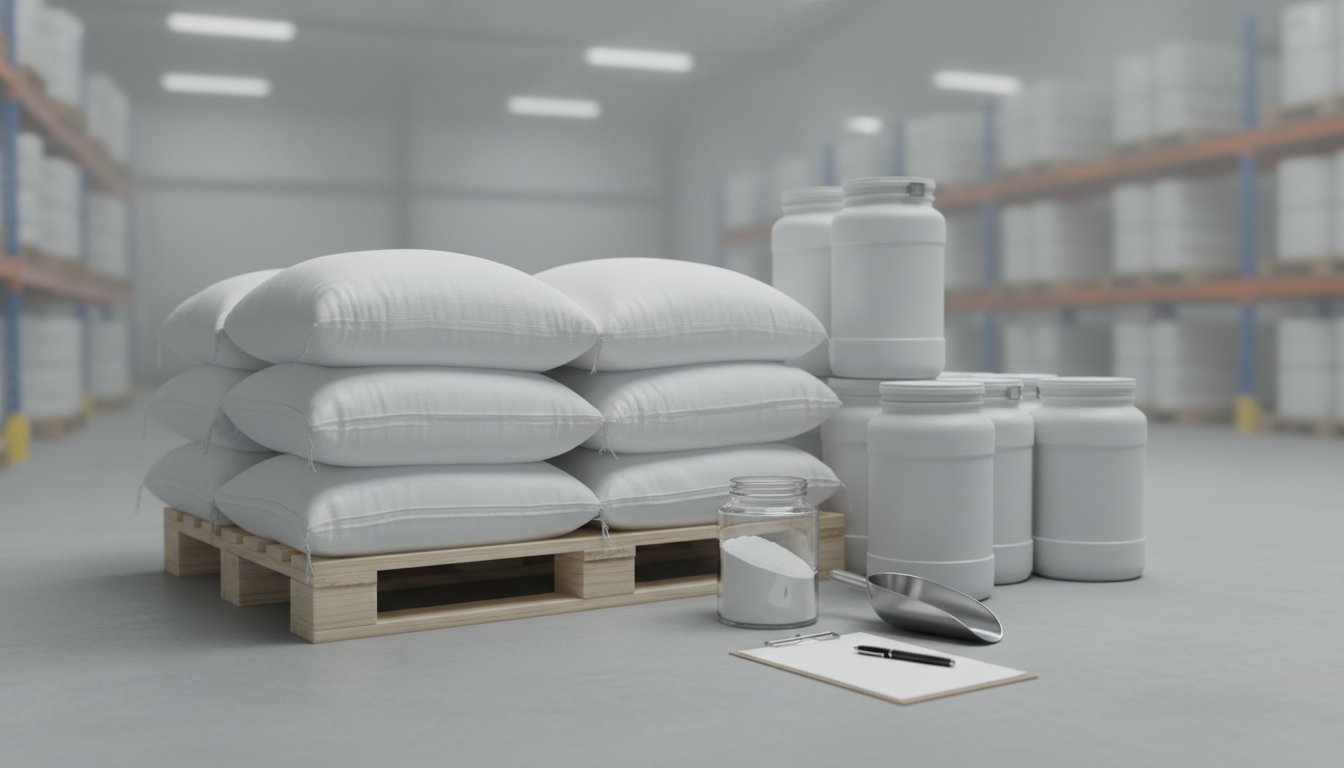
Creatine Monohydrate Specifications: What Bulk Buyers Should Check
A 500 kg lot lands at your plant. The powder looks exactly like last quarter's, the price is 8% lower, and the paperwork says "99.9% pure." Three weeks later your blend tastes faintly bitter, the tablet press sticks, and your client's lab flags a compound nobody on your team had heard of. That's usually when a purchase manager starts reading creatine monohydrate specifications properly instead of skimming the first line.
Creatine is a raw material where a great batch and a mediocre one look identical. Both are white, both are odourless, and both arrive in the same 25 kg bag carrying the same printed assay figure.
The difference shows up in a lab report — or in your rejection rate. Here's what belongs on the spec sheet, and what to push back on when it's missing.
What You're Actually Buying When You Order Creatine Monohydrate
Creatine monohydrate is creatine crystallised with one molecule of water locked into the structure. That bound water isn't contamination — it's part of the compound, and it means even perfectly pure creatine monohydrate is only about 87.9% creatine by mass. Anyone quoting you "100% creatine" in a monohydrate powder is either confused or hoping you are.
For a formulator, this matters at the dosing stage. If your label claim is 5 g of creatine, you're weighing roughly 5.7 g of monohydrate, and your overage calculations need to start from the assay on the batch COA rather than a generic number from a textbook.
How It's Made — and Where the Impurities Come From
Almost all commercial creatine is made synthetically, not extracted from meat. The standard route combines sodium sarcosinate with cyanamide in an acid-catalysed reaction at elevated temperature, then crystallisation, filtration, washing and vacuum drying. Those last four steps are where every meaningful impurity comes from.
Cyanamide can dimerise into dicyandiamide (DCD) when reaction pH and temperature aren't tightly controlled. Poor washing leaves it behind. Push the drying step too hot and creatine itself starts converting to creatinine, which is the degradation product, not a process residue.
Older or cost-cut processes are known for exactly this: bitter-tasting material carrying dicyandiamide and cyanide residues that then need masking agents to make palatable. If a supplier's sample tastes noticeably bitter, you've learned something about their purification before you've read a single number.
What "99.9% Purity" Really Means on a COA
This is the figure most buyers anchor on, and it's the one most likely to mislead. A "99.9%" assay is normally an HPLC result calculated on a dry basis — the sample is dried first, then the maths is done on what's left. Legitimate as a method, but it isn't a direct statement of what's sitting in your bag.
Some suppliers now publish a more honest number instead: assay ≥ 99.5% on a dry basis against USP methodology, with impurity limits spelled out separately. I'd take that over a bare 99.9% claim any day, because the second version can be audited and the first mostly can't.
The practical rule: purity claims without matching impurity limits are marketing. Sitting next to DCD, creatinine and heavy-metal figures, the same claim becomes a specification.
The Three Impurity Markers That Actually Separate Grades
If you check nothing else on a creatine COA, check these three. They're the fingerprints of process control, and they're what serious buyers in Europe and Japan have been specifying for years. EFSA has recommended limits for all three, and the well-known German reference material — Creapure, made by Alzchem at Trostberg in Bavaria — publishes specifications at or below them.
| Parameter | Reference limit | What it tells you |
|---|---|---|
| Dicyandiamide (DCD) | ≤ 50 mg/kg | Incomplete purification / poor washing after synthesis |
| Creatinine | ≤ 100 mg/kg | Excessive heat during drying, or degradation in storage |
| Dihydrotriazine (DHT) | ≤ 3 mg/kg | Side-reaction residue; suspected carcinogen, limit sits at detection level |
| Assay (HPLC, dry basis) | ≥ 99.5% to ≥ 99.9% | Overall quality, only meaningful alongside the rows above |
| Lead / Arsenic / Cadmium / Mercury | ≤ 0.1 mg/kg each | Raw material and equipment contamination control |
How bad can it get? Generic material has been tested at DHT levels above 110 mg/kg — more than thirty-five times the recommended ceiling. That's not a rounding error on a spec sheet — it's a different product wearing the same name.
Creatine Monohydrate Mesh Size: 80, 200 and 500
Mesh size is a sieve specification: the higher the number, the finer the particle that passes through. Your choice here has nothing to do with quality and everything to do with what happens downstream in your process. Pick it based on your equipment, not on what sounds premium.
| Grade | Typical opening | Best suited to | Relative cost |
|---|---|---|---|
| 80 mesh (standard) | Coarse crystalline | Capsules, tablets, bulk industrial use | Lowest |
| 100 mesh | ≈ 149 µm | General blending, granulation feeds | Low |
| 200 mesh (micronised) | ≈ 74 µm | Pre-workouts, sports nutrition blends, sachets | Medium |
| 500 mesh (ultra-fine) | ≈ 25 µm | Premium instant powders, high-end OEM work | Highest |
Why coarse isn't the same as cheap and nasty
An 80 mesh crystal flows better than a fine powder, and flow is what keeps a capsule filler running at speed. Fines bridge, they stick to punch faces, and they carry more static. Plenty of experienced tablet manufacturers deliberately buy the coarser grade.
- Better flow through hoppers and dosators
- Less dust during weighing and charging
- Lower cost per kg at the same assay
- Slight grit in a drink — irrelevant if you're encapsulating
Ask for particle size distribution, not just a mesh number
One sieve gives you one cut-off point. Two batches can both pass "95% through 200 mesh" and still behave completely differently in your blender, because one is loaded with fines and the other isn't. This is where most mesh-related complaints actually originate.
- Request Dv(10), Dv(50) and Dv(90) limits by laser diffraction
- Ask which test standard and dispersant were used
- Get bulk and tapped density on the same COA
- Agree a change-notification clause if the supplier alters milling
- Keep a retained sample from every approved lot for comparison
Micronised Creatine vs Regular: What Changes and What Doesn't
Micronised creatine is the same molecule, milled finer — usually to around 200 mesh against the standard 80. The marketing around it oversells the benefit quite badly, so it's worth being blunt about what you're paying extra for.
Creatine monohydrate dissolves at roughly 13–14 g per litre of water at 20°C, and grinding it doesn't move that ceiling. Finer particles improve dispersion and mouthfeel — the powder spreads more evenly and leaves less grit in the shaker. Better mixability, not better solubility; a powder can look like it's dissolving when it's only suspended.
On absorption there's nothing to buy. Standard monohydrate already shows bioavailability near 99% at typical 5–10 g doses, so a matched daily dose gives the same result from either grade. Buy micronised because your consumer drinks it, not because you think it works harder.
Reading a Creatine Monohydrate COA Line by Line
A batch-wise COA turns a supplier's promise into something you can hold them to. Generic ones — no batch number, no manufacturing date, no signature — are worth roughly what you paid for them. Here's what a usable COA carries.
Chemistry and identity
These establish that the material is what the label says and that the batch was made under control. Anything missing here is a reason to ask questions before the PO, not after delivery.
- Assay by HPLC, with basis stated (dry or as-is)
- Loss on drying / water content, typically around 12%
- pH of aqueous solution and appearance
- DCD, creatinine and DHT with numeric results, not "complies"
- Batch number, manufacturing date, retest or best-before date
Safety and microbiology
Your finished-product liability sits on these rows, especially if you're supplying a brand that runs its own third-party testing. Reference specifications for high-grade material give you a benchmark to write into your purchase spec.
- Lead, arsenic, cadmium, mercury — each ≤ 0.1 mg/kg by ICP-OES
- Total aerobic plate count ≤ 1,000 cfu/g
- Yeast and mould ≤ 50 cfu/g
- E. coli, Salmonella, S. aureus and coliforms — negative
- Residual solvents, where the process route warrants it
Buying Creatine Monohydrate in Bulk in India
Regulatory position first, since it's the question that comes up on every second call. Creatine doesn't appear on the WADA Prohibited List, and NADA follows WADA — so sports-nutrition brands aren't working around a doping restriction. Finished health supplements and nutraceuticals sold in India fall under the FSSAI Health Supplements, Nutraceuticals and Food for Special Dietary Use regulations, and the licence number on your pack is verifiable on the FoSCoS portal.
The raw-material side is where buyers get caught out. Most creatine reaching Indian manufacturers is imported, so you're often buying from a trader rather than the maker. Ask who made it and where — a supplier who can't answer that can't investigate a problem batch either.
Storage deserves a line too. Creatine converts to creatinine faster in warm, humid conditions, and a godown in June is exactly that. Keep it sealed, keep it dry, and don't buy twelve months of stock to chase a price break.
Frequently Asked Questions
Is 99.9% creatine monohydrate always better than 99.5%?
Not necessarily. A supplier publishing 99.5% alongside hard numbers for DCD, creatinine and DHT tells you more than one publishing 99.9% with no impurity data. Judge the specification as a whole rather than ranking suppliers by a decimal point.
What mesh size should I order for capsules?
80 to 100 mesh usually runs best on capsule and tablet lines, since coarser particles flow more predictably and dust less. Save 200 mesh for powders and sachets the consumer stirs into water. Running both formats? Two grades often cost less than compromising on one.
Does micronised creatine work better than regular?
At the same daily dose, no. Micronisation improves how the powder disperses and feels in the mouth, not how much creatine reaches muscle. It's a consumer-experience upgrade, and it's a fair thing to pay for — just don't let anyone sell it to you as a potency upgrade.
Why does my creatine COA show around 12% loss on drying?
That's the water of hydration built into the monohydrate crystal, not moisture pickup. A result well above the stated limit suggests the material has absorbed ambient moisture, which raises the risk of creatinine formation over time. Check the packaging integrity and the storage history before you accept it.
How do I verify a supplier's COA is genuine?
Ask for a batch-wise COA tied to the exact lot on your delivery, then send a retained sample for independent testing on your first two or three orders. Numeric results should appear against every parameter — "complies" is not a result. Resistance to independent verification tells you something useful in itself.
What packing should I expect for bulk creatine orders?
25 kg bags are standard, with HDPE drums used where extra moisture protection or stacking strength matters. Confirm inner liner, seal method and palletisation before dispatch, particularly for monsoon deliveries — and check the GST invoice matches the batch documentation.
The Bottom Line
Creatine is a commodity in name only. The molecule is identical everywhere, but the process behind it isn't, and the gap between a well-purified batch and a cheap one hides inside three impurity numbers and a particle size distribution. Write those into your purchase specification, insist on batch-wise COAs with real figures, and your price comparisons will finally compare the same thing.
My honest advice to any brand founder scaling past a few hundred kilos: fix your spec before you chase your price. It's far cheaper than a recall.
BulkFineChem supplies Creatine Monohydrate in bulk to nutraceutical manufacturers, supplement brands and distributors across India, alongside related ingredients including Dextrose, Whey Protein, Lactose, Milk Powder, Folic Acid, Citric Acid, Xanthan Gum, Sodium Citrate and Sodium Bicarbonate. Every consignment ships with batch-wise COA and a GST invoice, in 25 kg bags or HDPE drums, with pan-India delivery from our Vadodara base. Send us your specification — mesh grade, assay and impurity limits — and we'll quote against it at bulkfinechem.com.