
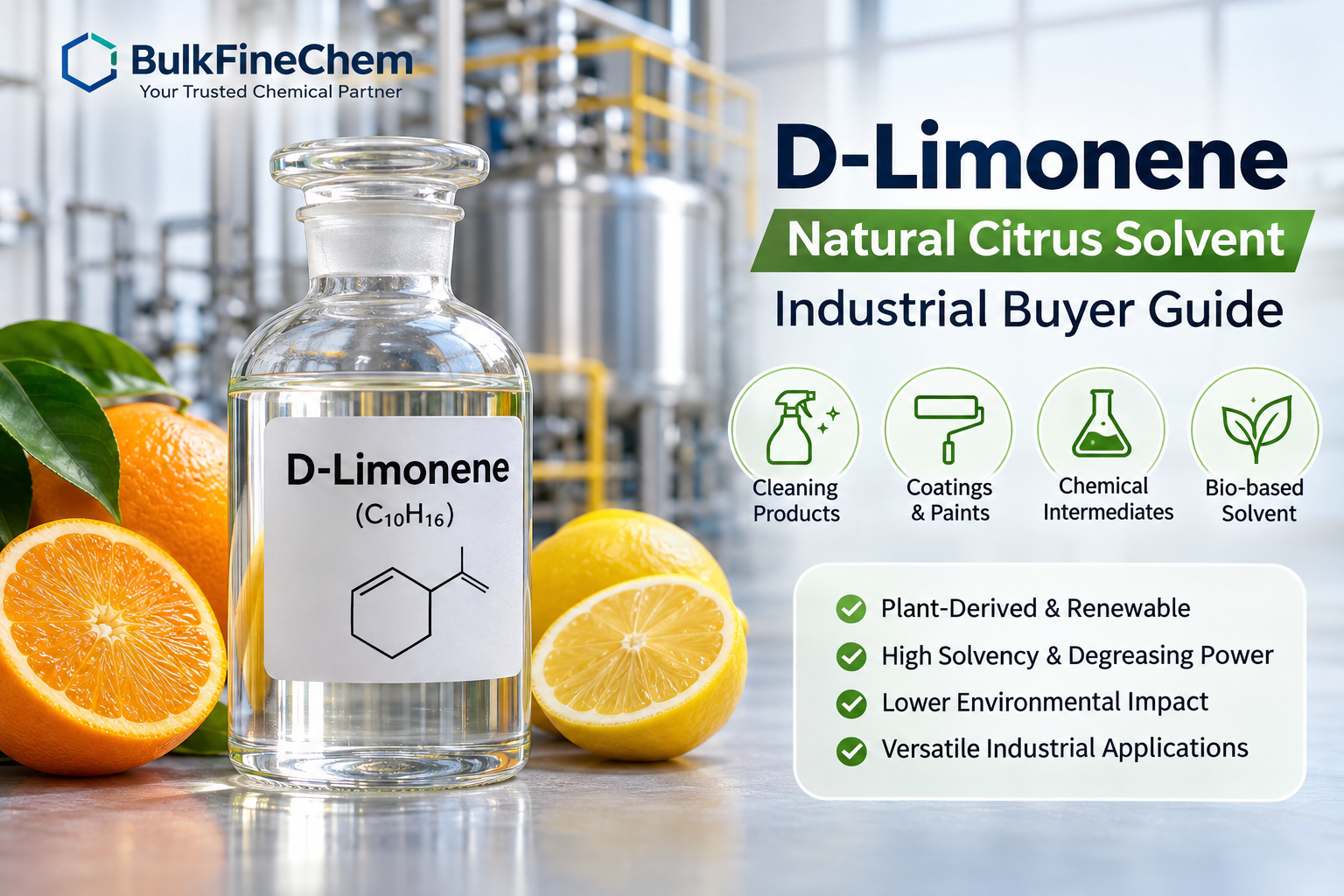
D-Limonene natural citrus solvent is a bio-based solvent used in industrial cleaning, degreasing, adhesive removal, fragrance systems and specialty chemical formulations. For buyers, the main sourcing question is not simply whether the material is “natural,” but whether the supplied grade has the right purity, odour profile, solvency, documentation, storage stability and packaging for the intended process.
This guide explains how industrial buyers can evaluate D-Limonene before purchasing it in bulk and how it differs from conventional solvent choices in real formulation and cleaning applications.
What Is D-Limonene?
D-Limonene is a terpene found naturally in citrus peel oils. Commercial D-Limonene is commonly sourced from citrus-processing streams and is used because it combines strong solvency with a characteristic citrus odour.
BulkFineChem supplies D-Limonene – Natural Citrus Solvent for cleaning products, fragrances, cosmetics, industrial degreasers and specialty formulations.

Where D-Limonene Is Commonly Used
D-Limonene is used across several industrial sectors because it can dissolve or loosen oily residues, adhesive deposits, inks, greases and some resinous soils.
- Industrial degreasers
- Parts and equipment cleaners
- Adhesive and label-removal formulations
- Printing and ink-cleaning products
- Automotive maintenance cleaners
- Fragrance and odour-masking formulations
- Specialty surface cleaners
- Agrochemical and specialty chemical formulations
D-Limonene vs Conventional Solvents
D-Limonene is often considered when formulators want a citrus-derived solvent with strong solvency. However, it should not be treated as a universal direct replacement for every petroleum-derived solvent.
| Factor | D-Limonene | Conventional Fast Solvents |
|---|---|---|
| Source | Citrus-derived terpene | Often petrochemical-derived |
| Odour | Strong citrus character | Varies by solvent |
| Evaporation | Generally slower than very fast ketone solvents | Can be very rapid depending on solvent |
| Solvency | Useful for oils, greases, adhesives and resinous soils | Depends heavily on solvent chemistry |
| Formulation role | Can act as solvent plus fragrance character | Often selected mainly for process solvency |
The best solvent should be selected by testing it against the actual soil, substrate, process temperature and finished formulation.
Key Buyer Factor 1: Purity and Composition
Industrial buyers should specify the required D-Limonene purity or grade rather than purchasing only by product name. Material from different sources can vary in composition, odour intensity and minor components.
Important specification items may include:
- D-Limonene assay or purity
- Appearance
- Colour
- Odour
- Specific gravity
- Refractive index where required
- Moisture or water content where specified
Key Buyer Factor 2: Solvency for the Actual Soil
A solvent that performs well on grease may not be the best choice for ink, adhesive, resin or coating residue. Buyers should test D-Limonene against the specific contaminant and substrate before approving a bulk purchase.
For degreasing
Evaluate removal speed, rinse behaviour, residue, substrate compatibility and drying time.
For adhesive removal
Test whether the solvent softens or lifts the adhesive without damaging plastic, painted or coated surfaces.
For printing and ink cleanup
Check compatibility with rollers, seals, coatings and equipment materials before plant-scale use.
Key Buyer Factor 3: Odour Profile
The strong citrus aroma can be an advantage in some formulated cleaners and a disadvantage in others. In fragrance-sensitive processes, the residual odour should be evaluated after cleaning or evaporation.
Buyers should not assume that a pleasant odour automatically means a safer or lower-risk material. Occupational handling decisions must still follow the SDS and site risk assessment.
Key Buyer Factor 4: Flammability and Handling
D-Limonene is a flammable organic solvent. Storage, transfer and use should follow the supplier SDS, local fire-safety requirements and the facility's solvent-handling procedures.
Important controls can include:
- Proper ventilation
- Ignition-source control
- Bonding and grounding where required
- Compatible pumps, seals and hoses
- Suitable PPE
- Approved storage containers
- Spill-control procedures
Key Buyer Factor 5: Oxidation and Storage
Terpene solvents can change during prolonged exposure to air, heat and light. Buyers should follow the supplier's recommended storage conditions and keep containers tightly closed when not in use.
Receiving checks
- Container and seal integrity
- Batch number
- COA match
- Appearance and odour
- Storage instructions
- Retest or shelf-life information
What to Check on the COA
The Certificate of Analysis should match the delivered batch and the agreed purchase specification.
- Product identity
- Batch or lot number
- Assay or purity
- Appearance
- Colour
- Relative density or specific gravity where specified
- Refractive index where specified
- Test date and release status
If a parameter is important to the manufacturing process, it should appear in the agreed specification rather than being assumed from a generic product description.
D-Limonene in Cleaning Formulations
D-Limonene can be used as a direct solvent or as part of a formulated cleaning system. In water-based cleaners, formulators may combine it with surfactants or emulsifying systems to disperse the oil-soluble solvent phase.
Important formulation considerations include:
- Solvent concentration
- Surfactant system
- Phase stability
- Rinseability
- Foam level
- Material compatibility
- Odour intensity
Material Compatibility Testing
Before using D-Limonene on painted surfaces, elastomers, plastics, seals or coated components, conduct compatibility testing. Strong organic solvents can soften, swell, craze or discolor some materials.
A controlled test should assess:
- Surface appearance
- Swelling or softening
- Gloss changes
- Seal or gasket compatibility
- Residue after drying
Bulk Packaging and Logistics
Packaging should match the buyer's consumption rate and transfer system. Small users may prefer drums, while larger industrial users may require higher-volume packaging subject to supplier capability and transport regulations.
Before placing an order, confirm:
- Required quantity
- Packaging size
- Delivery destination
- Storage capacity
- Transfer equipment
- Required COA, SDS and TDS documents
Frequently Asked Questions
Is D-Limonene a natural solvent?
Yes. Commercial D-Limonene is commonly derived from citrus peel oils and is classified as a terpene solvent.
Can D-Limonene be used as an industrial degreaser?
Yes. It is commonly used in degreasing and cleaning formulations, but performance should be tested against the actual soil and substrate.
Does D-Limonene evaporate quickly?
It generally evaporates more slowly than very fast solvents such as acetone, which can be useful or undesirable depending on the process.
Can D-Limonene damage plastics?
It can affect some plastics, elastomers, paints and coatings. Compatibility testing is recommended before use.
What documents should a bulk buyer request?
Request the batch COA, current SDS and relevant technical specification or TDS.
Is citrus odour proof that the product is safe?
No. Odour does not determine industrial safety. Follow the SDS and workplace risk controls.
What should be specified on a purchase order?
State the required grade, purity or key specifications, quantity, packaging, delivery location and required documentation.
Conclusion
D-Limonene natural citrus solvent can be a useful option for industrial cleaning, degreasing, adhesive removal and specialty formulations, but the buying decision should be based on specification, solvency testing, material compatibility, safety and storage requirements.
Need a bulk quote? Review BulkFineChem's D-Limonene product page and send the required quantity, grade, packaging and industrial application to the BulkFineChem team.