
Introduction
Humic acid is sold in more than one form, and choosing the right one can make a real difference in how well it performs in the field. While every form comes from the same source material, organic matter that has broken down over long periods into humus, the way it is processed changes its solubility, application method, and cost. Here's a practical look at the main forms of humic acid available commercially and how they differ.
Granules
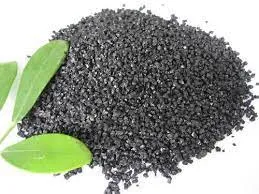
Granular humic acid, like the dark, coarse granules shown above, is one of the most common forms used in direct soil application. Granules are easy to handle, store, and blend with granular fertilizers such as NPK or urea before broadcasting. They break down slowly once in the soil, releasing humic substances gradually as moisture is absorbed. This makes granules a good fit for base dressing before planting or for blending into compound fertilizer formulations.
Powder
Powdered humic acid has a much finer particle size than granules, which gives it a larger surface area and faster solubility. It's typically used when a grower wants to prepare a solution for soil drenching, drip irrigation, or as an ingredient in liquid fertilizer blends. Because it dissolves quickly, powder is well suited to fertigation systems where uniform distribution matters.
Flakes
Flaked humic acid sits between granules and powder in terms of particle size. Flakes dissolve faster than granules but are easier to handle and dose accurately than fine powder, which can be dusty. They are often chosen for liquid formulation manufacturing where controlled dissolution rates are needed.
Potassium Humate
Potassium humate is produced by reacting humic acid with a potassium source, which makes it highly water-soluble. This form is popular for foliar sprays and fertigation because it dissolves almost completely, leaving little residue. It also has the added benefit of supplying potassium, an essential macronutrient, alongside the humic fraction.
Sodium Humate
Sodium humate works similarly to potassium humate in terms of solubility, but uses sodium instead of potassium in the reaction. It's generally more economical and is used in situations where potassium supplementation isn't a priority, such as in certain industrial or non-agricultural applications.
Which Form Should You Choose?
The right form depends on the application method and the outcome you're aiming for:
- Broadcasting or blending into granular fertilizer → granules
- Drip irrigation or fertigation → potassium humate or powder
- Foliar spraying → potassium humate
- Liquid formulation manufacturing → flakes or powder
- Budget-conscious bulk soil treatment → sodium humate or granules
Sourcing the Right Form in Bulk
Whichever form fits your operation, consistency matters. Humic acid content, solubility, moisture level, and particle size can vary significantly between suppliers and even between batches from the same supplier if quality control isn't tight. For fertilizer manufacturers and large-scale distributors, working with a bulk supplier that tests and documents each batch helps avoid inconsistent field performance.
BulkFineChem supplies humic acid in granule, powder, flake, and humate forms at bulk volumes, with quality documentation for every batch.
Conclusion
Not all humic acid products are interchangeable. Matching the form to your application method, whether that's broadcasting granules before planting or dosing potassium humate through a drip system, ensures you get the full benefit of this natural soil enhancer without wasting product or time.