
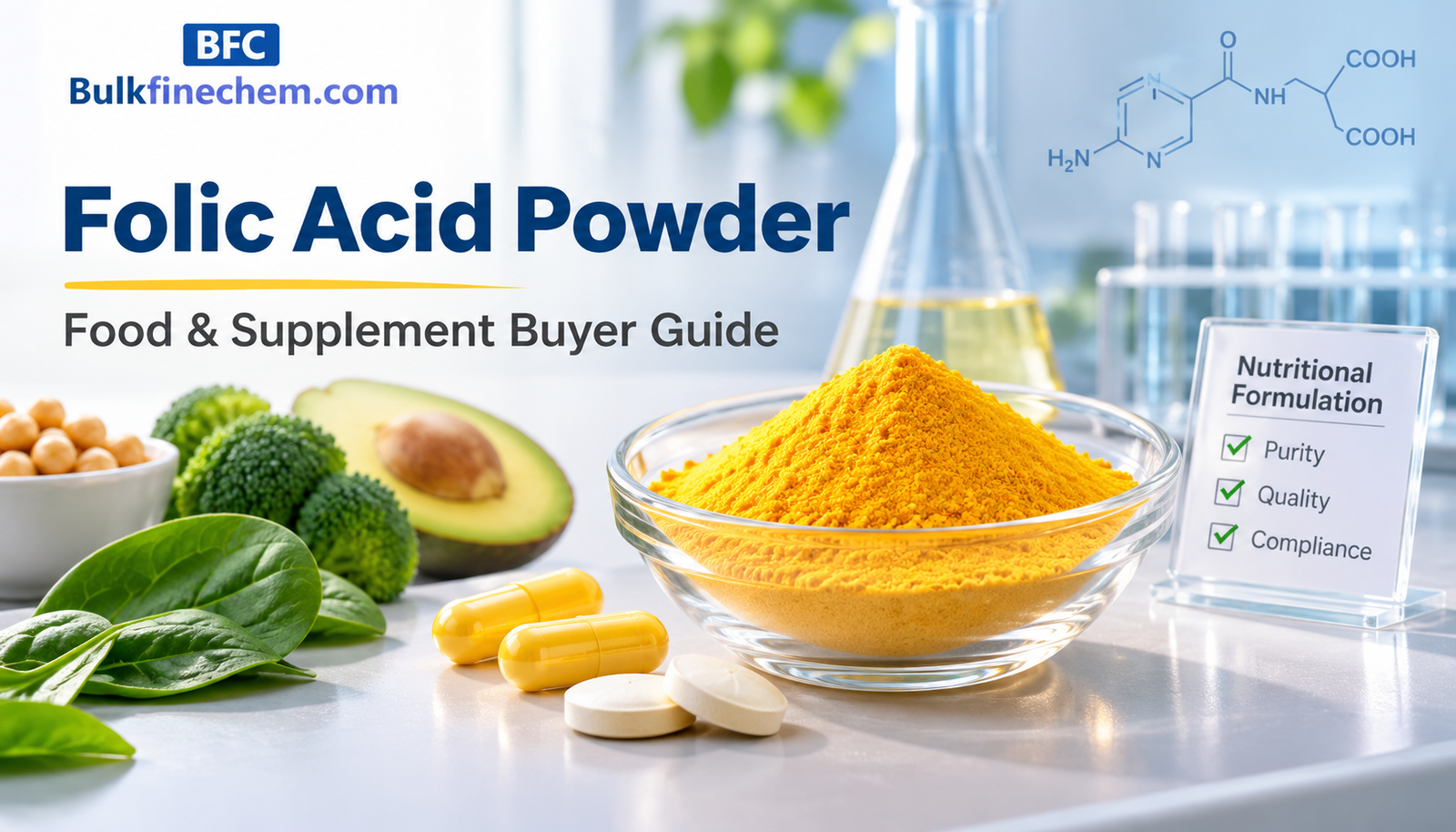
Folic acid powder bulk sourcing requires more control than simply comparing price per kilogram. Folic acid is typically used at very low inclusion levels in supplements, premixes and fortified foods, so assay, particle distribution, content uniformity, solubility, stability and batch documentation can have a major impact on manufacturing consistency.
BulkFineChem supplies Folic Acid Powder for food, nutraceutical, pharmaceutical and formulation applications.
What Is Folic Acid Powder?
Folic acid is the synthetic, fully oxidized form of folate commonly used in dietary supplements and fortified foods. Commercial material is generally supplied as a yellow to yellow-orange crystalline powder and is purchased against an agreed assay and quality specification.
For buyers, the critical issue is not only identity. The material must also fit the manufacturer’s process, dosage form, premix strategy and regulatory requirements.
Why Folic Acid Is Different From Many Bulk Ingredients
Unlike ingredients added at percentage-level doses, folic acid is often used at very small quantities. This means that a small weighing or blending error can create a large percentage error in the finished product.
Three practical risks
- Poor content uniformity
- Losses during handling or transfer
- Degradation during storage or processing
Because of these risks, many manufacturers do not add neat folic acid directly into a large batch. Instead, they may first prepare or purchase a diluted premix so the active is distributed more evenly.
Key Buyer Factor 1: Assay and Potency
The assay determines how much actual folic acid is present in the supplied raw material. Buyers should confirm whether the stated value is a minimum specification, an acceptable range or the actual batch result.
If the formulation is calculated using an assumed potency that does not match the delivered batch, the finished product can miss its target.
What to verify
- Declared assay
- Analytical method
- Batch result
- Correction factor used in formulation calculations
Key Buyer Factor 2: Particle Size and Content Uniformity
Particle size matters because folic acid is usually blended at a low use level. If the active particles are much finer or coarser than the surrounding premix ingredients, segregation can occur during transport, blending or filling.
Why premixing can help
A properly designed premix increases the amount of material being handled and can make even distribution easier. The carrier, dilution ratio and mixing sequence should be validated for the actual manufacturing system.
Key Buyer Factor 3: Solubility and Dispersion
Folic acid has limited solubility in many neutral or acidic aqueous systems and becomes more soluble under alkaline conditions. This matters for liquid products, beverages and processes where the vitamin must be dissolved rather than simply dispersed.
What formulators should test
- Final product pH
- Mixing temperature
- Order of addition
- Time required for dissolution or dispersion
- Risk of precipitation during storage
A clear solution during initial mixing does not guarantee that the ingredient will remain dissolved after pH adjustment or prolonged storage.
Key Buyer Factor 4: Light and Processing Stability
Folic acid can lose potency when exposed to unsuitable light, heat or strongly acidic conditions, especially in solution. Stability should therefore be considered from raw-material storage through final-product shelf life.
Storage controls
- Protect the powder from excessive light
- Keep containers tightly closed
- Avoid unnecessary heat exposure
- Control moisture and contamination
- Follow the supplier’s recommended storage conditions
Folic Acid for Food Fortification
Food manufacturers may use folic acid in flour, premixes, cereals, nutrition products and other fortified foods where permitted by the relevant market requirements.
The formulation team should account for:
- Target fortification level
- Processing losses
- Overage strategy where justified
- Uniformity across the batch
- Finished-product testing
Any fortification level and labeling claim should follow the applicable regulations for the destination market.
Folic Acid for Supplements
Supplement manufacturers may use folic acid in tablets, capsules, gummies, powders and multivitamin premixes. Because the dose is small, weighing accuracy and blend uniformity can become more important than the total raw-material quantity purchased.
Tablets and capsules
Evaluate premix homogeneity, powder flow and segregation risk before compression or filling.
Powders and sachets
Confirm that the active remains evenly distributed during transport, hopper feeding and packaging.
Gummies and liquids
Solubility, pH, temperature exposure and light stability become especially important.
What to Check on the COA
A batch-specific Certificate of Analysis should match the material received. Depending on the approved specification, buyers may review:
- Product identity
- Assay or potency
- Appearance
- Moisture or loss on drying
- Related impurities where specified
- Heavy metals where required
- Microbiological limits for food or supplement use
- Batch number
- Test date and release status
COA vs Specification
The product specification defines what the material must meet. The COA shows how the actual batch performed against those requirements. Buyers should review both rather than relying on a generic product description.
Food Grade, Nutraceutical Grade and Pharma Grade
Grade terms should be tied to measurable specifications and documentation. A buyer should state the intended use and required quality standard on the purchase order rather than assuming one supplier’s “premium grade” matches another supplier’s regulated grade.
Important questions include:
- What standard does the material comply with?
- Which test methods are used?
- What contaminant limits apply?
- What documentation is supplied with each batch?
Packaging and Handling
Folic acid is a high-value ingredient used at low dosage, so packaging should protect it while allowing accurate dispensing.
Receiving checklist
- Check container and seal integrity
- Confirm product and batch number
- Match the COA to the shipment
- Inspect the powder appearance
- Review storage instructions
- Record expiry or retest information
How to Compare Two Folic Acid Suppliers
| Factor | Why It Matters |
|---|---|
| Assay | Determines formulation potency calculation |
| Impurity limits | Supports quality and regulatory control |
| Particle behavior | Affects blending and content uniformity |
| COA consistency | Shows batch-to-batch quality control |
| Packaging | Protects material from light, moisture and contamination |
| Documentation | Supports QA and regulatory review |
| Lead time | Affects premix and production planning |
Common Procurement Mistakes
- Comparing only price per kilogram
- Ignoring assay differences between suppliers
- Adding neat folic acid without validating blend uniformity
- Using an old sample COA instead of the actual batch COA
- Ignoring light and storage conditions
- Assuming all “food grade” materials use the same specification
- Changing supplier without formulation or QA review
Frequently Asked Questions
Is folic acid the same as folate?
Folic acid is a synthetic form of folate commonly used in supplements and fortified foods. Other folate forms also exist.
Why is folic acid difficult to blend?
It is often used at very low quantities, so uneven distribution can create large potency differences within the finished batch.
Is folic acid highly soluble in water?
No. It has limited solubility in many neutral and acidic aqueous systems, so formulation pH and processing conditions matter.
Why should folic acid be protected from light?
Light exposure can contribute to degradation, particularly in solution, so suitable packaging and storage are important.
What should buyers check on the COA?
Review identity, assay, moisture, impurities, relevant contaminants and the actual batch information required by the approved specification.
Should folic acid be added directly to a large batch?
Not automatically. A validated premix or dilution step may improve content uniformity when the required dose is very small.
Does BulkFineChem supply folic acid powder?
Yes. BulkFineChem lists Folic Acid Powder for food, nutraceutical, pharmaceutical and formulation applications.
Conclusion
Reliable folic acid powder bulk sourcing requires tight control of assay, content uniformity, solubility, stability, packaging and batch documentation. Because folic acid is often used at low inclusion levels, formulation and blending controls can be just as important as the raw-material specification.
Need a bulk quote? Review BulkFineChem’s Folic Acid Powder product page and share your required grade, assay, quantity, packaging and application with the BulkFineChem team.