
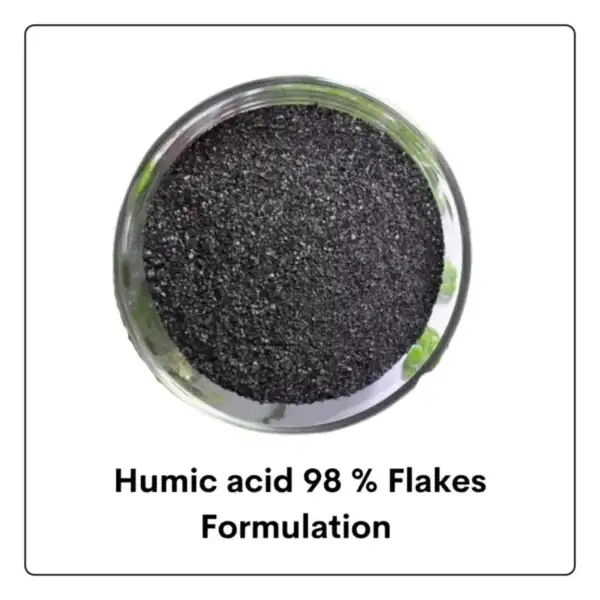
Humic Acid 98% Flakes: Formulation, Uses and Bulk Buying Guide
Humic acid flakes are widely used by agricultural input manufacturers, fertilizer formulators, distributors, and bulk buyers who need a concentrated humic raw material for soil-conditioning and nutrient-management products. Products marketed as Humic Acid 98% Flakes are typically selected for formulation work where concentration, handling, solubility, and batch consistency are important.
The “98%” figure should always be checked against the supplier’s Certificate of Analysis (COA) and the test method used. Different suppliers may describe humic content, humate content, dry matter, or related parameters differently, so technical verification is essential before commercial formulation.
What Are Humic Acid 98% Flakes?
Humic acid flakes are a concentrated solid form of humic substances, generally produced from humic-rich natural sources such as leonardite. Compared with ready-to-use liquid products, flakes are compact, easier to store in bulk, and useful as a raw material for producing liquid humic formulations, soluble blends, soil conditioners, and fertilizer products.
The physical flake form makes the material convenient for industrial handling, but its performance in a formulation depends heavily on solubility, particle characteristics, pH, ash level, moisture, and the actual humic-content specification.
Why Formulators Use High-Concentration Humic Flakes
1. High Active-Material Loading
A concentrated flake grade allows formulators to transport and store more active raw material per unit weight than many diluted liquid products. This can simplify bulk storage and reduce unnecessary water freight.
2. Flexible Formulation Options
Humic acid flakes can be used as a starting raw material for several agricultural products. Depending on grade and chemistry, they may be incorporated into soluble humic products, fertilizer blends, soil conditioners, or liquid concentrates after suitable processing.
3. Easier Bulk Handling
Dry flakes are generally easier to package, stack, transport, and inventory than large volumes of liquid material. They can therefore be practical for distributors, private-label manufacturers, and fertilizer-production facilities.
4. Useful for Custom Concentrations
Manufacturers can formulate different end-product strengths from a concentrated raw material instead of purchasing multiple finished liquid strengths. This provides more flexibility for product-development and contract-manufacturing operations.
Common Applications of Humic Acid Flakes
- Humic acid liquid formulation
- Soil-conditioner manufacturing
- Granular and powder fertilizer blends
- Water-soluble agricultural formulations
- Organic-input and soil-health products
- Private-label fertilizer products
- Commercial fertigation formulations, when the selected grade is suitable
Humic Acid Flakes vs Powder vs Liquid
| Factor | Flakes | Powder | Liquid |
|---|---|---|---|
| Concentration | Often sold as a concentrated raw material | Can also be highly concentrated | Usually diluted with water |
| Handling | Good for bulk storage and formulation | Easy to blend but may create dust | Ready for pumping and dosing |
| Freight | Efficient because little water is shipped | Efficient | Higher water weight |
| Formulation flexibility | High | High | Lower if purchased as finished concentration |
| Key quality check | Solubility and humic-content specification | Particle size and solubility | Stability, pH and active content |
How Humic Acid Flakes Are Used in Formulation
The exact formulation process depends on the chemical form of the material, intended end product, water quality, and desired concentration. In commercial manufacturing, processors generally evaluate dissolution behavior, pH adjustment requirements, filtration needs, compatibility, and final-product stability before scaling up.
For liquid formulation work, do not assume that every product labeled “humic acid flakes” will dissolve equally. Some materials are significantly more soluble than others. A pilot test is recommended before commercial production.
Important Specifications to Check Before Buying
Humic Content
Ask the supplier how the stated percentage was measured. A headline value such as 98% should be supported by a COA and a defined test method.
Water Solubility
This is one of the most important parameters for liquid and fertigation formulations. Poorly soluble material can cause sediment, filter blockage, and inconsistent finished-product concentration.
Moisture
Moisture affects storage stability, actual dry-matter content, and handling characteristics.
Ash Content
High mineral or ash levels can affect product purity and formulation behavior. This value should be considered together with the supplier’s reported humic specification.
pH
pH can influence compatibility with other fertilizer ingredients and may affect the steps required during liquid formulation.
Physical Appearance
Color, flake size, uniformity, and freedom from foreign matter provide useful visual indicators, although appearance alone cannot confirm chemical quality.
Documents Bulk Buyers Should Request
- Certificate of Analysis (COA)
- Technical Data Sheet (TDS)
- Safety Data Sheet (SDS)
- Batch number and manufacturing information
- Humic-content test method
- Solubility specification
- Moisture and ash specification
- Packaging details
- Country-of-origin information where required
Packaging and Storage
Humic acid flakes are generally packed in moisture-resistant industrial bags, often with an inner liner. Packaging size varies by supplier and buyer requirement.
Store the material in a cool, dry place with the packaging sealed. Avoid unnecessary exposure to moisture because absorbed water can affect flow, weight, and product consistency.
What to Check Before a Bulk Order
Before placing a large order, request a representative sample and test it in your intended formulation. Review the COA, compare multiple batches if possible, and confirm that the supplier can maintain the same specification for repeat shipments.
Commercial buyers should also confirm minimum order quantity, packaging, lead time, freight terms, documentation, and whether the material is intended for the buyer’s target agricultural application and market.
Frequently Asked Questions
What does Humic Acid 98% Flakes mean?
It generally refers to a supplier-declared high-concentration humic flake product. The exact meaning of “98%” can vary, so buyers should verify the COA and analytical method rather than relying on the product name alone.
Can humic acid flakes be used to make liquid humic acid?
Suitable grades can be used as raw material for liquid formulations, but solubility and processing requirements must be tested before scale-up.
Are humic acid flakes water soluble?
Solubility varies significantly by grade and chemical form. Always request a water-solubility specification if the material will be used in liquid products or irrigation systems.
What is the difference between humic acid flakes and potassium humate flakes?
Potassium humate is a potassium salt of humic substances and is often selected when improved water solubility is required. Buyers should check the actual composition because commercial naming practices differ.
Is 98% humic acid automatically better than a lower-percentage product?
No. The stated percentage is only one parameter. Solubility, ash, moisture, test method, raw-material source, consistency, and suitability for the intended formulation are also important.
Should I test a sample before buying in bulk?
Yes. A sample or pilot batch can help confirm dissolution, compatibility, appearance, and finished-product performance before a larger commercial commitment.
Conclusion
Humic Acid 98% Flakes can be a useful concentrated raw material for fertilizer and soil-conditioning formulations, especially for manufacturers and distributors that need flexibility in product development. The most important step is to verify the technical specification rather than purchasing only on the basis of a headline percentage.
Need bulk agricultural formulation inputs? Contact BulkFineChem to discuss product specifications, commercial quantities, packaging, documentation, and sourcing requirements for your application.