
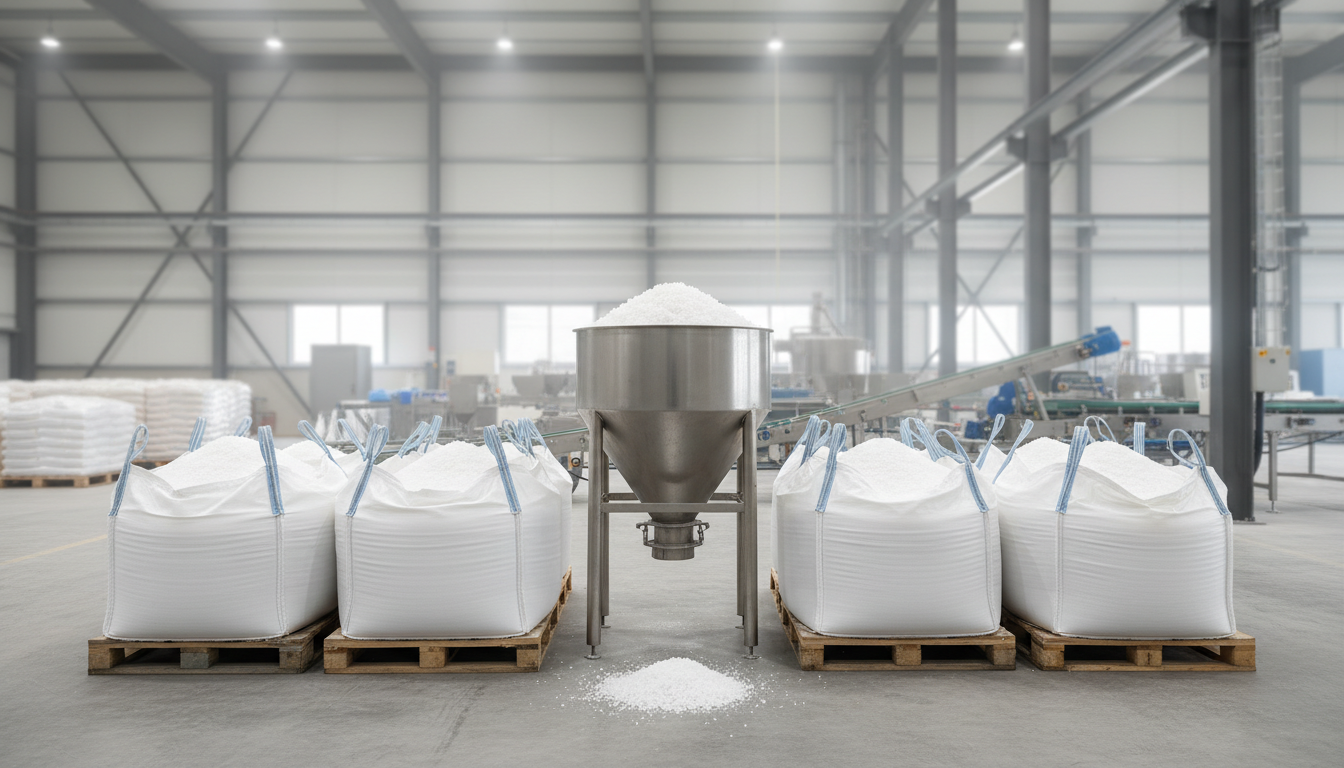
Walk into almost any chemical plant, textile dyeing unit, or water treatment facility in India and you'll find drums or bags of one deceptively simple compound sitting in the raw material store: sodium chloride. Most people know it as table salt. In bulk industrial form, though, it's doing jobs that have nothing to do with seasoning food — softening water, making chlorine and caustic soda, fixing dye onto fabric, and keeping oil rigs running smoothly.
If you're sourcing industrial sodium chloride for your production line, the grade you pick matters more than the price per kg. Get it wrong and you could be feeding contaminants into a reactor that a cheaper, purer grade would have kept out. This guide walks through what industrial and refined sodium chloride actually is, how it's graded, and where each grade fits.
What Is Industrial Sodium Chloride?
Chemically, industrial sodium chloride is the same molecule as table salt — NaCl, one sodium ion bonded to one chloride ion. What separates an industrial drum from a kitchen shaker isn't the chemistry, it's the purity, the crystal size, and what's been left in or taken out during processing. Industrial grades typically run upward of 97% NaCl, with the rest made up of moisture and trace minerals like calcium and magnesium sulfate that a food-grade wash would strip out.
It's produced three ways: solar evaporation of seawater or brine in large pans, mining from rock salt deposits, or vacuum evaporation of purified brine. Each method gives a different crystal structure and impurity profile, which is exactly why a chlor-alkali plant and a leather tannery don't always reach for the same bag.
How Refined and Industrial Grades Differ
"Refined" and "industrial" aren't strict legal categories the way food-grade and pharma-grade are — they're more like a purity spectrum. Refined salt has gone through extra washing and recrystallization to push NaCl content higher and strip out insoluble matter. Industrial grade, used where absolute purity isn't critical, skips some of those steps and costs less as a result.
Typical Grade Comparison
Here's roughly how the grades stack up on the numbers buyers actually ask about:
| Grade | NaCl Purity | Typical Use | Moisture |
|---|---|---|---|
| Crude/Rock Industrial | ~95–97% | De-icing, non-critical process salt | Higher, variable |
| Industrial Refined | 97–99% | Chlor-alkali, textile, leather, water treatment | Low, controlled |
| Vacuum/Refined | 99%+ | High-purity chemical synthesis, pharma intermediates | Very low |
Ask your supplier for the batch-specific Certificate of Analysis rather than relying on the grade name alone — "industrial grade" isn't standardized across sellers, and a CoA is the only way to know exactly what purity you're getting for that lot.
Where Bulk Sodium Chloride Actually Gets Used
Once you look past the kitchen, demand for bulk salt spreads across a surprisingly wide set of industries. Each one cares about a slightly different property — purity for chemical synthesis, particle size for de-icing, low insolubles for brine electrolysis.
Chlor-Alkali and Chemical Manufacturing
This is the single largest industrial consumer of salt worldwide. Electrolysis of brine made from sodium chloride produces chlorine gas, caustic soda, and hydrogen — three building blocks behind everything from PVC to soap to water disinfectants.
- Feedstock for chlorine and caustic soda production
- Raw material for sodium-based chemical synthesis
- Precursor for hydrochloric acid manufacture
- Brine preparation for downstream electrolysis plants
Textile, Leather and Dyeing
Dye houses use salt to help fix dye molecules onto fabric fibers — it's a cheap, effective way to push more color onto the cloth instead of down the drain. Tanneries use it too, in the curing stage, to draw moisture out of raw hides before they spoil.
- Dye-fixing agent in reactive dyeing processes
- Hide curing and preservation in leather tanning
- Bath salt concentration control in wet processing units
- Finishing treatments for certain fabric types
Water Treatment and Softening
If your plant runs ion-exchange softeners, you already know they need regular regeneration with a strong brine solution — that's bulk salt doing quiet, unglamorous work behind the scenes of clean process water.
- Regenerating ion-exchange resin beds
- Brine preparation for softening systems
- pH and mineral balance adjustments in effluent treatment
- Boiler feedwater pre-treatment
Oil, Gas and De-Icing
Drilling fluids use salt to control density and viscosity downhole, and municipal contractors buy it by the truckload every winter for a much simpler reason — melting ice on roads before it turns into a hazard.
- Drilling mud density and viscosity control
- Well completion fluid formulation
- Road and pavement de-icing
- Cold-weather infrastructure maintenance
What to Check Before You Place a Bulk Order
Specification sheets can look reassuring and still hide the wrong details. Before signing off on a purchase order, it's worth confirming a handful of things directly with the supplier rather than assuming the product listing covers it all.
- NaCl purity percentage backed by a batch CoA, not just a spec sheet claim
- Moisture content, especially if you're storing in bulk for long periods
- Insoluble matter and heavy metal limits for chemical or pharma-adjacent use
- Crystal size and form — fine powder, granular, or coarse crystal — matched to your process equipment
- Whether TDS/SDS documentation is available for regulatory or safety filing
This is where sourcing through a documented B2B supplier pays off. BulkFineChem's industrial sodium chloride listing is sold against MOQ by kg, MT or L depending on grade and packaging, with a GST tax invoice and batch-wise Certificate of Analysis on every order, and TDS/SDS available on request — the same documentation discipline manufacturers expect before a raw material clears their QC gate.
Storage and Handling for Bulk Salt
Salt is stable and doesn't degrade with age, but it does have one long-standing enemy: moisture. Bulk quantities stored in a damp warehouse will cake, clump, and eventually pick up contamination from wet packaging — none of which helps your process line.
Practical Storage Tips
None of this is complicated, but skipping it is exactly how a good batch turns into a caked, unusable block six months into storage.
- Store in a dry, covered area away from direct rain or condensation
- Keep bags off the floor on pallets to avoid moisture wicking upward
- Rotate stock on a first-in, first-out basis for high-turnover operations
- Reseal opened bags tightly between uses to limit humidity exposure
- Avoid stacking heights that risk bag rupture under bulk storage weight
FAQs About Industrial Sodium Chloride
Is industrial sodium chloride the same as table salt?
Chemically, yes — both are NaCl. The difference is purity and processing. Industrial grade allows more residual minerals and moisture than the tightly controlled food-grade salt sold for consumption.
What purity level do I need for chlor-alkali production?
Most chlor-alkali plants specify refined industrial grade at 97–99% NaCl with low insoluble matter, since impurities can foul membrane cells. Always confirm against your plant's specific process requirements.
Can industrial grade salt be used in food processing?
No. Food applications require dedicated food-grade salt manufactured and tested to food-safety standards. Industrial grade is not intended for consumption.
How is bulk salt packaged for industrial buyers?
It typically ships in HDPE bags, jumbo bags, or bulk tankers depending on order size and grade. Confirm packaging options and MOQ directly when requesting a quote.
What documents should come with a bulk salt order?
A GST tax invoice and a batch-wise Certificate of Analysis, at minimum. Ask for a Technical or Safety Data Sheet as well if your internal QC or compliance process requires one.
Does BulkFineChem supply both industrial and refined grades?
Check the current specification and available grade on the product page, or request a quote for your specific purity and packaging needs.
The Bottom Line
Sodium chloride might be the plainest-looking chemical in this entire catalogue, but the grade you choose has real downstream consequences — for your equipment, your product quality, and your compliance paperwork. Match the grade to the job, ask for a CoA on every batch, and you'll avoid the kind of quiet, expensive problems that show up months after a "cheap salt" purchase.
Related Products:
- Sodium Chloride – Industrial and Refined Salt
- Sodium Bicarbonate Food Grade Powder
- Guar Gum Powder – Food and Industrial Grade
Ready to source industrial sodium chloride in bulk? View the product listing for current specs, or head straight to Quick Order to request a quotation with your required grade, quantity and delivery location.