
A container of menthol crystals bulk can look identical on the loading dock and behave completely differently in your kettle. One lot congeals cleanly at the expected temperature, the next stays soft, clumps together or leaves a waxy residue in the transfer lines. For a balm maker in Baddi, a confectioner in Ahmedabad or a solvent blender in Ankleshwar, that difference shows up as failed batch records, not as a saved rupee per kilogram.
BulkFineChem supplies Peppermint Oil IP/BP/USP and menthol-bearing mint materials for pharma, cosmetic, food, oral care and industrial formulation use, with grade and specification confirmed before dispatch. This guide walks through the specification questions that actually decide whether a lot works in your process: source, assay, melting behaviour, packing and what to look for on the COA.
What Menthol Crystals Actually Are
Menthol is the main aroma compound of mint oil, a cyclic monoterpene alcohol (C10H20O) that is solid at room temperature. When peppermint oil is chilled, the menthol separates out as crystals; those crystals are then separated from the remaining dementholised oil by centrifuging or filtering. Refined, recrystallised material gives the familiar white, translucent needles or flakes with a sharp cool odour.
Two things matter more than the word "menthol" on the label. The first is the isomer: natural menthol from peppermint is largely the l-menthol form, while synthetic menthol is produced in several stereoisomer mixes. The second is purity, usually read as the menthol content by gas chromatography. A lot at 99% plus behaves very differently in a formula from a 90% material that still carries mint esters and other terpenes.
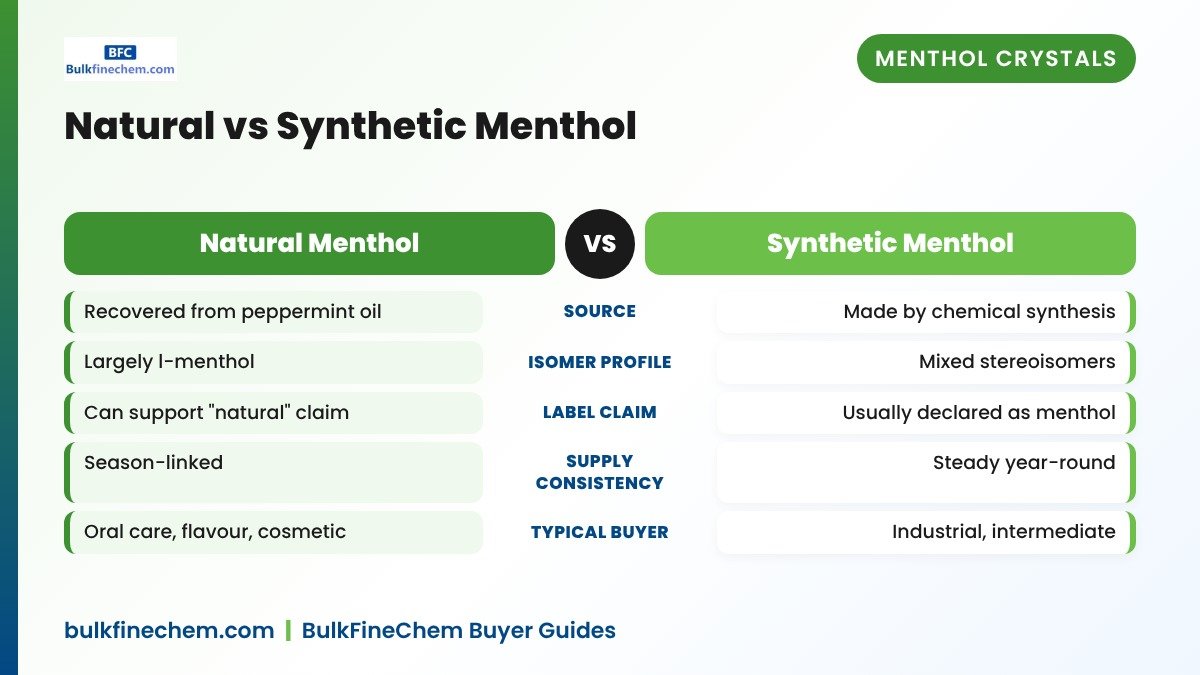
Natural Peppermint Menthol vs Synthetic Menthol
Both routes supply material that can meet a tight assay, so the choice is rarely about purity alone. It is about the odour profile your panel accepts, the documentation your regulatory file needs, and how the crystal melts and re-crystallises in your equipment.
Buyers who list the material as "natural peppermint oil derived" on a label usually need the natural route with a supporting traceable document trail. Industrial users who only need a cooling agent or a menthol feedstock often take synthetic material because supply volumes are steadier across the year.
Grades and Where Each One Is Used
Menthol crystals move into four broad application bands. Which band you buy for decides the specification you should insist on.
| Application band | Typical grade expectation | What to confirm before ordering |
|---|---|---|
| Oral care and pharma formulations | Pharmacopoeial grade (USP/IP/BP monograph material) | Monograph reference on the COA, batch traceability, heavy metals and residue limits |
| Food and flavour use | Food grade with FCC-type specification | Assay by GC, identity tests, food-grade packing and lot coding |
| Cosmetics and topicals | Cosmetic grade, high menthol assay | Odour and appearance profile, melting range, allergen declaration |
| Industrial and intermediate use | Technical grade, high purity | Assay, moisture, residue on ignition, ester content |
An oral care manufacturer in Maharashtra that switched from a technical lot to a pharmacopoeial lot did not change the cooling effect. What changed was the number of out-of-specification reviews, because the identity and impurity data now matched what the regulatory file already claimed.
Specification Parameters That Decide Performance
Most disputes come from three numbers: assay, melting range and clarity of the melt. Read them together, not one at a time.
- Assay by GC. The menthol content, usually expressed as a percentage. High-purity crystalline material sits well above 90%, and pharmacopoeial grades are specified at a still tighter level.
- Melting range. Menthol melts at a low temperature, so a narrow, expected range is the fastest check that a lot is what the COA says. A depressed or wide range points to residual oil or solvent.
- Appearance and clarity of solution. White crystals that dissolve to a clear solution in the stated solvent. Cloudiness suggests moisture, wax or higher-boiling residue.
- Specific rotation and refraction. These separate the isomer profile of natural l-menthol from synthetic mixes, which is why they appear on genuine pharmacopoeial COAs.
- Ester content, moisture and residue on ignition. Small numbers that govern odour stability and whether the crystals stay free-flowing in storage.
How to Read the Menthol COA
A COA is only useful when the parameters match the questions above. Our broader walkthrough, how to read a certificate of analysis, covers the general structure; for menthol, check these points on every lot.
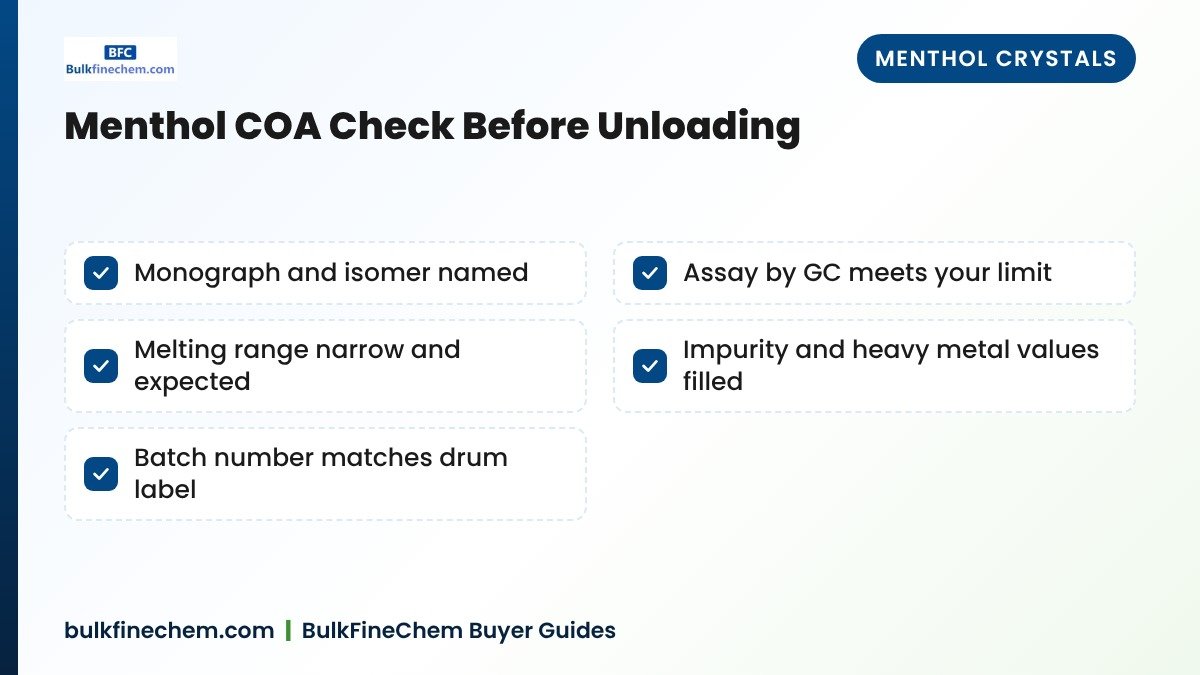
- Match the monograph. Confirm the COA names the standard the material is sold against (USP, IP, BP or FCC) and that the product name and isomer are stated, not just "menthol".
- Check assay and melting range against your own specification. Compare the reported values with your internal limit, not with the supplier's default range.
- Look for the impurity side. Heavy metals, residue on ignition, water content and non-volatile residue should each have a number, not a blank cell.
- Verify the batch and date. Batch number on the COA must match the drum or carton label, with a manufacturing or retest date.
- Run your own confirmatory check. A melting point tube and a simple organoleptic comparison against your retained standard catch most problems before the material enters the weigh room.
If a supplier cannot provide the impurity data, the COA vs SDS vs TDS breakdown explains which document should carry what.
Safety, Handling and Storage
Menthol crystals look harmless and are handled carelessly, which is the main problem with them. They are flammable solid, volatile at modest temperatures and a strong irritant to eyes and respiratory tract in dust or vapour form.
- Wear safety glasses, gloves and, where dust or vapour builds up during charging, respiratory protection suited to organic vapours. Follow the SDS and local regulations.
- Keep containers closed in a cool, dry, well-ventilated store away from heat, sparks and oxidising agents. Menthol is incompatible with strong oxidisers and many strong acids.
- Avoid heating crystals directly on a hot plate. Melt in a jacketed vessel at the lowest practical temperature, and remember that molten menthol attacks some gaskets and plastics.
- Spills: sweep up dry crystals rather than hosing them down; the vapour in an unventilated spill area is what causes complaints.
- Store drums off the floor and out of direct sunlight. In a Gujarat summer, a drum sitting in a loading yard can reach its melting point, then re-crystallise into a solid cake.
Melt menthol slowly in a jacketed vessel; a hot plate gives you a cake, a burnt odour and a blocked transfer line.
Monsoon and Summer Storage in Indian Plants
Menthol is not hygroscopic in the way a salt is, but humidity and heat still damage it. Between June and September, damp warehouse air condenses on cool crystal surfaces and leaves a frosted, sticky layer that weighs incorrectly on the scale. From March to June, the risk is the opposite: partial melting in transit or in a hot store.

Practical points that hold up in most plants: keep the store below roughly 25 degrees where possible, do not open drums in humid conditions unless you will use the whole pack, and let a cold drum come to room temperature before opening so condensation does not form inside. For export consignments, confirm the packing is sealed against leakage of vapour, since a container that has "breathed" menthol on arrival has lost assay.
Qualifying a Menthol Supplier in Five Steps
- Fix your specification in writing. State assay, melting range, grade reference, packing and the documents you need, before you request a quote.
- Ask for a pre-shipment COA and a sample. Run your melting point and GC check against your retained standard.
- Confirm packing and batch coding. Drums or cartons with liner, batch number, net weight and manufacturing date on every unit.
- Order a trial lot. Process it on your own equipment through a full cycle, including storage of the finished product.
- Agree the retention and retest policy. Retained samples from each lot and a defined retest period protect both sides when a batch is questioned months later.
Frequently Asked Questions
What is menthol made from?
Commercial menthol is mainly recovered by chilling peppermint oil so the menthol crystallises, then separating the crystals from the remaining dementholised oil. A large share of world supply is also produced synthetically from petrochemical feedstocks in several isomer forms.
What is the difference between l-menthol and synthetic menthol?
l-Menthol is the single isomer obtained from natural peppermint oil, while synthetic menthol may contain a mix of stereoisomers. The isomer profile affects odour character, specific rotation and how the material is declared on a label.
What purity should I buy for oral care products?
Oral care and pharmaceutical formulations normally call for pharmacopoeial grade material, with the monograph reference stated on the COA. Confirm the assay, impurity limits and heavy metal data against your own specification and regulatory file.
How do I check menthol crystals on receipt?
A melting range determination and an organoleptic comparison against a retained standard catch most problems quickly. A clear solution in the stated solvent and a white, dry crystal appearance are simple supporting checks before the lot goes to the weigh room.
How should menthol crystals be stored in Indian weather?
Store sealed drums or cartons in a cool, dry, ventilated store away from heat and oxidisers, ideally below about 25 degrees. In monsoon, avoid opening packs in humid air; in summer, keep packs out of direct sun and off hot floors to prevent melting and caking.
Does menthol have a shelf life?
Packaged material carries a manufacturer's retest or expiry period, typically supported by retained sample testing. In practice, sealed packing kept cool retains assay far better than an opened drum, so issue stock in full-pack quantities where you can.
Sourcing Menthol Crystals From BulkFineChem
If you are comparing menthol crystals bulk lots, the fastest way to shorten the evaluation is to send the specification you actually work to. BulkFineChem supplies menthol-bearing mint materials and Peppermint Oil IP/BP/USP in bulk packing, with COA and SDS available with orders and grade confirmed before dispatch. Share your grade, quantity, packing and destination with the BulkFineChem enquiry team, or browse the full product range.
Disclaimer: This article is general technical and procurement information. Always follow the product's Safety Data Sheet, Technical Data Sheet and the regulations that apply to your industry, and confirm suitability with trials before full-scale use.