
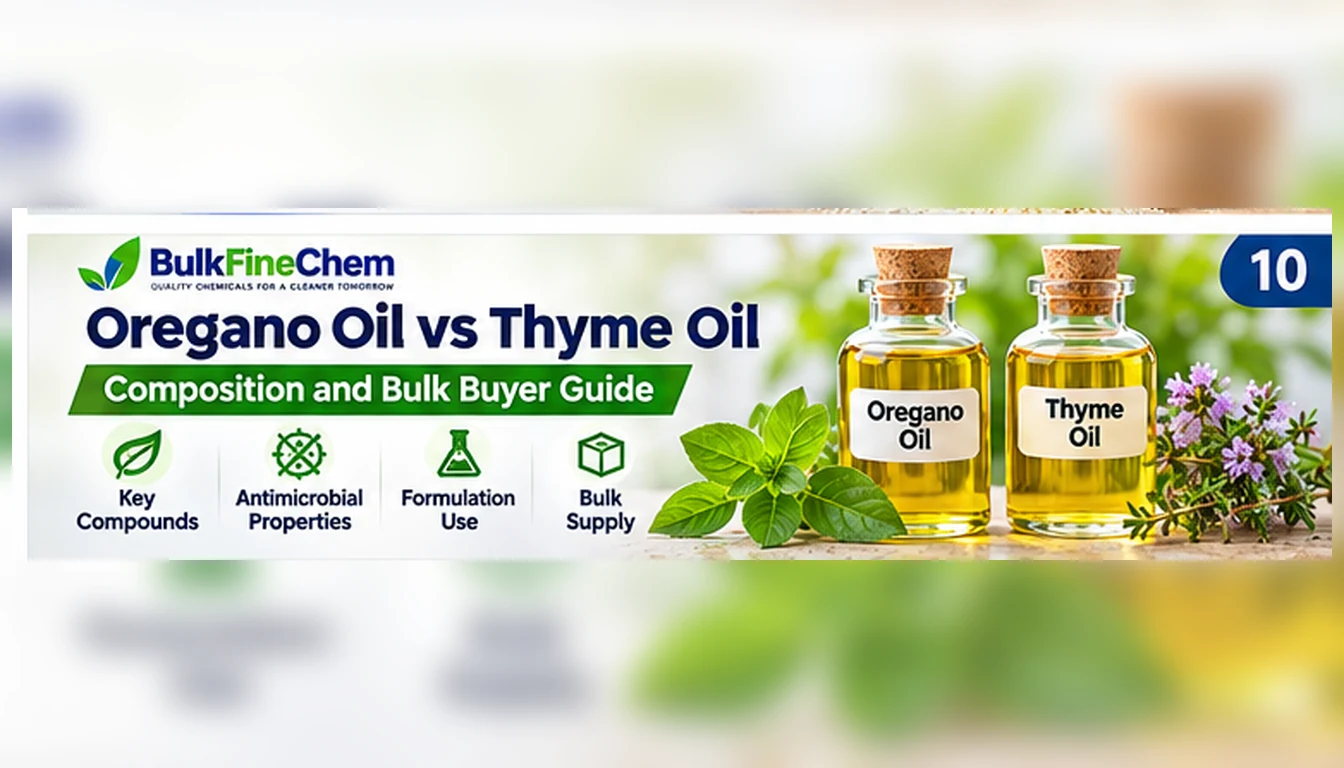
Oregano oil vs thyme oil is a useful comparison for flavor, fragrance and specialty-formulation buyers because both oils can contain strongly aromatic phenolic compounds, yet their dominant constituents and sensory profiles can vary significantly by botanical source and chemotype.
BulkFineChem supplies Oregano Oil and Thyme Oil for spice-oil and formulation buyers.
Oregano Oil vs Thyme Oil: Quick Comparison
| Factor | Oregano Oil | Thyme Oil |
|---|---|---|
| Aroma | Strong, warm, herbaceous and spicy | Herbaceous, medicinal-spicy or softer depending on chemotype |
| Common major constituents | Often carvacrol-rich, but variable | Often thymol-rich, but chemotypes vary widely |
| Buyer focus | GC profile, carvacrol level, odor, oxidation | Chemotype, thymol/carvacrol/linalool profile, odor, oxidation |
Why Chemotype Matters
Essential oils from the same plant species can have different dominant volatile compounds. A thyme oil described only by botanical name may not have the same aroma or composition as another thyme batch. Oregano can also vary substantially by origin and plant type.
Carvacrol and Thymol
Carvacrol and thymol are structurally related aromatic compounds commonly associated with oregano and thyme oils. Their proportions can strongly influence odor, formulation character and commercial specification.
Do not buy by name alone
If a formulation depends on a defined marker level, the buyer should request the chromatographic profile or a specification with the required constituent range.
Aroma and Sensory Selection
Oregano oil is often very intense and spicy-herbaceous. Thyme oil can range from strong thymol-type profiles to softer linalool-type profiles depending on chemotype. Sensory samples should therefore be approved before commercial scale.
What to Check on the COA
- Botanical identity
- Plant part where relevant
- Origin if specified
- Relative density
- Refractive index
- Optical rotation where specified
- GC composition and key marker compounds
- Appearance, color and odor
Oxidation and Storage
Essential oils should be protected from excessive heat, light and prolonged air exposure. Oxidation can change aroma and chemical composition, so the buyer should follow the stated storage and shelf-life conditions.
Formulation Compatibility
Strong spice oils can dominate a blend at low levels. Formulators should check compatibility with carriers, fragrances, flavors and other essential oils in the actual product system.
How to Choose Between Oregano and Thyme Oil
- Define the target aroma and composition.
- Specify any required marker-compound range.
- Review a batch GC/COA profile.
- Approve a sensory sample.
- Run stability testing in the finished formula.
- Confirm packaging and storage controls.
Common Procurement Mistakes
- Assuming every oregano oil is carvacrol-rich
- Assuming every thyme oil is thymol-rich
- Ignoring chemotype
- Approving only by odor without analytical data
- Using an old sample COA for a new batch
Frequently Asked Questions
Is oregano oil always higher in carvacrol?
No. Natural composition varies, so buyers should review the actual batch profile.
Is thyme oil always thymol type?
No. Thyme can occur in several chemotypes with different dominant constituents.
Can oregano and thyme oils be blended?
Yes, when the sensory and composition targets support the blend.
Why is GC data useful?
Gas-chromatographic data helps buyers compare the volatile composition of different batches.
How should spice oils be stored?
Follow supplier instructions and protect them from excessive heat, light and air exposure.
Does BulkFineChem supply both oils?
Yes. BulkFineChem lists both Oregano Oil and Thyme Oil.
Conclusion
The oregano oil vs thyme oil choice should be based on chemotype, marker compounds, aroma, batch COA and finished-formulation testing.
Need a bulk quote? Share your required oil, composition target, quantity and packaging with BulkFineChem.