
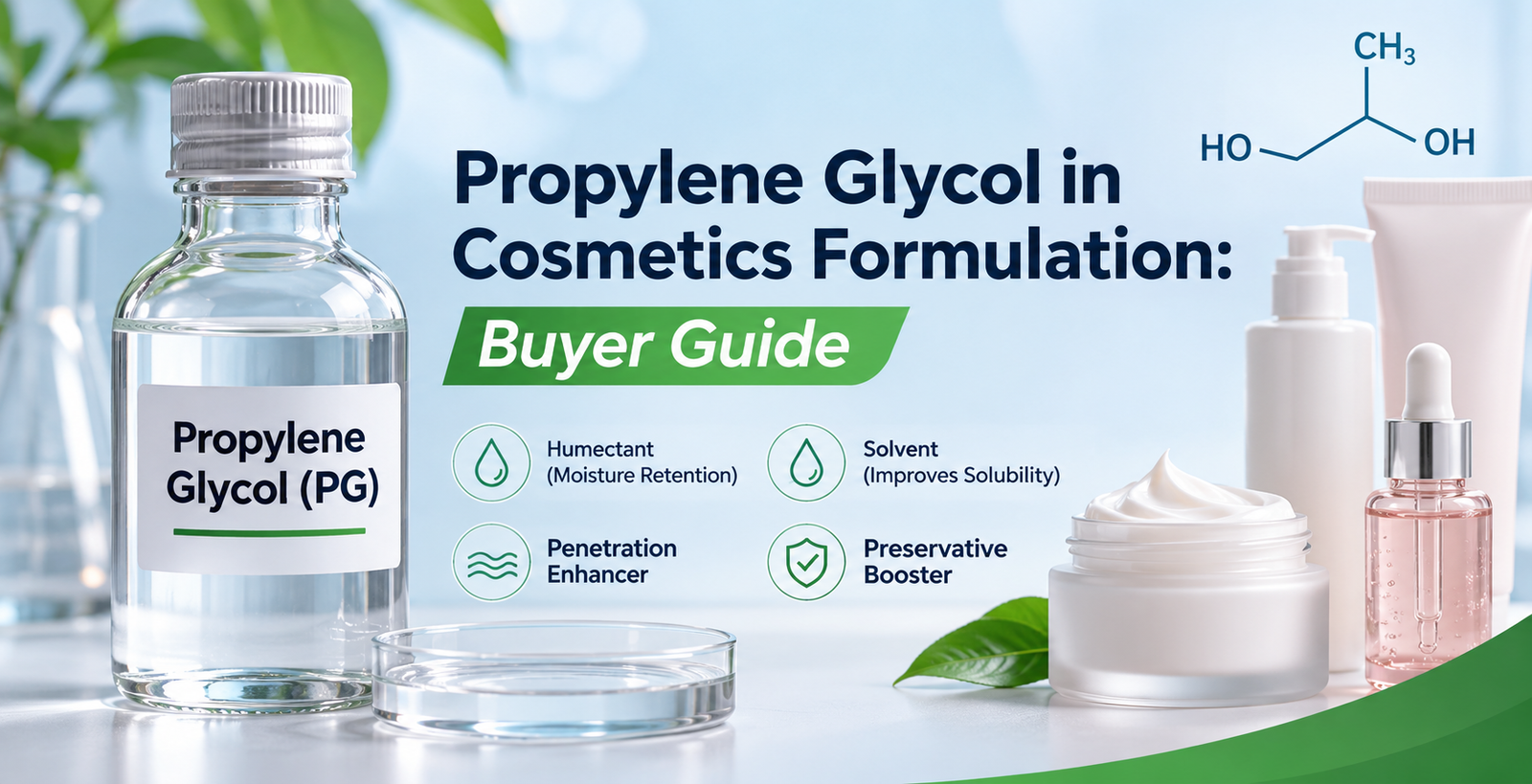
Propylene glycol in cosmetics is widely used because one ingredient can perform several formulation roles at once. It can help retain moisture, dissolve compatible ingredients, support product texture and act as a carrier in skincare, haircare and personal-care systems. For bulk buyers, however, the purchasing decision should go beyond the ingredient name and price per kilogram.
This guide explains how cosmetic manufacturers and procurement teams can evaluate propylene glycol by function, formulation fit, grade, COA parameters, handling, storage and bulk-sourcing requirements.
What Is Propylene Glycol?
Propylene glycol is a clear, colorless liquid used in multiple industries. In cosmetic and personal-care formulations, it is commonly used as a humectant, solvent, carrier and viscosity-supporting ingredient.
BulkFineChem supplies Propylene Glycol Liquid for cosmetic, personal-care, pharmaceutical, food, industrial and specialty formulation applications.

Why Propylene Glycol Is Used in Cosmetic Formulations
Formulators choose propylene glycol because it can perform more than one practical function in a finished product.
- Humectant
- Solvent
- Carrier
- Viscosity-adjusting support
- Ingredient dispersing aid
- Moisture-management component
The exact role depends on the formula, concentration, other ingredients and intended product type.
Key Role 1: Humectancy
One of the best-known uses of propylene glycol in cosmetics is moisture retention. As a humectant, it can help hold water within the formulation and support the intended sensory and hydration profile of the finished product.
Where this can matter
- Face creams
- Body lotions
- Serums
- Hair conditioners
- Leave-on treatments
- Personal-care gels
The total humectant system may also contain glycerin, sorbitol or other moisture-binding ingredients, so propylene glycol should be evaluated as part of the full formulation rather than in isolation.
Key Role 2: Solvent and Carrier
Propylene glycol can help dissolve or carry ingredients that are not easily incorporated into water alone. This can be useful for selected botanical extracts, fragrances, actives and processing aids.
Why solvent performance matters
A raw material that dissolves well in propylene glycol can be easier to distribute uniformly through the formulation. However, compatibility should always be tested in the real product because solubility can change when water, surfactants, salts, oils or other solvents are present.
Key Role 3: Texture and Formulation Support
Propylene glycol can influence viscosity, slip and overall product feel depending on the system. It may also help reduce crystallization or support ingredient dispersion in some formulations.
Because the effect depends on concentration and the surrounding formulation, bench testing remains important before a full production batch.
Propylene Glycol in Skincare
In skincare, propylene glycol is commonly incorporated into water-based and emulsion systems.
Common skincare formats
- Moisturizers
- Serums
- Toners
- Gels
- Cleansers
- Body lotions
Formulators should evaluate skin feel, tackiness, drying profile, active compatibility and finished-product stability when setting the use level.
Propylene Glycol in Haircare
Haircare formulations may use propylene glycol as a moisture-supporting and solvent ingredient.
Typical haircare uses
- Conditioners
- Hair masks
- Scalp products
- Styling gels
- Leave-on treatments
In these systems, it should be tested for compatibility with surfactants, cationic conditioners, polymers, fragrances and botanical extracts.
Propylene Glycol in Cleansers and Wash-Off Products
In wash-off products, propylene glycol can help dissolve ingredients and support formulation uniformity. It may be used alongside surfactant systems in facial cleansers, body washes and related personal-care products.
Buyers should confirm that the selected grade is appropriate for the intended cosmetic application and that the batch documentation matches the manufacturer’s quality specification.
What Bulk Buyers Should Check Before Ordering
A professional purchase specification should define more than the words “propylene glycol.” The correct grade and quality requirements should be written clearly on the purchase order.
- Confirm the required grade. The buyer should state the quality level needed for the intended formulation.
- Review purity. Assay should match the approved raw-material specification.
- Check water content. Water can affect processing and formulation calculations.
- Confirm appearance and colour. These can be useful incoming-quality checks.
- Review identity and physical properties. Density or refractive index may be included where relevant.
- Check documentation. Request the batch COA plus current safety and technical documents.
Important COA Parameters
The exact COA depends on the supplier and grade, but buyers may review:
- Product identity
- Batch or lot number
- Assay or purity
- Appearance
- Colour
- Water content
- Specific gravity or density
- Refractive index where specified
- Acidity or related quality parameters where specified
- Test date and release status
Critical parameters should be written into the approved purchase specification so they are not left to assumption.
Why Grade Selection Matters
Propylene glycol is sold for different industries. A material suitable for general industrial use should not automatically be treated as acceptable for cosmetic, food or pharmaceutical manufacturing.
Before buying, confirm:
- Intended end use
- Applicable quality standard
- Required purity
- Manufacturing and handling controls
- Customer or regulatory documentation needs
If the product is used in a regulated finished formulation, procurement should follow the quality specification approved by the manufacturer’s QA team.
Propylene Glycol vs Glycerin
Both propylene glycol and glycerin can be used as humectants, but they are not identical ingredients.
| Factor | Propylene Glycol | Glycerin |
|---|---|---|
| Primary formulation role | Humectant and solvent | Humectant and emollient-supporting ingredient |
| Viscosity | Lower | Higher |
| Sensory profile | Generally lighter | Can feel more tacky at higher levels |
| Solvent utility | Often useful for dissolving compatible actives | Useful in different moisture-focused systems |
Many formulations use both rather than choosing one exclusively.
Storage and Handling
Propylene glycol should be stored according to the supplier’s instructions in clean, compatible and well-sealed containers.
Good receiving practice
- Check container integrity
- Confirm batch number
- Match the COA to the delivery
- Inspect appearance
- Review storage instructions
- Keep containers closed to prevent contamination
Dedicated transfer equipment can help reduce cross-contamination in facilities that handle multiple liquid raw materials.
Bulk Packaging and Procurement Planning
Packaging should match the buyer’s consumption rate, storage capacity and transfer system. Purchasing too much material can increase inventory exposure, while undersized packs can create unnecessary handling.
Before ordering, confirm:
- Required quantity
- Packaging preference
- Minimum order quantity
- Delivery destination
- Storage capacity
- Batch-document requirements
- Lead time
Common Procurement Mistakes
- Buying only by price without comparing specifications
- Failing to state the required grade
- Accepting a generic sample COA instead of the actual batch COA
- Ignoring water content or purity limits
- Assuming all propylene glycol is interchangeable
- Skipping formulation compatibility testing
- Not checking packaging suitability for the plant’s transfer system
Frequently Asked Questions
What does propylene glycol do in cosmetics?
It is commonly used as a humectant, solvent, carrier and formulation-support ingredient.
Is propylene glycol used in skincare?
Yes. It is used in moisturizers, serums, cleansers, gels, lotions and other personal-care products.
Is propylene glycol the same as glycerin?
No. Both can act as humectants, but they have different physical properties and formulation behavior.
What should buyers check on the COA?
Review the batch identity, assay, water content, appearance and other parameters required by the approved specification.
Can any industrial propylene glycol be used in cosmetics?
No. Buyers should confirm that the grade and documentation are appropriate for the intended cosmetic application.
How should propylene glycol be stored?
Store it in compatible, sealed containers under the supplier’s recommended conditions and protect it from contamination.
Does BulkFineChem supply propylene glycol?
Yes. BulkFineChem lists Propylene Glycol Liquid for cosmetic, personal-care, pharmaceutical, food, industrial and specialty formulation applications.
Conclusion
Propylene glycol in cosmetics is valuable because it can combine humectant, solvent and formulation-support functions in one liquid raw material. The best bulk-buying decision comes from matching the grade, purity, COA, packaging and formulation performance to the finished-product requirement.
Need a bulk quote? Review BulkFineChem’s Propylene Glycol Liquid product page and share your required quantity, packaging, grade and application with the BulkFineChem team.