
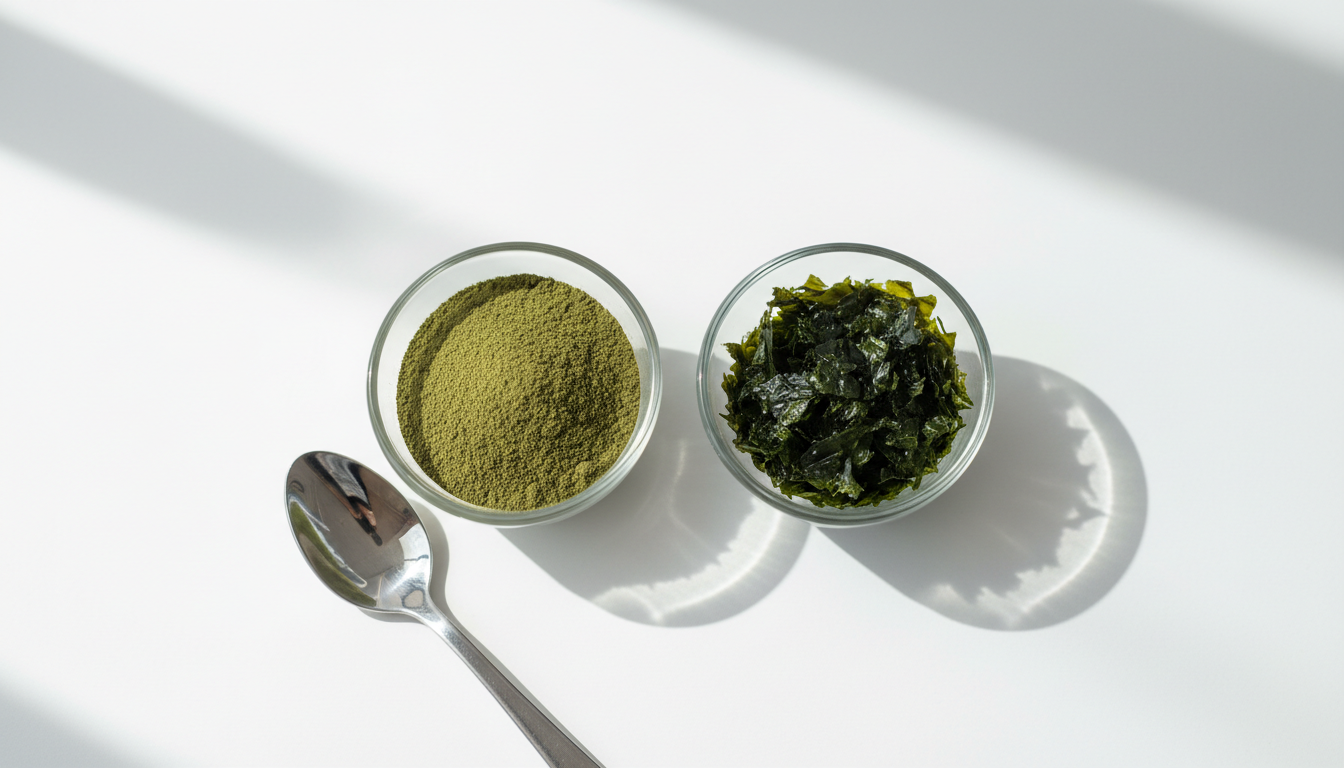
Seaweed Extract Powder vs Flakes: Which Form Should You Buy?
A purchase manager calls us roughly once a month with the same complaint. The last consignment of seaweed extract left sludge at the bottom of the mixing tank, and the line sat idle while somebody filtered 400 litres by hand. Nine times out of ten the extract wasn't defective — it was the wrong physical form.
The seaweed extract powder vs flakes question looks cosmetic on a quotation. It isn't. Form drives dissolution time, dust exposure, blending accuracy, storage behaviour and, often enough, the landed cost per kilo of active.
Here's what separates the two, what to check on a COA before releasing a purchase order, and where India's biostimulant rules sit after the regulatory reset of 2025.
Start With the Seaweed, Not With the Form
Before you argue about powder or flakes, settle the species. A seaweed extract biostimulant India buyers source today typically comes from one of three raw materials, and they are not interchangeable — they differ in polysaccharide profile, mineral load and cost.
Ascophyllum nodosum extract is the reference material for most of the published agronomic work. It grows in the cold North Atlantic, from eastern Canada across to northern Europe, and it's harvested rather than farmed. The dried, milled biomass runs roughly 44.7% carbohydrate, 18.6% ash, 5.2% protein and 3.0% lipid, with alginic acid at about 28% of dry weight, fucoidans near 11.6%, mannitol around 7.5% and laminarin close to 4.5%.
Sargassum, a warm-water brown alga, is widely used in India and generally costs less. Kappaphycus alvarezii is a red seaweed farmed along the Indian coast and the basis of several potassium-rich sap products developed here. A flake made from Sargassum and a powder made from Ascophyllum aren't two forms of the same thing — they're different products sharing a name.
Extraction Decides What's Actually in the Bag
The single biggest driver of performance isn't the form and isn't even the species. It's how the seaweed was broken down. Published reviews of Ascophyllum-based biostimulants are blunt about this: bioactivity and composition depend on the extraction method used, so two extracts from identical raw material can behave very differently in the field.
The Main Extraction Routes
Industrial practice has settled around a handful of methods, each leaving a different fingerprint on the final extract. Ask your supplier to name theirs — a vendor who can't answer this is reselling, not manufacturing.
- Alkaline hydrolysis (NaOH or KOH at 70–100°C) — the most widely used industrially; breaks complex polysaccharides into lower-molecular-weight oligomers
- Acid hydrolysis (sulphuric or hydrochloric, 40–50°C) — targets fucose-containing sulphated polysaccharides and strips phenolics
- Water-based extraction — simple hydration of dried seaweed, reported to retain phytohormone-like activity
- Enzyme-assisted extraction — gentler, selective, and usually priced accordingly
- Microwave, ultrasound, supercritical fluid and pressurised liquid methods — each pulls a different bioactive fraction
Alkaline extraction is why so many commercial extracts carry high potassium figures — the KOH used in processing contributes to the K₂O on the spec sheet. Not a fault, but know it's there before you build a nutrient claim around it.
Powder vs Flakes: What Actually Differs
Both forms come out of the same upstream process — extract, clarify, concentrate. They part company at the drying stage, and that one difference cascades into everything your plant experiences.
Powder is usually spray dried, then milled and sieved to a consistent particle size. Flakes come off a drum or belt dryer as thin sheets that fracture into irregular pieces, described on most spec sheets as "brown to dark brown flakes or coarse powder". Bigger particles, less surface area, different handling behaviour.
| Parameter | Seaweed Extract Powder | Seaweed Extract Flakes |
|---|---|---|
| Typical drying route | Spray dried, then milled and sieved | Drum or belt dried, fractured into flakes |
| Particle size | Fine, uniform, controlled mesh | Coarse, irregular, variable |
| Dissolution speed | Fast — high surface area | Slower — needs longer agitation or warm water |
| Clumping on addition | Higher risk; can "fish-eye" if dumped in | Lower risk; disperses before it gels |
| Dust during handling | Significant; needs extraction and PPE | Minimal |
| Dry blending accuracy | Excellent — blends evenly with carriers | Poor — segregates from fine powders |
| Hygroscopicity / caking | Higher surface area, absorbs moisture faster | More forgiving in humid godowns |
| Bulk density | Higher, more consistent | Lower and variable; affects filling |
| Typical solubility claim | Up to 100% at 2% aqueous solution | Commonly ≥98% water soluble |
| Best suited to | Dry blends, WSG/WDG, sachets, precise dosing | Liquid manufacture, tank mixing, fertigation stock solutions |
Notice the trade-off. You buy speed and blending precision with powder, and you pay for it in dust control. You buy easy handling with flakes, and you pay for it in mixing time.
Solubility Is Where Most of the Complaints Start
Seaweed extract solubility gets quoted as a single number, which is misleading. A product can be 100% soluble and still take twenty minutes to go into cold water, and that's the gap where production complaints live.
Two things matter operationally: how much finally dissolves, and how long it takes to get there. Fine powder wins on speed but will form gel-coated lumps if you tip a 25 kg bag into a still tank — the outside of the lump hydrates, the inside stays dry, and you filter out good material as waste. Flakes wet more gradually and rarely lump, but they'll happily sit at the bottom of an under-agitated tank for half an hour.
My honest advice: test with your own water. Hardness, temperature and agitation in a Vadodara plant in May are nothing like a lab beaker, and a 2% dissolution trial on a 200-gram sample costs almost nothing next to a failed batch.
How to Read a Seaweed Extract Specification Sheet
Seaweed extract specifications vary more than almost any other agro-input we supply. Real numbers help, so consider an Ascophyllum-based powder marketed in India with alginic acid at 16.6%, organic matter 58.8%, K₂O 10.4%, moisture 9.2% w/w and 100% solubility at 2% solution.
Now set that against a typical flake spec: alginic acid 4–8%, organic matter 40–50%, K₂O 12–18%, moisture ≤8%, solubility ≥98%, pH of a 1% solution between 8.5 and 10.5. Same product category, very different composition.
Parameters Worth Arguing Over
Don't accept a one-page spec with four lines on it. These parameters decide whether the material performs in your formulation, and every one should appear on a batch-wise COA.
- Alginic acid percentage — the headline active; ranges from single digits to high teens
- Organic matter and K₂O — check whether the potassium is intrinsic or extraction-derived
- Moisture — above about 10% you're paying for water and inviting caking
- Water solubility and insoluble matter — ask for both, not just the flattering one
- pH of solution, bulk density, particle size or mesh, and heavy metals
Where India's Biostimulant Rules Stand Right Now
This part has teeth, and plenty of formulators are still working off outdated assumptions. Biostimulants came under the Fertiliser (Control) Order, 1985 through notification S.O. 882(E) dated 23 February 2021, which created Schedule VI. Seaweed extracts sit in the botanical extracts category there.
The Insecticides Act, 1968 and CIB&RC don't govern biostimulants — the FCO definition specifically excludes pesticides and plant growth regulators registered under that Act. Formulating a true PGR alongside a seaweed base means two separate regulators and two separate files.
The 2025 reset is what changed the market. Over 8,000 provisional G3 registrations had been issued, and they expired after a final extension to 16 June 2025. From 17 June 2025, 9,352 stood cancelled, and only 146 products had completed full notification into Schedule VI.
What the Rules Mean for Your Purchase File
The Third Amendment Order of 8 May 2024 tightened data requirements while easing one specific burden for materials like seaweed.
- No biostimulant may be manufactured or imported unless notified and included in Schedule VI
- Form G applications require chemistry, bioefficacy trial data, toxicity and heavy metal analysis
- Seaweed extracts, protein hydrolysates, amino acids, vitamins and humic/fulvic acids are exempt from toxicology data, subject to an affidavit of non-toxicity
- The pesticide residue threshold was raised to 1 ppm, replacing the earlier 0.01 ppm limit
- A Central Biostimulants Committee was constituted to issue further guidelines
Buying raw seaweed extract as an input is a different matter from selling a registered finished biostimulant. Keep that distinction clean in your documentation.
Matching the Form to Your Formulation
Forget which form is "better". Ask what your line does with the material once the bag is open, because that answers the question in about thirty seconds.
Manufacturing liquid biostimulants or fertigation concentrates? Flakes usually make more sense — gentler dispersion, far less dust in the batching room, and you have agitation on your side anyway. Powder is the right call when the extract goes into a dry blend, a water-soluble granule or a sachet pack, because flakes segregate from fine carriers like China Clay or Talcum Powder during blending and you'll see it in your assay.
Quick Decision Guide by Use Case
Most buyers fall into one of these five situations. Find yours and the form more or less picks itself.
- Liquid biostimulant manufacturing with tank agitation — flakes
- Dry water-soluble fertiliser blends and NPK carriers — powder
- WSG/WDG granulation with Bentonite Granules or Precipitated Silica — powder
- Small-pack retail sachets needing dose accuracy — powder
- Bulk fertigation stock solutions at farm or estate level — flakes
Frequently Asked Questions
Is seaweed extract powder stronger than flakes?
Not inherently. Strength comes from alginic acid content, extraction quality and species — not from particle size. Compare the actual spec figures side by side, since a well-made flake can easily out-spec a cheap powder.
Which form dissolves faster?
Powder, by a clear margin, because of its far greater surface area. Flakes need longer agitation or slightly warm water. The catch is that powder lumps if you add it too fast to a static tank, so steady addition into a moving vortex matters more than the form.
Can I substitute flakes for powder at the same dose in an existing formulation?
Only after checking the assay. Alginic acid, organic matter and K₂O often differ substantially between the two grades, so a straight swap can shift your actives. Re-run a small batch, verify solubility and dose against the new COA, then scale.
Does seaweed extract need FCO registration before I buy it?
As a raw material input, you're buying a chemical, not selling a registered product. Registration obligations attach when you manufacture or import a finished biostimulant for sale, which must be notified under Schedule VI. Talk to your regulatory consultant before you label anything.
What packing should I ask for in bulk?
Standard bulk packing is 25 kg bags, with HDPE drums where moisture protection matters more. Powder benefits from an inner liner given its hygroscopicity, and stock should sit off the floor in humid godowns.
How do I verify quality on arrival?
Insist on a batch-wise COA and check it against your own quick tests — a 2% solubility trial, a moisture check and a visual on colour and odour. Any reputable supplier will send a pre-dispatch sample, and refusing that request tells you something.
The Bottom Line
Powder and flakes aren't better or worse than one another — they're built for different processes. Choose powder when you need speed, blending precision and dose uniformity in a dry system. Choose flakes when you're making liquids, want minimal dust, and have agitation to spare. Then spend your real energy on the things that actually decide performance: species, extraction route, and a batch-wise COA you can trust.
BulkFineChem supplies Seaweed Extract in both powder and flake form from our Vadodara base, in 25 kg bags and HDPE drums, with batch-wise COA, GST invoice and pan-India delivery. We also stock the inputs that usually sit alongside it in a biostimulant or fertiliser formulation — Chitosan Flakes, Trichoderma TC, Mycorrhiza TC, 6-BA 99%, Sodium Nitrophenolate PGR, NATCA, Potassium Hydroxide Flakes, Magnesium Sulphate, Ammonium Sulphate, Bentonite Granules, Precipitated Silica, China Clay and Neem Oil. If you'd like to buy seaweed extract in bulk India-wide, or simply want a sample and full specification sheet before committing, get in touch through https://bulkfinechem.com and tell us what your line runs on — we'll recommend the form that fits.