
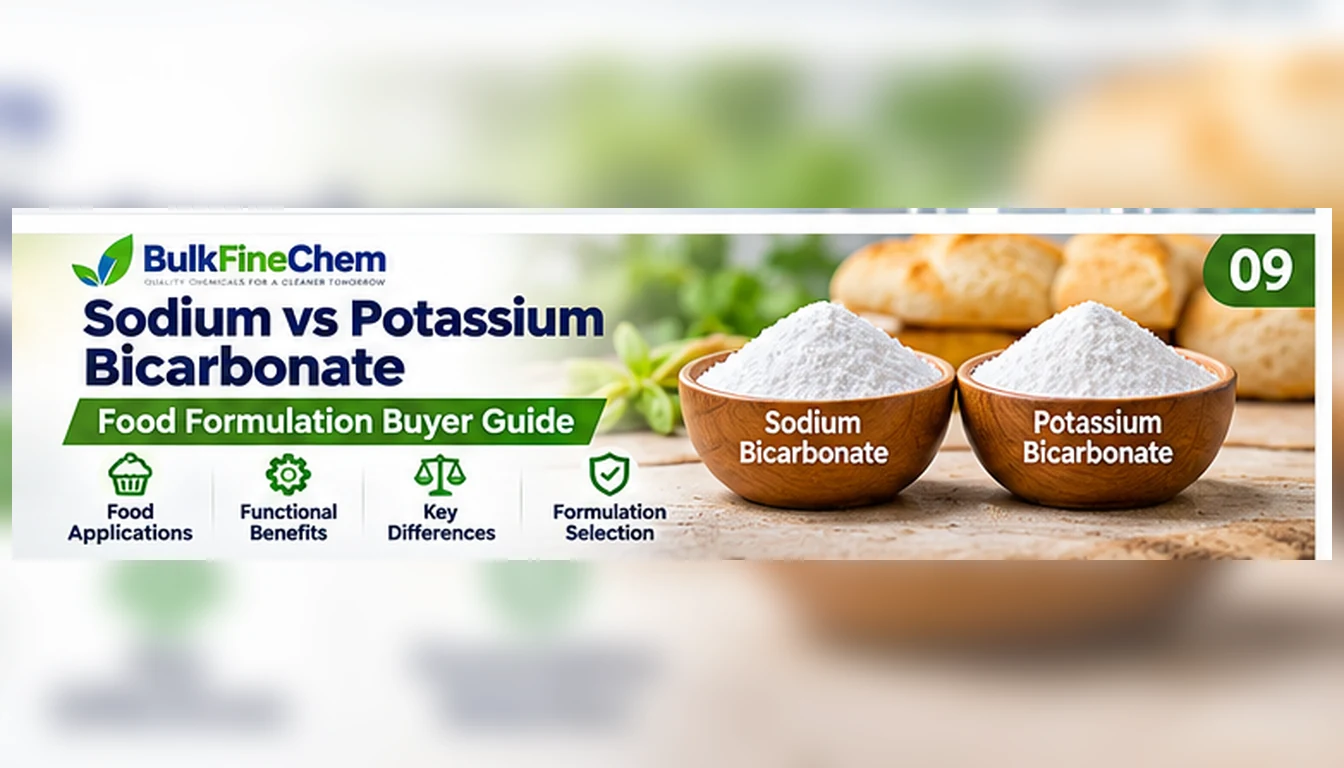
Sodium vs potassium bicarbonate is an important formulation decision in bakery, dry mixes and other food systems because both can participate in acid-base reactions, but they differ in sodium contribution, molecular weight, taste impact and handling behavior. The best choice depends on the finished recipe rather than a simple one-for-one substitution.
BulkFineChem supplies Sodium Bicarbonate Food Grade Powder and Potassium Bicarbonate Food Grade for food formulation buyers.
Sodium vs Potassium Bicarbonate: Quick Comparison
| Factor | Sodium Bicarbonate | Potassium Bicarbonate |
|---|---|---|
| Alkali ion | Sodium | Potassium |
| Common food role | Leavening and pH adjustment | Leavening and pH adjustment |
| Formulation reason | Established broad-use ingredient | Useful when reducing sodium contribution |
| Substitution | Requires formulation recalculation and sensory testing | |
Why They Are Not a Direct 1:1 Replacement
The two salts have different molecular weights. Replacing sodium bicarbonate with the same weight of potassium bicarbonate changes the neutralizing capacity and the amount of sodium or potassium delivered to the formula. Bakers and food formulators should calculate substitution on a chemical-equivalent basis and validate the real recipe.
Leavening Behavior
Both bicarbonates can react with food acids to release carbon dioxide. The amount and timing of gas formation depend on the acid system, moisture, temperature and processing conditions.
What to test
- Dough or batter pH
- Volume and crumb structure
- Spread
- Color development
- Residual alkaline taste
Sodium Reduction
Potassium bicarbonate may be considered when a product-development team is working to reduce sodium from the leavening system. The full nutrition profile and sensory effect should still be evaluated because other ingredients can remain major sodium contributors.
Taste and Finished-Product Quality
Excess bicarbonate of either type can create undesirable alkaline flavor or color changes. Potassium salts can also have a distinct taste profile. Formulation trials should therefore compare finished products rather than only lab pH.
Moisture and Storage
Food-grade bicarbonates should be kept dry and protected from contamination. Moisture can cause caking and reduce powder handling quality.
What to Check on the COA
- Identity
- Assay
- Moisture or loss on drying
- pH or alkalinity where specified
- Insoluble matter where required
- Food-grade compliance documentation
- Batch number and test date
Which One Should a Food Manufacturer Buy?
Choose sodium bicarbonate when the established formula, cost target and labeling profile support it. Consider potassium bicarbonate when sodium reduction is part of the formulation brief and the taste and processing results are acceptable.
Bulk Buying Checklist
- State the exact food-grade material.
- Set assay and moisture limits.
- Review the actual batch COA.
- Run equivalent-based formulation trials.
- Confirm packaging and moisture protection.
- Validate taste, volume and shelf stability.
Frequently Asked Questions
Can potassium bicarbonate replace sodium bicarbonate?
It can in selected formulations, but the amount should be recalculated and the finished food tested.
Which one reduces sodium?
Potassium bicarbonate removes the sodium contribution from that bicarbonate ingredient, though total product sodium depends on the full recipe.
Do they produce the same amount of gas by weight?
No. Their different molecular weights mean a weight-for-weight substitution is not chemically equivalent.
Can potassium bicarbonate affect taste?
Yes. Sensory testing is important, especially at higher use levels.
What should buyers check on the COA?
Review identity, assay, moisture and other limits required by the approved food specification.
Does BulkFineChem supply both?
Yes. BulkFineChem lists food-grade sodium bicarbonate and potassium bicarbonate.
Conclusion
The sodium vs potassium bicarbonate choice should be made through formulation calculation, baking or process trials, sensory evaluation and batch-quality review.
Need a bulk quote? Share the required bicarbonate, quantity, packaging and food application with BulkFineChem.