

Trisiloxane ethoxylate agricultural adjuvant products are used by formulators to improve wetting, spreading and surface coverage in selected agrochemical systems. For buyers, the key question is not whether the material is called a “superspreader,” but whether its specification, compatibility and performance match the finished formulation.
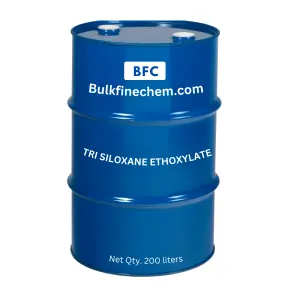
BulkFineChem lists Tri Siloxane Ethoxylate Liquid for agricultural and specialty formulation use.
What Is Trisiloxane Ethoxylate?
Trisiloxane ethoxylates are organosilicone surfactants valued for their ability to reduce surface tension. In agricultural formulations, this can help a spray liquid wet and spread across difficult leaf surfaces more efficiently than a conventional surfactant in some systems.
Why Surface Tension Matters
A droplet that beads strongly may cover only a small surface area. Lower surface tension can increase spreading, but excessive spreading or runoff may be undesirable. The optimum adjuvant level therefore depends on the formulation, crop surface, spray volume and application conditions.
Technical Grade vs Finished Adjuvant
Raw trisiloxane ethoxylate may be used as a formulation ingredient, while commercial spray adjuvants can contain blends of surfactants, solvents and other components. Buyers should confirm whether they need a raw surfactant or a finished registered product.
Key Specifications to Review
- Appearance and color
- Active content or solids where specified
- Surface-tension performance where specified
- Density or specific gravity
- Water content
- pH where relevant
- Batch COA and test method references
Compatibility Testing
Organosilicone adjuvants should be tested in the actual formulation. Compatibility can change with salts, emulsifiers, oils, active ingredients, pH and water hardness.
What to observe
- Clarity or phase separation
- Foam behavior
- Emulsion stability
- Spreading pattern
- Runoff
- Storage stability
Formulation and Use-Level Considerations
More adjuvant is not always better. Too much surfactant can change spray behavior or increase formulation cost without improving performance. Formulators should determine the appropriate level through controlled lab and field-development work consistent with local regulations.
Storage and Handling
Keep the material in compatible, tightly closed containers and follow the supplier’s storage instructions. Protect it from contamination and temperature conditions outside the approved range. Receiving teams should verify packaging integrity and batch documentation before use.
Bulk Procurement Checklist
- Define whether you need raw adjuvant or finished product.
- Set critical physical and performance specifications.
- Request a batch-specific COA.
- Run compatibility and stability trials.
- Confirm packaging and transfer requirements.
- Review regulatory requirements for the destination market.
Frequently Asked Questions
Is trisiloxane ethoxylate a surfactant?
Yes. It is an organosilicone surfactant used where strong wetting and spreading performance is desired.
What does “superspreader” mean?
It describes very strong spreading behavior on some surfaces, but actual performance depends on the formulation and use conditions.
Can it be added to any agrochemical formula?
No. Compatibility and performance should be tested in the specific formulation.
What should the COA show?
It should report the agreed identity and physical or performance parameters for the delivered batch.
Does higher use level always improve spreading?
No. Formulators should optimize the level rather than assuming more is better.
Does BulkFineChem supply trisiloxane ethoxylate?
Yes. BulkFineChem lists Tri Siloxane Ethoxylate Liquid for formulation buyers.
Conclusion
A trisiloxane ethoxylate agricultural adjuvant should be selected through specification review and formulation testing. Strong wetting performance is useful only when compatibility, stability and spray behavior are controlled.
Need a bulk quote? Send BulkFineChem your required quantity, packaging and formulation application.