
What Is Aluminium Chloride Anhydrous? Uses, Grades and Bulk Sourcing Guide
Aluminium chloride anhydrous doesn't get much attention outside a chemical plant, but it's quietly behind an enormous slice of the organic chemicals you use every day — from the detergents in your laundry cabinet to the dyes in your clothes. If you're a manufacturer or formulator trying to nail down a reliable, bulk-quantity source of this compound, you've probably already run into the two big headaches: finding a supplier who actually stocks it (rather than sourcing it on demand from China) and figuring out exactly which grade you need. This guide covers both.
We'll walk through what aluminium chloride anhydrous actually is, how it's manufactured, where it gets used industrially, what the specification sheet should look like, and how the bulk-sourcing process works when you order it through BulkFineChem's Aluminium Chloride Anhydrous listing.
What Is Aluminium Chloride Anhydrous?
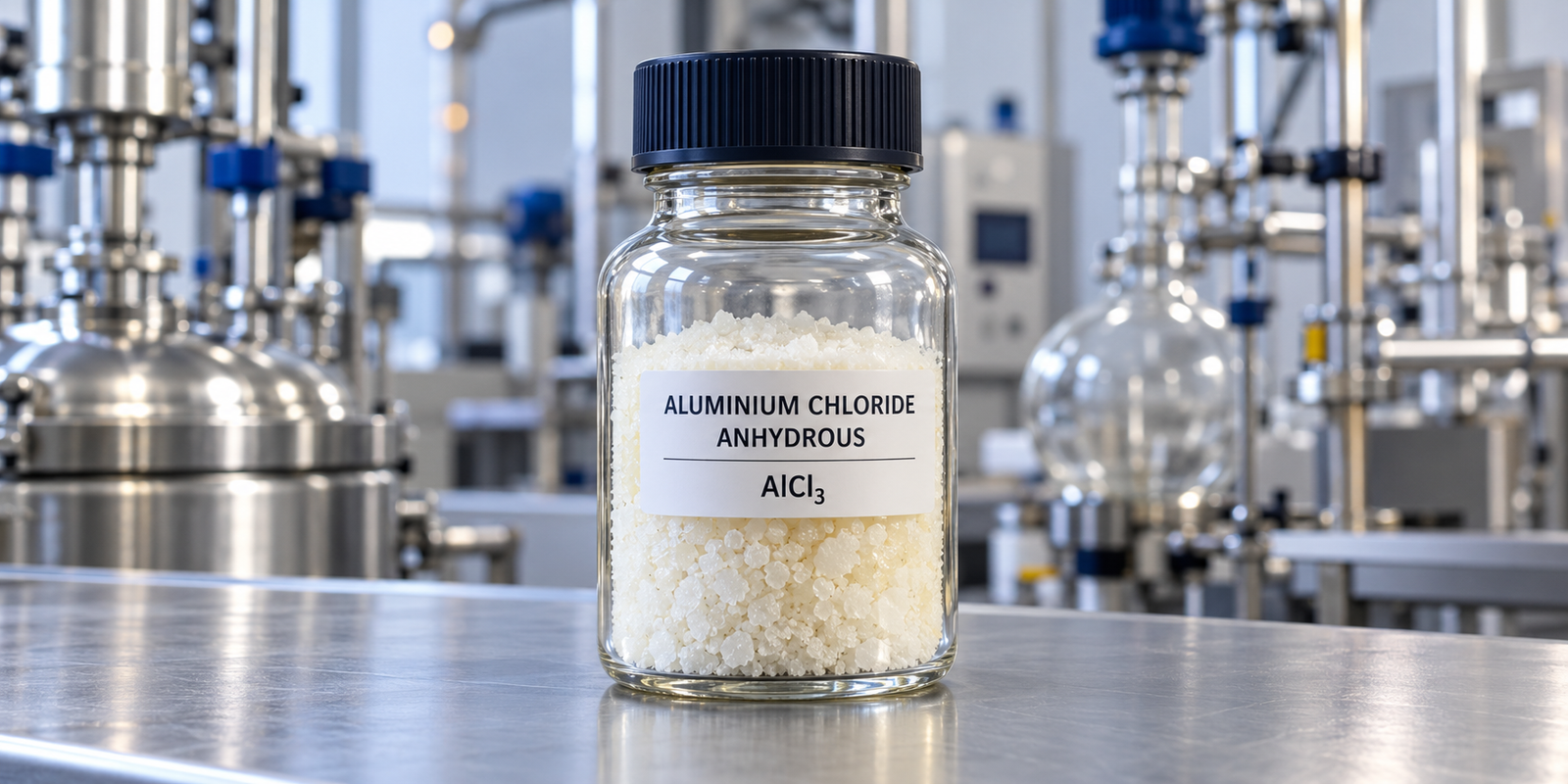
Aluminium chloride anhydrous — chemical formula AlCl₃, CAS number 7446-70-0 — is the water-free form of aluminium chloride. In its pure state it's a white crystalline solid, though the commercial-grade material you'll actually receive is usually pale yellow or grayish, a tint that comes from trace iron and moisture picked up during handling. Here's the interesting bit: below about 400°C, AlCl₃ doesn't exist as a simple single molecule at all. It pairs up into a dimer, Al₂Cl₆, and only breaks apart into individual AlCl₃ units above roughly 800°C.
That dimeric structure is exactly why the compound behaves the way it does — it's a strong Lewis acid, meaning it's hungry for electron pairs, which is the whole reason it works so well as a catalyst (more on that below). It's also aggressively moisture-sensitive. Drop it in humid air and it reacts almost immediately, fuming and releasing hydrochloric acid gas. That single property shapes everything about how it's packaged, shipped and stored.
How Is Aluminium Chloride Anhydrous Manufactured?
Two production routes dominate industrial manufacturing, and the one used affects purity more than most buyers realize.
Direct Chlorination of Molten Aluminium
Chlorine gas is passed through molten aluminium metal at 670–850°C inside a ceramic-lined reactor. The reaction is strongly exothermic, and the aluminium chloride vapor produced is condensed in air-cooled chambers. It's the more common, lower-cost route, and it's what most commercial "technical grade" material comes from.
Chlorination of Alumina (Aluminium Oxide)
A less common but higher-purity method: carbon monoxide and chlorine combine over activated charcoal to form phosgene in situ, which then reacts with high-purity alumina in a fluidized-bed reactor at 500–600°C. This route avoids some of the metallic impurities that creep in from the molten-aluminium process, so it's typically reserved for pharmaceutical-intermediate or high-purity catalyst applications.
Physical and Chemical Properties
| Property | Value |
|---|---|
| Molecular formula | AlCl₃ |
| Molar mass | 133.34 g/mol |
| Appearance | White to pale yellow/grayish crystalline solid |
| Density | ~2.44 g/cm³ |
| Sublimation point | ~181°C (at atmospheric pressure) |
| Structure below 400°C | Dimeric — Al₂Cl₆ |
| Water reactivity | Highly reactive; releases HCl fumes and heat on contact with moisture |
| Solubility | Reacts violently rather than simply dissolving in water; soluble in organic solvents |
Industrial Uses and Applications
Ask any organic chemist what AlCl₃ is for, and "Friedel-Crafts" is the first thing out of their mouth. But that's really just the entry point — the compound shows up across a surprisingly wide spread of industries.
Friedel-Crafts Catalyst in Organic Synthesis
This is the headline use, and for good reason. As a strong Lewis acid, anhydrous AlCl₃ catalyzes Friedel-Crafts alkylation and acylation reactions — the backbone chemistry behind a long list of aromatic compounds.
- Alkylation of benzene to produce linear alkylbenzene, the raw material for synthetic detergents
- Ethylbenzene production, a direct precursor to styrene and polystyrene
- Acylation reactions in fragrance and flavor compound synthesis
- Catalyzing polymerization and isomerization steps in petrochemical processing
- Anthraquinone dye intermediate synthesis
Dyes, Pigments and Petrochemicals
Beyond catalysis, AlCl₃ plays a direct role in manufacturing phthalocyanine green and blue pigments, and it's used in hydrocarbon reforming to boost octane ratings in refining operations. If you're formulating dye intermediates or specialty pigments, this is usually one of the first raw materials your process chemist will ask about.
Water Treatment and Other Industrial Uses
Less glamorous, but genuinely useful: aluminium chloride (in various forms) acts as a coagulating and flocculating agent in wastewater treatment, helping settle out suspended solids faster than in untreated water. It's also used in some metal-surface treatment and pharmaceutical intermediate processes where a strong, well-characterized Lewis acid catalyst is needed.
Grades, Purity and Packaging
Most buyers sourcing this in bulk are choosing between industrial/technical grade (typically 98%+ AlCl₃, suitable for catalysis and general industrial synthesis) and higher-purity grades reserved for pharmaceutical intermediate work. Whichever grade you need, always ask for a batch-specific spec sheet rather than relying on a generic product datasheet — purity, iron content and moisture level can shift noticeably between production lots given how reactive this compound is. On BulkFineChem's product page, you can check current packaging options and request the Certificate of Analysis for the specific batch you'd be buying.
Handling, Storage and Safety
This isn't a chemical you want to get casual about. Anhydrous AlCl₃ is corrosive and irritating to skin, eyes and the respiratory tract, and — worth repeating — it reacts with atmospheric moisture to release hydrochloric acid fumes. A few non-negotiables:
- Store in cool, dry conditions in tightly sealed containers — most suppliers recommend using stock within six months, since it tends to cake and absorb moisture over time
- Handle under a fume hood, or with a respirator fitted with acid-gas filters, in poorly ventilated spaces
- Always wear chemical-resistant gloves, goggles and protective clothing
- Never add water directly to the solid — moisture exposure should be minimized at every handling step
- Follow standard hazardous-goods packaging and labeling requirements during transport
Ask your supplier for the current Technical Data Sheet (TDS) and Safety Data Sheet (SDS) before your first order — you'll want both on file for your own EHS documentation anyway.
How to Source Aluminium Chloride Anhydrous in Bulk from BulkFineChem
BulkFineChem supplies aluminium chloride anhydrous to manufacturers, formulators, traders and institutional buyers — this is strictly a B2B platform, not a retail or consumer channel. Here's how the process actually works, start to finish:
- Enquiry: Submit your requirement — quantity (kg/MT), grade and delivery location — through the product page or the Quick Order form.
- Quotation: You'll receive a formal quote against your MOQ, with pricing tied to the quantity and packaging you've requested.
- Advance payment: Orders proceed on a 50–100% advance payment basis, confirmed at the quotation stage.
- Dispatch: Your order ships pan-India with a GST tax invoice and a batch-specific Certificate of Analysis (CoA). TDS/SDS are available on request, and an e-way bill is generated automatically for larger consignments.
If you'd rather skip the back-and-forth, the quickest route is the Quick Order page — submit your quantity once, and the quotation comes to you.
FAQs About Aluminium Chloride Anhydrous
Is aluminium chloride anhydrous the same as hydrated aluminium chloride?
No. Anhydrous AlCl₃ is completely water-free and works as a strong Lewis acid catalyst. The hydrated form (AlCl₃·6H₂O) is far less reactive and won't work properly in Friedel-Crafts reactions — using hydrated material by mistake is one of the more common lab errors chemists run into.
Why does aluminium chloride anhydrous smoke when exposed to air?
It's reacting with atmospheric moisture, releasing hydrochloric acid gas in the process. That's exactly why it has to be stored in sealed, moisture-proof packaging.
What's the shelf life of anhydrous AlCl₃ once opened?
Most suppliers recommend using an opened container within a few weeks to months, depending on how well it's resealed and the humidity of your storage environment — it tends to cake and lose reactivity as it absorbs moisture.
What MOQ does BulkFineChem offer for bulk orders?
MOQ is set per order and depends on packaging and grade — submit your requirement through the Quick Order form and you'll get exact figures in your quotation.
Do you provide a Certificate of Analysis with every batch?
Yes — every dispatch includes a batch-specific CoA, and TDS/SDS documents are available on request alongside your GST tax invoice.
Can aluminium chloride anhydrous be used outside organic synthesis?
Yes. Beyond its catalytic role, it's used in pigment manufacturing, hydrocarbon refining, and (in related forms) water treatment flocculation — though the anhydrous grade specifically is aimed at synthesis and catalysis applications.
The Bottom Line
Aluminium chloride anhydrous is one of those unglamorous industrial chemicals that ends up touching an outsized share of what gets manufactured downstream — detergents, dyes, plastics, fragrances. Getting it from a supplier who can actually document the batch, ship it correctly packaged, and hit your delivery window matters more than it might seem, given how moisture-sensitive the material is.
Ready to source it in bulk? Check current availability on the Aluminium Chloride Anhydrous product page, or go straight to Quick Order to request your quotation.
Related Products
- Aluminium Chloride Anhydrous — Friedel-Crafts catalyst grade
- Zinc Chloride – Anhydrous and Solution
- Phosphorus Trichloride (PCl3) – Industrial Grade