
Half a percent. That’s usually all the xanthan gum a food formulation needs — and yet getting that half a percent wrong is one of the most common reasons a sauce batch separates, a gluten-free loaf collapses, or a drilling mud stops carrying cuttings.
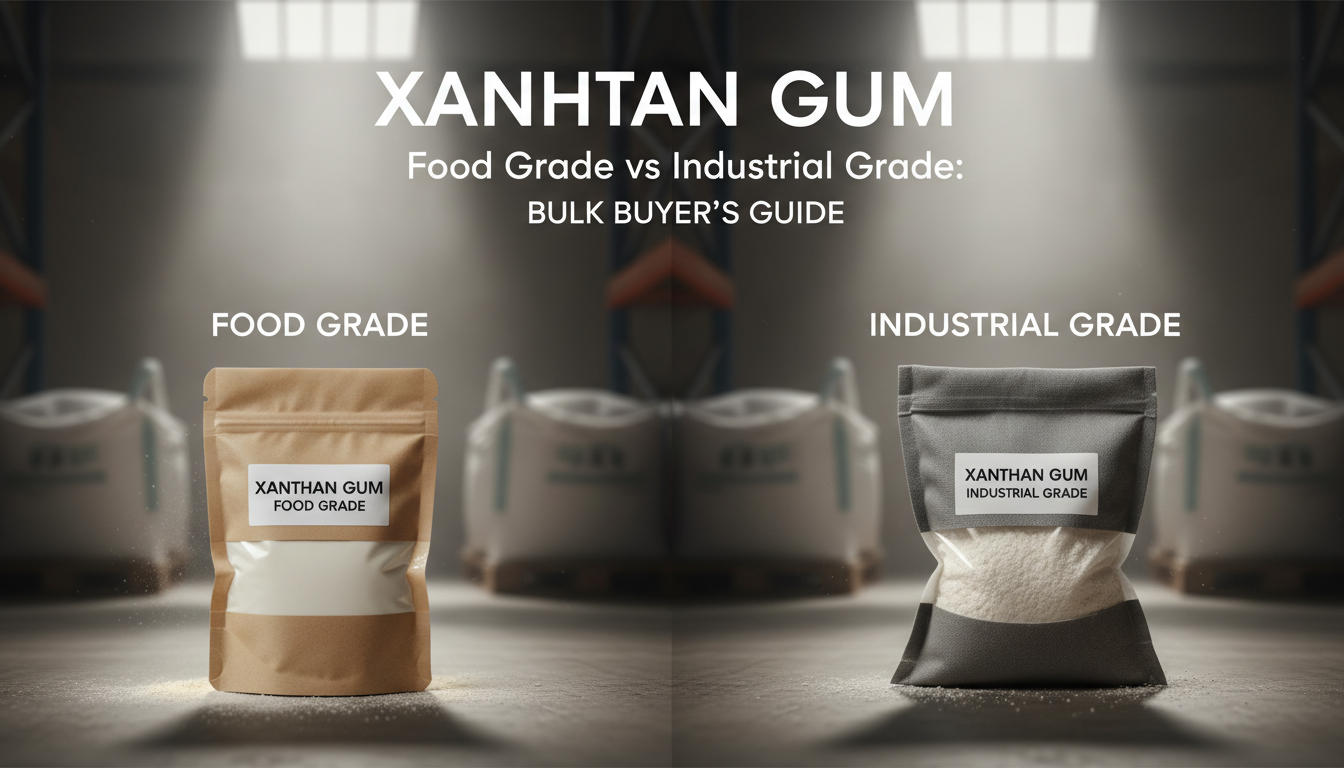
The confusion almost always starts at the purchase order. Xanthan gum food grade vs industrial grade sounds like a question about purity. It mostly isn’t. Both come off the same fermentation line. What separates them is particle size, viscosity consistency, documentation and testing — and those differences decide whether your batch behaves.
Here’s what to specify, and what to check when the drums arrive.
What Xanthan Gum Actually Is
It’s a polysaccharide, not a synthetic polymer. That distinction matters because it explains why batches vary at all — you’re buying the output of a living process, not a reaction vessel.
Production runs through fermentation. The bacterium Xanthomonas campestris is fed glucose or sucrose in an aerated, stirred medium for one to four days. The polymer is then precipitated with isopropyl alcohol, dried, and milled into water-soluble powder. That final milling step is where mesh size gets decided, and it’s the spec most buyers forget to name.
- CAS number: 11138-66-2
- E number: E415
- Monomer formula: C₃₅H₄₉O₂₉
- Approved for food use in the US, Canada and Europe since 1968
- EFSA reviewed it in 2017 and found no adverse effects, even at high intake
The Property You’re Actually Buying: Shear Thinning
Xanthan gum is pseudoplastic. Put it under shear — stirring, pumping, pouring — and it thins. Stop the shear and it thickens straight back up.
That single behaviour is why it shows up in such wildly different industries. A salad dressing that pours easily but clings to leaves, and a drilling mud that pumps down a well but suspends rock cuttings when circulation stops, are the same physics doing the same job.
Typical Use Levels
Dosing is low enough that small specification errors get amplified. You’re working in fractions of a percent, so a viscosity variance of 10% between batches is something your production floor will notice.
- Most food applications: 0.5% or less
- Emulsion stabilisation: from as little as 0.1%
- Foam systems: 0.2–0.8%
- Industrial suspensions: typically higher, and far less sensitive to mouthfeel
- Always confirm dosing against your own bench trial — supplier ranges are a starting point, not a spec
Food Grade vs Industrial Grade: What Actually Differs
Both grades are xanthan gum. The molecule is the same. What changes is everything wrapped around it — the milling, the testing, the paperwork and the price.
The table below is the version worth putting in front of your purchase team.
| Parameter | Food Grade (FCC) | Industrial Grade |
|---|---|---|
| Standard referenced | FCC / food pharmacopoeial | In-house or technical spec |
| Typical mesh | 80 mesh (standard), 200 mesh (fast dispersion) | Commonly coarser, mesh often unspecified |
| Viscosity tolerance | Tight, batch-verified | Wider band accepted |
| Heavy metals / microbial | Tested and reported per batch | Often not tested |
| Residual solvent (isopropanol) | Specified and limited | Usually not specified |
| Documentation | Batch COA, allergen and kosher/halal statements on request | Basic spec sheet |
| Typical use | Sauces, beverages, bakery, dairy, cosmetics | Drilling fluids, concrete, cleaning formulations |
| Cost | Higher | Lower |
One rule follows from this: if your product is eaten, drunk or applied to skin, food grade isn’t an upgrade you opt into. It’s the floor.
80 Mesh vs 200 Mesh — The Spec Most Buyers Skip
Ask for “food grade xanthan gum” and you’ll typically receive 80 mesh, because that’s the commercial default. Whether it suits your process is a separate question entirely.
Mesh is about how fast the powder hydrates and how easily it lumps — not about quality. Neither grind is better; they solve different problems.
When 80 Mesh Is Right
The workhorse grind, and the safer default for most wet-mix processes.
- Coarser particles wet out more gradually, which reduces clumping
- Well suited to high-shear mixers that can work the powder in
- Standard for sauces, dressings, bakery pre-mixes and most industrial uses
- Generally the cheaper and more widely stocked option
- Dust generation is lower, which your plant floor will appreciate
When 200 Mesh Earns Its Premium
Finer grind, faster hydration, and a real tendency to fish-eye if you dump it in badly.
- Disperses and builds viscosity noticeably quicker
- Preferred for instant and cold-water applications where mixing time is short
- Common in beverage powders, instant mixes and some cosmetic gels
- Needs proper dispersion — pre-blend with sugar or another dry carrier, or use a powder-induction system
- Costs more, so specify it only where the hydration speed is doing real work
Put the mesh on the purchase order every time. It costs nothing to state and it prevents the most avoidable batch complaint in the category.
Reading the COA Before You Accept the Drum
A spec sheet describes what the supplier sells in general. A certificate of analysis describes what’s in your drum. They aren’t the same document, and only one of them is worth much.
Five parameters carry most of the risk.
- Viscosity — usually reported at 1% solution in 1% KCl. Check the test conditions match across batches, not just the number
- Particle size / mesh — confirm it matches what you ordered, with the percentage passing stated
- Loss on drying — high moisture means you’re paying for water and risking caking in storage
- pH of solution — drifts affect stability in sensitive formulations
- Heavy metals and microbial counts — non-negotiable for food, pharma and cosmetic end use
If the batch number on the COA doesn’t match the batch number on the bag, treat the document as decorative and ask for the right one.
Storage and Handling in Bulk
Xanthan gum is hygroscopic. Left open in an Indian summer it will pull moisture out of the air and cake into something your dosing equipment can’t handle.
Nothing exotic is required — just discipline about resealing.
- Keep bags sealed; reseal immediately after partial withdrawal
- Store cool and dry, off the floor, away from direct sun
- Typical shelf life is around two years unopened — confirm against the COA date
- Don’t store food grade and industrial grade in the same bay without clear separation and labelling
- First in, first out, with the batch number tracked into your production records
FAQs About Xanthan Gum Grades
What is the difference between food grade and industrial grade xanthan gum?
The polymer is the same; the control around it differs. Food grade is manufactured and tested to FCC standards with batch-wise viscosity, heavy metal, microbial and residual solvent reporting. Industrial grade carries a basic specification check and a wider viscosity tolerance. Never substitute industrial grade into an ingestible or skin-contact product to save cost.
Which mesh size of xanthan gum should I order?
80 mesh for most wet processes with adequate mixing — it lumps less and costs less. 200 mesh where hydration speed matters, such as instant beverage powders or short-cycle cold mixes, and where you have a proper dispersion method. State the mesh explicitly on the PO; leaving it blank usually gets you 80 mesh by default.
How much xanthan gum do I need in a formulation?
Most food applications sit at 0.5% or below. Emulsions can stabilise from around 0.1%, and foam systems typically run 0.2–0.8%. Industrial suspensions generally use more. Treat published ranges as a starting point and confirm on your own bench trial, because mesh, viscosity grade and your other ingredients all shift the number.
Is xanthan gum safe as a food additive?
It has been approved for food use in the US, Canada and European countries since 1968 and carries the E number E415. EFSA re-evaluated it in 2017 and reported no adverse effects even at high intake levels. As with any additive, the safety position assumes food-grade material with proper documentation.
Why does viscosity vary between xanthan gum batches?
Because it’s a fermentation product, not a synthesised chemical. Feedstock, fermentation time and milling all introduce variation. That’s exactly why you compare COAs across two or three batches before committing to a supplier, and why you agree a viscosity tolerance band in writing up front.
Can I use xanthan gum in cosmetics and industrial products from the same stock?
You can, provided that stock is food or cosmetic grade with the right documentation — running the higher grade across both is a valid simplification. The reverse never works. Industrial-grade material lacks the testing that a skin-contact or ingestible product needs on file.
The Bottom Line
Specify three things and most xanthan gum problems disappear: the grade, the mesh, and the viscosity tolerance you’ll accept. Then check the batch COA against the bag before it goes anywhere near production.
It’s a five-minute discipline that protects a whole production run.
BulkFineChem supplies Food Grade and Industrial Grade Xanthan Gum in bulk packing to food processors, beverage brands, cosmetic manufacturers and industrial formulators across India — alongside Citric Acid, Sodium Bicarbonate, Dextrose, Lactose and the wider bulk ingredient range. Batch-wise COA, GST invoice, pan-India delivery. See the range at bulkfinechem.com or send your specification for a quote.