
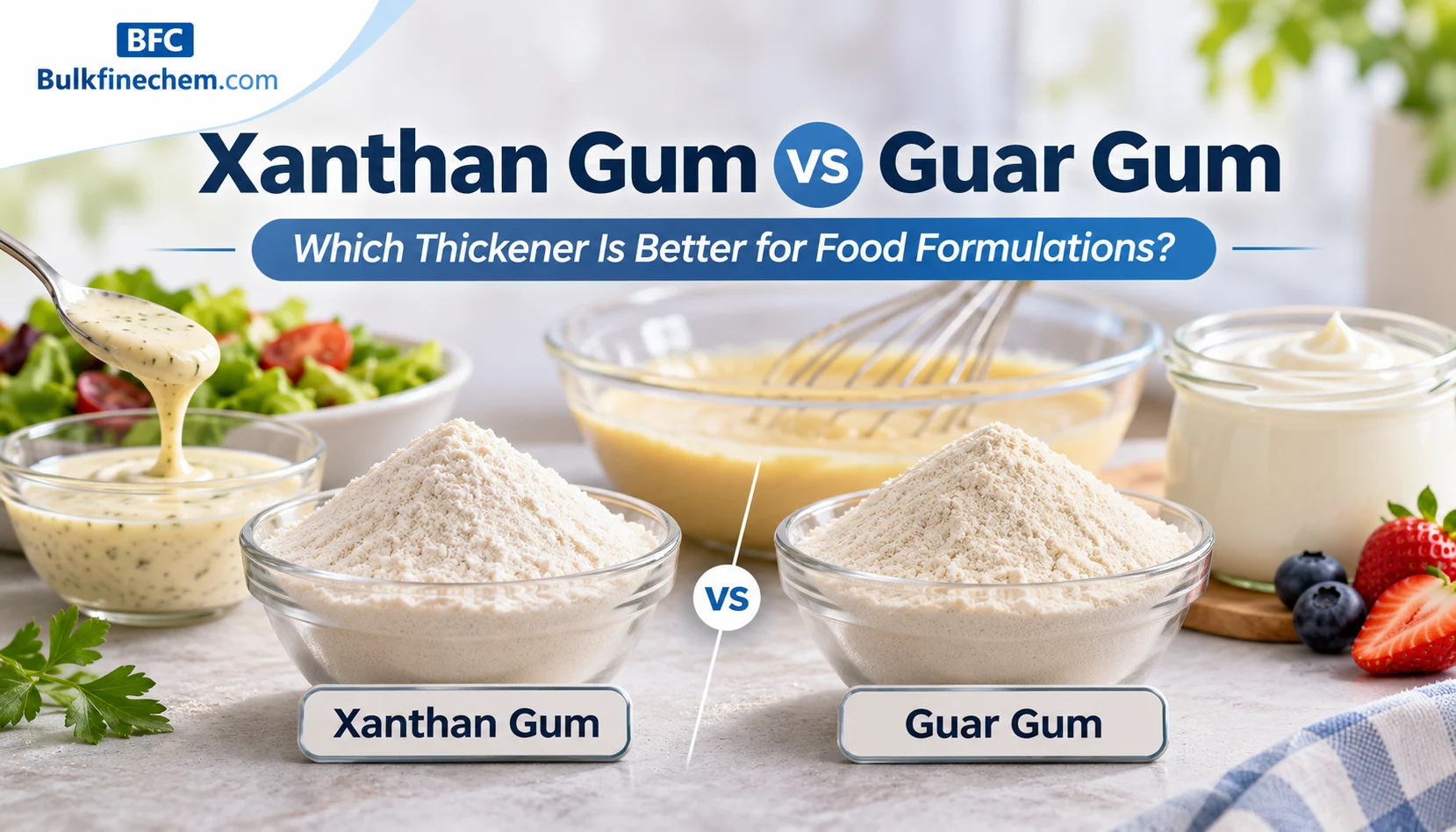
Xanthan gum vs guar gum is one of the most practical hydrocolloid comparisons for food formulators because both ingredients can thicken and stabilize products, yet they behave differently in water, under shear, across pH ranges and during heating. The right choice depends on the finished food, processing conditions, target texture and cost.
BulkFineChem supplies both Xanthan Gum Powder – Food & Industrial Grade and Guar Gum Powder – Food and Industrial Grade for food and industrial formulation buyers.
Xanthan Gum vs Guar Gum: Quick Comparison
| Factor | Xanthan Gum | Guar Gum |
|---|---|---|
| Primary role | Thickener, stabilizer and suspension aid | High-efficiency thickener and texture builder |
| Hydration | Usually hydrates readily in cold or hot water when properly dispersed | Hydrates well in water but can form lumps if added poorly |
| Shear behavior | Strong shear-thinning behavior | High viscosity but less pronounced shear-thinning profile |
| Acid/process tolerance | Often selected for acidic and demanding process conditions | Works well in many neutral and mildly acidic systems |
| Buyer focus | Viscosity, particle size, hydration and stability | Viscosity, mesh, moisture, hydration and cost |
What Is Xanthan Gum?
Xanthan gum is a fermentation-derived polysaccharide used as a thickener, stabilizer, suspending agent and rheology modifier. It is valued for building viscosity at low use levels and for maintaining useful texture across a wide range of processing conditions.
Common food applications
- Sauces and dressings
- Bakery fillings
- Dairy and dairy-alternative products
- Beverage systems
- Gluten-free bakery products
- Frozen foods
What Is Guar Gum?
Guar gum is a galactomannan obtained from guar seed and is widely used as a thickener, stabilizer and water-binding ingredient. BulkFineChem's listed guar gum grades can vary by viscosity, mesh size and intended application.
Common food applications
- Ice cream and dairy products
- Sauces and gravies
- Bakery formulations
- Dry mixes
- Pet food and feed systems
- General thickening applications
Key Difference 1: Viscosity Development
Guar gum is known for strong thickening efficiency, especially in water-based systems where rapid viscosity build is required. Xanthan also develops viscosity efficiently, but its biggest advantage is often how that viscosity behaves during mixing, pumping and pouring.
Why shear-thinning matters
Xanthan solutions can be thick while standing still, then become easier to pour or pump when shear is applied. This makes xanthan useful in dressings, sauces and suspensions where a product should stay stable on the shelf but still flow during use.
Key Difference 2: Hydration and Dispersion
Both gums must be dispersed correctly. If powder is added too quickly to water, the outside of a particle cluster can hydrate first and trap dry powder inside, creating persistent lumps.
Better dispersion methods
- Add slowly into a strong vortex
- Pre-blend with dry ingredients such as sugar where appropriate
- Pre-disperse in oil when the formulation allows it
- Use controlled high-shear mixing when required
Guar in particular can become difficult to disperse once lumps form, so process design should be confirmed during scale-up.
Key Difference 3: pH and Process Stability
Xanthan gum is often selected when a formulation must tolerate acidic conditions, temperature changes or repeated shear. Guar can perform very well in many neutral or mildly acidic systems but may lose viscosity more readily under harsher processing conditions.
The correct choice should be verified using the actual food matrix rather than a water-only lab test.
Key Difference 4: Texture and Mouthfeel
Hydrocolloids influence more than thickness. They can affect creaminess, body, suspension, pourability and perceived richness.
Xanthan texture
Xanthan can create a smooth, stable texture and helps keep particles suspended, but excessive use can produce an undesirable elastic or slimy character in some foods.
Guar texture
Guar can produce strong body and a creamy mouthfeel. Too much guar can create an overly heavy or gummy texture.
Key Difference 5: Cost and Use Level
The cheapest ingredient per kilogram is not necessarily the lowest-cost formulation. A gum that requires a lower dose, improves process stability or reduces product failure can be more economical overall.
Compare:
- Required use level
- Price per kilogram
- Processing losses
- Mixing time
- Texture consistency
- Finished-product stability
Can Xanthan Gum and Guar Gum Be Used Together?
Yes. In some formulations, combining gums can create a texture or viscosity profile that neither gum delivers alone. Blending can also help balance cost, mouthfeel, hydration and stability.
However, the optimum ratio depends on the food system and should be confirmed through formulation trials.
Which Gum Is Better for Sauces and Dressings?
Xanthan gum is often a strong starting point for sauces and dressings because its shear-thinning behavior supports suspension at rest while allowing the product to pour during use. Acidic formulations can also favor xanthan when stability is important.
Which Gum Is Better for Dairy and Frozen Products?
Guar gum is widely used in dairy and frozen systems for body and water management. Xanthan may also be used alone or in combination when additional suspension or process stability is required.
Which Gum Is Better for Gluten-Free Bakery?
Both can be useful. Xanthan is commonly selected for structure and dough/batter viscosity, while guar can contribute binding and moisture management. The best system depends on flour blend, hydration, fat level and final texture.
What Bulk Buyers Should Check on the COA
A buyer should compare the actual batch against the agreed formulation specification.
- Product identity
- Viscosity
- Moisture
- Particle size or mesh
- pH where specified
- Ash or purity-related parameters where required
- Microbiological limits for food use
- Batch number and test date
Storage and Handling
Both gums should be stored dry and protected from contamination. Moisture can cause lumping, poor flow and handling problems.
Receiving checklist
- Check bag and liner integrity
- Confirm the batch number
- Match the batch COA
- Inspect for moisture damage or caking
- Store off the floor in a dry area
How to Choose Between Xanthan and Guar Gum
- Define the target texture. Decide whether suspension, thickening, creaminess or pourability is most important.
- Map the process. Consider pH, heat, shear and freeze-thaw conditions.
- Compare hydration behavior. Test how each gum disperses in the actual process.
- Measure viscosity over time. Do not rely only on initial viscosity.
- Check sensory quality. Evaluate mouthfeel, tackiness and after-feel.
- Calculate total formulation cost. Compare use level and process performance, not just price per kilogram.
Frequently Asked Questions
Is xanthan gum stronger than guar gum?
Not universally. Guar can produce very high viscosity, while xanthan often provides stronger process stability and shear-thinning behavior. The better choice depends on the formula.
Which gum hydrates faster?
Xanthan often hydrates readily when properly dispersed, while guar can also hydrate quickly but is especially prone to lumping if added poorly.
Which gum is better for acidic foods?
Xanthan is often preferred in more acidic systems because of its useful viscosity stability under demanding conditions.
Can xanthan and guar gum be blended?
Yes. Blends can be used to balance viscosity, texture, process stability and cost.
What should a food buyer check on the COA?
Review viscosity, moisture, particle size, food-grade quality parameters, microbiology where required and the exact batch identity.
Why do gum powders form lumps?
The outside of a powder cluster can hydrate before the inside disperses. Controlled addition and strong mixing help prevent this.
Does BulkFineChem supply both gums?
Yes. BulkFineChem lists both Xanthan Gum Powder and Guar Gum Powder in food and industrial grades.
Conclusion
The xanthan gum vs guar gum decision should be based on viscosity behavior, hydration, pH, shear, texture and total formulation cost. Xanthan can be especially useful where suspension and process stability matter, while guar can be attractive when strong thickening and cost efficiency are priorities.
Need a bulk quote? Review the BulkFineChem xanthan gum and guar gum product pages and share your required grade, viscosity, mesh, quantity, packaging and application with the BulkFineChem team.