
A cumin container that clears the port of Mundra and gets held up at the destination usually fails on two lines of the certificate of analysis. One is moisture. The other is ash. Everything else on the sheet, colour, size, even aroma, is easier for the buyer to forgive.
If you are buying bulk cumin for re-export or for a grinding line, this guide gives the numbers that decide whether a lot passes, explains what pushes each number out of range, and covers the packing and storage checks that protect those numbers between Vadodara and the destination warehouse.
What Cumin Seed Moisture and Ash Actually Measure
Moisture is the water left in the seed after drying and cleaning, reported as a percentage of sample weight. It is the number that decides whether the lot will stay stable in a container, and it is the first figure that moves when bags sit on an open yard through the Gujarat monsoon.
Ash is what remains after the seed is burnt off at high temperature. It tells you how much mineral matter is present, which is where soil, sand and dust from the threshing floor show up. A separate acid-insoluble ash figure narrows that down further to the silica fraction, so a buyer can see whether the residue is seed mineral or ground stone.
The two numbers are connected in practice. A lot dried properly but handled roughly on a concrete floor can pass on moisture and still fail on acid-insoluble ash. A lot cleaned well but stored in damp jute can pass on ash and arrive caked and mouldy.
The Specification Lines That Decide Acceptance
Most cumin contracts quote the same short block of figures. The ranges below are typical for cleaned and sorted seed moving in bulk from Indian markets; always confirm the exact limits against your own purchase contract and the buyer's destination requirements.
| Parameter | Typical Range | What It Tells You |
|---|---|---|
| Moisture (%) | 8-10 | Field drying and storage stability |
| Total Ash (%) | 9-13 | Overall mineral and soil residue |
| Acid Insoluble Ash (%) | 0.3-3 | Sand and silica from the threshing floor |
| Foreign Matter (%) | 0.5-2 | Stalk, stones, other seeds and dust |
| Volatile Oil (%) | 2.5-4 | Freshness and whether the aroma survived storage |
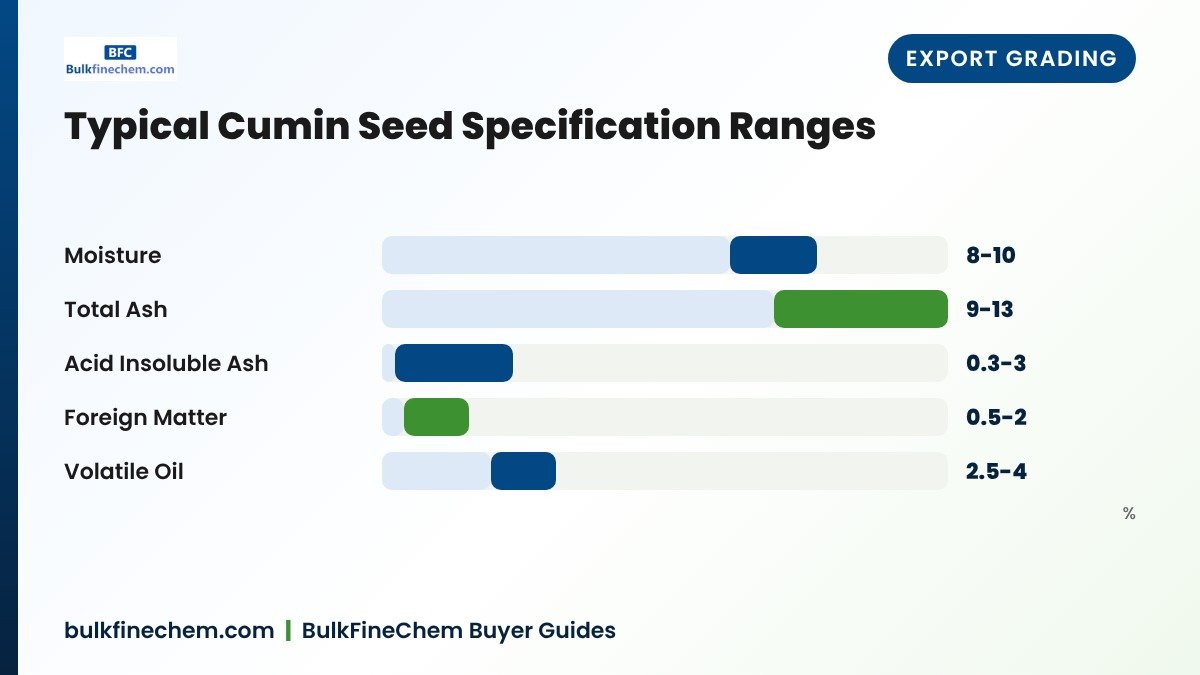
Moisture at 8-10% is the practical target for seed that will sit in a container for weeks. Below 8% the seed becomes brittle and loses fines in handling; above 10% you are inviting caking and mould. Total ash between 9-13% is normal for genuine cumin, because the seed itself carries mineral matter. Acid insoluble ash held to 0.3-3% is the line that separates a clean lot from one that picked up soil. Foreign matter under 0.5-2% reflects how well the destoner and indent sorter ran. Volatile oil in the 2.5-4% band tells you the lot is recent and was not over-heated during drying.
Why Lots Fail After They Leave the Warehouse
A certificate that reads clean on the dispatch day can read badly thirty-five days later at sea. The usual causes are specific and mostly avoidable.
- Container sweat. Moisture in the headspace of the container condenses on the steel walls at night and drips back on the top layer of bags, which is why pallet-level stowage and desiccant matter.
- Monsoon bagging. Seed dried to 9% in July and bagged into jute that absorbed humidity on the yard can gain a point or two before the truck even leaves.
- Over-drying to hit a number. Sun-drying below 8% makes the seed look excellent on the certificate and lose volatile oil at the same time, so the aroma test fails instead.
- Floor sweeping in the cleaning line. Recycled floor stock blended into a clean lot raises acid insoluble ash sharply while leaving the visual grade untouched.
- Old stock blended with new. Aged cumin sits at the lower end of the volatile oil range and drags a mixed lot below the buyer's minimum.
A certificate that reads clean on the dispatch day can still fail at the destination if the packing cannot hold the moisture where you put it.
How to Grade a Lot Before You Commit
Grading is a short sequence, and the order matters more than the equipment. Sample first, then test, then decide.
- Sample across the lot. Pull from multiple bags at different heights and pallets, not from three bags at the door. A composite sample is the only fair basis for a decision.
- Weigh the moisture first. Run the moisture test on the composite before anything else, because every other result is reported against a changing weight.
- Split the foreign matter. Sieve a known weight and separate stalk, stones, dust and other seeds. Report it as a percentage of that weight.
- Burn for ash. Run total ash and acid insoluble ash on the same ground sample so the two figures are comparable.
- Check oil and appearance. A quick volatile oil determination plus a visual and aroma check catches old stock that the chemical figures alone will not show.
- Compare against the contract, not the market norm. Write the agreed limits on the sample bag and reject against those, so a dispute later has a fixed reference.
Keep the retained sample from each lot. If a destination lab reports a different figure, the retained sample is what settles whether the difference came from the lot or from the handling after dispatch.
Moisture Control Through Gujarat Storage Months
Season changes the plan. Between March and June, ambient heat in a Vadodara warehouse drives moisture out of the seed unevenly, and the top layer of a stack dries faster than the core. Between June and September, the risk reverses: jute absorbs humidity, and seed resting on a bare floor picks up moisture from the slab.
The practical controls are unglamorous and effective.
- Use pallets, always. Keep every stack off the slab and away from walls so air moves under and around the bags.
- Cover before the rains. Close the warehouse openings during monsoon and run the stacking plan so older lots move out first.
- Re-test before dispatch. A lot that read 9% in August should be re-checked in October, not assumed.
- Do not chase a low number. A lot at 9.5% bagged into dry packing beats a lot sun-dried to 7.5% and stripped of oil.
- Segregate by arrival batch. Mixing a new arrival with old stock is the fastest way to make a specification unpredictable.
For the wider picture on how Indian agro lots are inspected before export, this Bulk export sourcing guide for agro produce and spices covers the sampling and documentation stage in more detail.
Packing Options and What They Do to the Numbers
Packing is not just about carrying weight. It decides how much the moisture figure moves during transit and how consistent your net weights stay across a container.
| Packing | Net Weight (kg) | Typical Transit Moisture Gain (%) | Tare Variation (kg) |
|---|---|---|---|
| New jute bag | 50 | 1-2 | 0.3-0.5 |
| PP woven bag with liner | 50 | 0.5-1 | 0.1-0.2 |
| PP bag with liner, vacuum option | 25 | 0.3-0.5 | 0.05-0.1 |

New jute is cheap and strong but hygroscopic, so expect the moisture figure to drift up by 1-2% on a long monsoon-route transit. A lined PP woven bag at the same 50 kg net holds the figure within half a point to one point and gives steadier tare weights for net-weight contracts. The 25 kg lined format costs more in packing and is the choice when the buyer is re-packing into retail and cannot accept any caking. Whatever the format, the bags must be food-grade, clean and odour-free, and the pallets must be fumigated and marked for the destination market.
Safety, Handling and Warehouse Hygiene
Cumin seed is a food raw material, so the handling rules are about contamination control rather than chemical hazard.
- Follow the SDS and food handling rules. Ask the supplier for the Safety Data Sheet and handle the lot under your own HACCP or GMP programme.
- Keep the sampling area clean. Sweep the sampling point before each lot so the sample does not pick up residue from the previous one.
- Isolate rejected lots. A lot held for re-inspection must sit away from accepted stock, clearly marked.
- Control pests in the stack. Routine monitoring of the storage area matters more than any single treatment, and any treatment must be legal for the destination market.
- Handle dust with basic PPE. Fine spice dust in a cleaning line warrants a proper mask and eye protection for the operator.
What to Check Before Buying in Bulk
Before confirming a container, put these items in writing with the supplier.
- Contract limits. The exact maximum moisture, maximum total ash, maximum acid insoluble ash and minimum volatile oil, agreed before the lot is bagged.
- Certificate of Analysis. Lot-specific figures with the test methods and the sampling basis, not a generic specification sheet. Compare it line by line using How to read a certificate of analysis.
- Sampling agreement. Who samples, from how many bags, and where the retained sample is kept for thirty days.
- Packing and pallet spec. Bag type, liner, net weight, pallet fumigation marks and the destination market's labelling rules.
- Documents. Commercial invoice with GST details, packing list, phytosanitary certificate and the export paperwork your buyer's customs authority expects.
- Grading basis. Whether the price is on cleaned sorted seed or on as-is market stock, since the two behave differently on the ash line.
For the cleaning and de-stoning stage that sits behind a good foreign matter figure, our Bulk export quality cumin seeds are supplied in bagged bulk lots with grade and specification confirmed before dispatch. Related lots on the site include Dry red chilli export quality and the Turmeric fingers versus powder comparison, both of which turn on the same moisture and foreign matter logic. The document set itself is covered in COA vs SDS vs TDS.
Frequently Asked Questions
What is the ideal moisture content for export cumin seed?
Most export contracts hold cleaned cumin seed between 8 and 10%. Below 8% the seed turns brittle and loses volatile oil, above 10% it cakes and is at risk of mould in transit. Confirm the exact limit in your contract.
Why is acid insoluble ash more telling than total ash?
Total ash includes the natural minerals in the seed, so a genuine lot can read high and still be clean. Acid insoluble ash isolates the silica fraction, which is where soil and sand from the threshing floor show up.
How much moisture can cumin gain during sea transit?
In new jute on a monsoon route a lot can gain around 1 to 2 percentage points over a long transit. A lined woven bag typically holds that drift to half a point or one point. Actual movement depends on the route, the season and the stowage.
How should a bulk cumin lot be sampled?
Draw from multiple bags at different heights and across pallets and combine them into one composite sample. Test the composite, never a single bag, and retain part of it for thirty days in case the destination lab reports a different figure.
Does sun drying improve the cumin specification?
Not always. Sun drying can push moisture below the contract range while driving off volatile oil, so the lot passes on moisture and fails on aroma. Mechanical or shade drying with a moisture check at the end gives a steadier result.
What documents should accompany a bulk cumin export order?
A lot-specific certificate of analysis with test methods, the safety data sheet, commercial invoice with GST details, packing list and the phytosanitary certificate your buyer's customs authority requires. Grade and specification should be confirmed before dispatch.
Conclusion
Cumin seed moisture and ash are the two lines that decide an export lot, and both are controlled long before the container is sealed: in the drying yard, in the cleaning line, in the bag you choose and in the warehouse where the lot waits for the vessel. Hold moisture at 8-10%, keep acid insoluble ash low through clean handling, and re-test rather than assume after storage.
Need a quote? Send your requirement to the BulkFineChem team with grade, quantity and destination, or browse All products.
Disclaimer: This article is general technical and procurement information. Always follow the product's Safety Data Sheet, Technical Data Sheet and the regulations that apply to your industry, and confirm suitability with trials before full-scale use.