
A bakery mix plant near Ahmedabad keeps one dextrose silo and switches suppliers between seasons. When a lot of dextrose monohydrate vs anhydrous arrives without the hydrate form clearly stated on the bags, the first sign is not in the lab report. It is the dough being a shade softer than usual, the free-flow agent working harder, and a hopper that bridges on a humid July morning. Hydrate form is a specification line, and it changes recipe maths, flow behaviour and sweetness per kilogram.
BulkFineChem supplies Dextrose Monohydrate Powder DextroPro for bakery mixes, dry blend food plants, beverage and nutrition manufacturing, fermentation and industrial formulation, in bulk packing with a Certificate of Analysis for every consignment.
Why the Hydrate Form Matters in a Dry Blend
Dextrose (glucose) is sold as the monohydrate, in which each molecule carries one molecule of water of crystallisation, and as the anhydrous form with most of that water removed. On the label both are simply dextrose, so buyers often treat the two as interchangeable. In a dry blend they are not. The hydration water is part of the powder's mass, so one kilogram of monohydrate delivers slightly less dextrose solids than one kilogram of anhydrous, and the moisture you measure on the COA is not the same thing as that hydration water.
Three practical consequences follow. Recipe maths in a dry mix must be converted when the hydrate form changes. Bulk density changes, which affects how a volumetric filler or a screw feeder delivers a target weight. And surface behaviour changes, which affects how the powder flows through a hopper in Gujarat or Maharashtra humidity.

Hydration Water, Purity and What the COA Actually Reports
Read the COA in this order. First the identity and assay line, which confirms the dextrose content on the stated basis. Then the loss on drying or moisture figure, which tells you how much water the lot carries. Then the ash and clarity lines, which speak to refining quality. Then microbiological limits and any allergen statement, which the food plant's QC file needs.
Ask one question of every figure: on what basis is it reported? A purity of "not less than 99.5 percent, dried basis" and a purity of "not less than 99.5 percent, as is" are not the same number for the same powder, because the water is excluded in one and included in the other. This is the single most common source of confusion when a plant compares two suppliers' COAs side by side. Our guide to how to read a certificate of analysis covers the same point across ingredient categories.
Specification Table: What to Compare Line by Line
Use a table like this in your own incoming-material specification, and ask the supplier to confirm the basis for each line before you place a trial order.
| Parameter | Monohydrate | Anhydrous |
|---|---|---|
| Water of hydration | About 7 to 9 percent | Usually 1 percent or less |
| Dextrose solids per kg | Slightly lower | Slightly higher |
| Sweetness per kg of powder | Lower | Marginally higher |
| Typical use | Bakery mixes, dry blends, beverage, fermentation | Moisture-sensitive dry blends, extruded and low-moisture systems |
| Behaviour in humid stores | Free-flowing when dry and sealed | Readily absorbs surface moisture, cakes faster |
Treat the ranges in the table as typical, not as a purchase limit. Your signed specification and the supplier's Technical Data Sheet are the reference.
Recipe Conversion When You Switch Forms
The conversion is arithmetic, not a judgement call. Because monohydrate carries roughly 7 to 9 percent water of hydration, a dry blend formulated on anhydrous dextrose needs a slightly higher weight of monohydrate to deliver the same dextrose solids, and the other way round when you move to anhydrous. Do the conversion on the hydration figure stated on your own COA, not on a textbook number, and record it as a controlled change in your formulation file.
Switching dextrose hydrate forms without re-weighing the dry blend changes your recipe, your sweetness and your moisture, all on the same day.
Two side effects to watch during the trial. In a yeast-leavened mix the available sugar level influences fermentation rate, so a plant that changes forms mid-production may see proof times shift slightly even though nothing else moved. In a powdered drink mix or an icing blend, sweetness perception per gram of powder changes, which the sensory panel notices before the lab does. Related reading on how ingredient grades drive these small shifts is in our xanthan gum food industry buying guide.
Particle Size and Bulk Density in a Dry Blend
Hydrate form is not the only variable. Dextrose monohydrate is normally crystalline and granular, while dextrose anhydrous is often milled finer. Particle size and bulk density decide three things on your plant floor: how much a given scoop or volumetric cup actually weighs, how fast the powder dissolves in a wet mix, and how much air it traps when you pack it into a pouch.
- Filler accuracy. A plant filling by volume must recalibrate the setting when bulk density changes, even if the recipe is untouched.
- Dissolution. Finer powder wets and dissolves faster, which matters in instant mixes and dry beverage powders.
- Dust and dust recovery. Fine anhydrous powders raise dust at the bag dump station, which is a housekeeping, yield and cross-contamination question.
- Blend uniformity. In a ribbon blender, a wide difference in particle size between dextrose and the minor ingredients can lead to segregation during handling.
Ask for the mesh or sieve analysis and the packed bulk density in writing, and check both on the first trial lot against the figures you formulated with.
Quality Checks Before You Accept a Dextrose Delivery
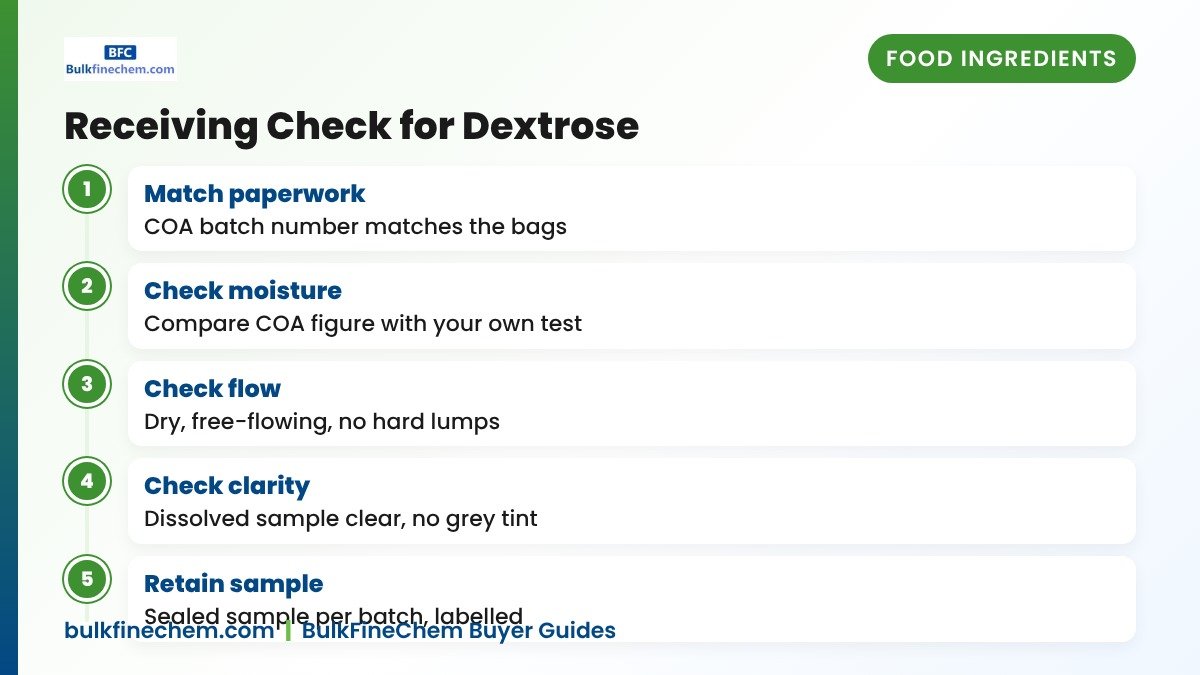
Food-grade dextrose should arrive with a documented quality record, not just a product name. Build your receiving checklist around the parameters below, and keep the retained sample from every lot for the shelf life of the finished goods made from it.
- Match the paperwork to the load. Confirm the product name, hydrate form, batch number, manufacturing and expiry dates and net weight on the delivery against the COA for that exact batch.
- Check moisture and loss on drying. Compare the COA figure with your own quick moisture check on a composite sample drawn from several bags across the load.
- Check appearance and flow. Free-flowing, dry, free-lumping white powder with no off odour. Any hardness that breaks only with force points to moisture ingress in transit or storage.
- Check solution clarity and colour. A dissolved sample should give a clear solution with no grey tint, which is a fast screen on refining quality.
- Check ash and microbiological limits. Confirm sulphated ash and the stated microbiological results are within your specification, and that the COA carries the test methods.
- Draw and retain a sample. Keep a sealed retained sample per batch, labelled with the batch number, for the life of the finished product.
Storage, Caking and Monsoon Handling
Dextrose is hygroscopic. In Indian warehouse conditions the risk is not chemical hazard, it is water: caking, colour pickup at the bag mouth and, in a badly sealed store, microbial growth in a damp crust. Dextrose is not a hazardous material in transport or storage terms, so the controls are housekeeping controls.
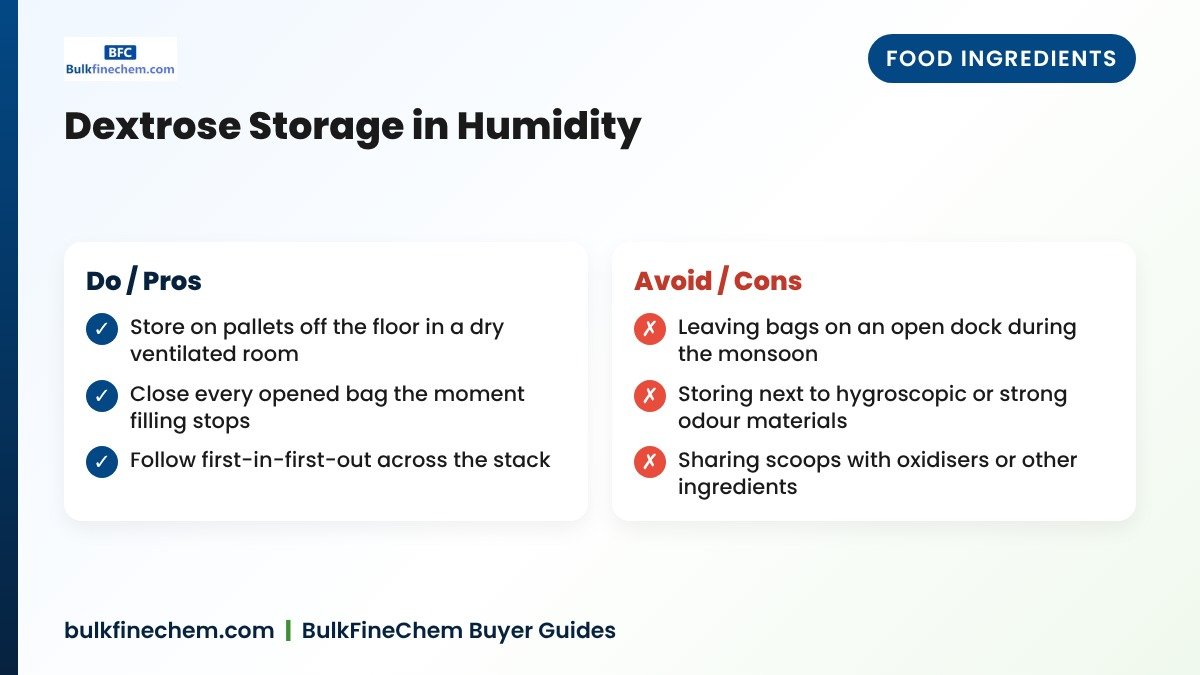
- Store on pallets, off the floor and away from outside walls, in a cool, dry, well-ventilated room.
- Keep bags sealed until the moment of use and close every opened bag. Once a bag is cut, the remaining powder is exposed to room humidity.
- During the June to September monsoon, hold deliveries in a covered staging area and move stock straight to the store instead of leaving it on an open dock.
- Practice first-in-first-out. Long residence in a humid store is the most common cause of a hardened bag at the bottom of a stack.
- Do not store dextrose beside hygroscopic or strongly odorous materials, and never share a scoop or shovel with a strong oxidiser or another ingredient.
- Follow good housekeeping and the product's SDS for dust control at the bag dump station, and clean spills immediately to keep the floor safe.
For a broader look at how Indian humidity affects ingredient handling, see our cold pressed vs refined carrier oils guide, which treats the same moisture problem from the oil side, and our agro produce and spices export sourcing guide for moisture limits in a different ingredient class.
Frequently Asked Questions
What is the difference between dextrose monohydrate and dextrose anhydrous?
Monohydrate crystals carry one molecule of water of crystallisation, typically around 7 to 9 percent of the powder's weight, while anhydrous dextrose has most of that water removed and usually tests at 1 percent or less. Both are dextrose (glucose) on the label, but the hydration water changes dextrose solids per kilogram, sweetness and bulk density.
Can I replace dextrose anhydrous with monohydrate in a dry bakery mix without changing the recipe?
Not without a conversion. Because monohydrate carries hydration water, the same weight delivers slightly less dextrose solids, so the blend needs re-weighing and a documented formulation change. Run a trial batch and check proof time, sweetness and finished moisture before releasing the change.
Does dextrose hydrate form affect sweetness?
Yes, slightly. Anhydrous dextrose has more dextrose solids per kilogram of powder, so it tastes marginally sweeter at the same powder weight. The difference is small but a sensory panel can detect it in an icing or a powdered drink mix.
Which dextrose is better for humid Indian warehouses?
Neither form fixes storage on its own. Anhydrous dextrose tends to pick up surface moisture and cake faster, while dry, sealed monohydrate generally stays free-flowing. Pallet storage off the floor, sealed bags, covered dock handling in the monsoon and first-in-first-out matter more than the hydrate form.
What should I check on a dextrose COA before accepting a bulk order?
Confirm the hydrate form and batch number, the assay with its reporting basis, loss on drying or moisture, sulphated ash, solution clarity and colour, and the stated microbiological limits with test methods. Keep a retained sample from every lot for the shelf life of the finished product.
Is dextrose a hazardous material for storage and transport?
Dextrose is not treated as a hazardous material in ordinary transport and storage. The practical controls are good housekeeping: dust control at the bag dump station, prompt cleanup of spills, sealed bags and dry pallet storage. Follow the product's SDS for handling guidance.
Sourcing Dextrose From BulkFineChem
If your plant buys dextrose for bakery mixes, dry blends, beverages or nutrition manufacturing, the specification you sign should state the hydrate form, the basis of the purity figure, moisture, mesh or particle size, packed bulk density and the microbiological limits you will test. BulkFineChem supplies bulk dextrose with COA and SDS available with orders, grade and specification confirmed before dispatch, and packing suited to food plant handling. Tell us the application, quantity, packing and destination. Send your requirement to the BulkFineChem team or browse the full product range.
Disclaimer: This article is general technical and procurement information. Always follow the product's Safety Data Sheet, Technical Data Sheet and the regulations that apply to your industry, and confirm suitability with trials before full-scale use.