

Disodium EDTA vs Tetrasodium EDTA: Industrial Uses, Differences and Bulk Buying Guide
Disodium EDTA vs tetrasodium EDTA is a meaningful specification choice for detergent manufacturers, textile processors, cleaning-product formulators and other industrial buyers. These compounds belong to the ethylenediaminetetraacetic acid (EDTA) family of metal-ion chelating agents, but their counter-ion content, solution pH and formulation behaviour are not identical. Choosing a grade solely by its price or the letters “EDTA” can lead to an unsuitable product for the intended processing conditions.
This guide explains what the different EDTA forms do, how to shortlist the correct grade, and what to request from a supplier before buying in bulk in India. It is a purchasing overview; final selection should follow a formulation trial, application-specific rules and the supplier's current technical and safety data sheets.
What Is EDTA and What Does a Chelating Agent Do?
EDTA is a chelating agent that can bind dissolved metal ions such as calcium, magnesium, iron and copper. By forming soluble complexes under suitable conditions, it helps formulators manage hardness, unwanted metal-catalysed reactions and certain precipitation problems. Actual effectiveness depends on solution pH, metal identity, competing ingredients and the chosen EDTA form.
EDTA acid and sodium salts
The free acid, disodium, trisodium and tetrasodium forms are chemically related but have different molecular masses and acid-base properties. The sodium salts are commonly chosen in water-based formulations because they can be easier to incorporate than poorly water-soluble EDTA free acid. Note that the anhydrous and hydrated forms of any salt are not equivalent on a kilogram-for-kilogram active-content basis.
Why the EDTA salt form matters
Disodium EDTA is often supplied as a mildly acidic solid, commonly in a dihydrate form. Tetrasodium EDTA is a more alkaline salt. Their aqueous solutions can therefore influence formulation pH differently. However, EDTA's chelating action is not limited to a single fixed pH range based solely on the product label.
Disodium EDTA vs Tetrasodium EDTA: Key Differences
Both salts contain an EDTA-derived ligand, but they differ in sodium substitution and acid-base behaviour. Confirm exact chemical identity and assay from the supplier's technical data sheet rather than using a generic name alone.
| Comparison | Disodium EDTA | Tetrasodium EDTA |
|---|---|---|
| Salt form | Two sodium counter-ions | Four sodium counter-ions |
| Typical solution character | Often acidic to mildly acidic at specified concentration | Generally alkaline at specified concentration |
| Common formulation screening | Products where pH adjustment and stability must be controlled | Alkaline cleaners and other high-pH systems |
| Product verification | Specify exact salt, hydrate, assay and concentration | Specify exact salt, hydrate or solution strength and assay |
| Interchangeability | Not automatically interchangeable | Not automatically interchangeable |
Manufacturer technical documents for commercial EDTA chelating agents, including Dow's VERSENE product family, describe multiple EDTA salts and solution grades. A supplier's documented product characteristics should control any comparison of actual values.
What About EDTA Free Acid?
EDTA free acid is useful as a distinct starting material or for applications that specifically require the acid form. It has comparatively low solubility in water at ordinary conditions. Industrial formulators frequently choose a suitable sodium salt when a water-based chelating agent is required, but the correct selection also depends on final pH and process chemistry.
Do not confuse acid with disodium EDTA
The names are not interchangeable. EDTA free acid has a different formula mass and protonation state from its sodium salts. A purchase order should explicitly identify the requested material and hydrate state, together with a test method for purity or active content.
Where Are Disodium and Tetrasodium EDTA Used?
Industrial uses overlap because the compounds share chelating chemistry. Which grade works best depends on the wider formulation, not solely on a generic application label.
Detergents and industrial cleaning
EDTA salts can sequester hardness ions and help limit interference from dissolved metals. Tetrasodium EDTA is often evaluated for alkaline cleaning formulas; disodium grades may be more convenient in other formulations. The technical team should assess the ingredient's pH impact and required chelation capacity.
Textile processing and dyeing
Controlling unwanted metal ions can improve process consistency during some textile operations. Selection should consider water chemistry, processing pH, dye system and the customer's wastewater-discharge requirements.
Personal-care and other formulations
Selected EDTA salts are used to help maintain formulation stability by controlling trace metals. Cosmetic, food and pharmaceutical uses may require specific permitted grades, regulatory reviews and purity standards. Never assume an industrial grade qualifies for those uses.
Agricultural formulations
EDTA-related chelation chemistry is used in certain micronutrient products, but a finished chelated micronutrient is not equivalent to a bag of plain EDTA salt. The intended metal complex and any applicable fertilizer specifications must be verified separately.
How to Choose the Correct EDTA Grade
Begin with your manufacturing process and a written chemical specification. A useful purchasing evaluation covers performance, technical acceptance and the total delivered cost.
1. Identify working pH and target metals
State the actual operating pH range and which ions you need to manage. Chelation behaviour can vary with pH and competing chemistry, so a product should be qualified in the complete formulation or process stream.
2. Compare active content on the same basis
A quote may be for anhydrous powder, hydrated powder or aqueous solution. Compare price per verified unit of relevant EDTA active or chelation capacity rather than comparing the price of two differently constituted products directly.
3. Check formulation compatibility
Evaluate clarity, precipitation, product pH, stability and downstream effects during a controlled trial. A grade change may require corresponding formulation adjustments and should not be treated as a simple direct substitution.
4. Review sustainability and wastewater requirements
EDTA is persistent under many environmental conditions and can influence metal mobility. If wastewater discharge is material to the process, consider site permit requirements, wastewater treatment compatibility and whether suitable alternatives can achieve the same purpose.
What Should Be on the Certificate of Analysis?
A batch-specific Certificate of Analysis (CoA) should tie the offered material to measurable acceptance criteria. Useful fields may include:
- Exact chemical name and salt form, with CAS number corresponding to the particular material
- Hydration state and assay or active-content basis
- Chelation value or equivalent measurement where specified by the buyer
- pH at a stated test concentration, if relevant to the grade
- Moisture, insoluble matter and other application-specific impurity limits
- Batch identification, testing date and traceability information
Request the current Safety Data Sheet (SDS) and Technical Data Sheet (TDS) as well. For a detailed guide, see how to read a Certificate of Analysis.
Bulk EDTA Supply in India
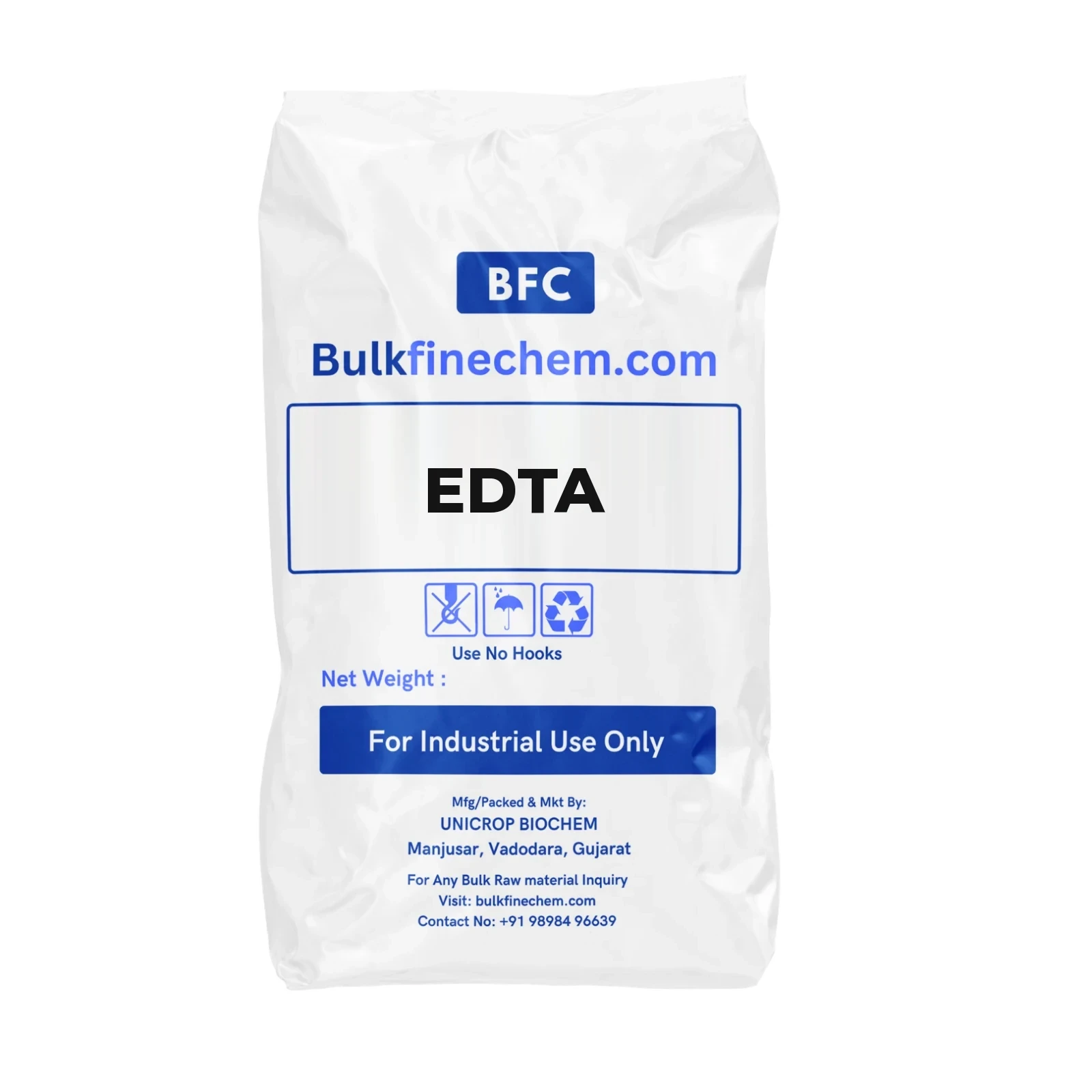
BulkFineChem lists EDTA – Ethylenediaminetetraacetic Acid and Salts, including acid, disodium, trisodium and tetrasodium grades. The listing describes white crystalline powder, packing in 25 kg HDPE bags or fibre drums, a 100 kg minimum order quantity, and a batch CoA with dispatch. These are catalogue details; confirm the available form, specification and packaging at the time of enquiry.
Information to include in your enquiry
- Exact form: EDTA acid, disodium, trisodium or tetrasodium
- Required purity, hydrate state, solution strength or chelation specification
- Intended industry and process working-pH range
- Requested quantity, frequency, packaging and Indian delivery location
- Required TDS, SDS and batch CoA
- Any application-specific certification or testing requirements
For broader procurement planning, see our bulk chemical supplier checklist.
Safe Storage and Handling
Use the applicable SDS for each particular EDTA grade. Avoid uncontrolled dust exposure, wear appropriate personal protective equipment, and keep the product in suitable sealed packaging away from contamination and moisture. Separate incompatible substances according to the SDS. Since chemical-specific and environmental requirements can differ across EDTA grades, do not treat a general low-hazard description as a reason to omit workplace controls.
Frequently Asked Questions
1. Are disodium EDTA and tetrasodium EDTA the same chemical?
No. They are different sodium salts of EDTA. Although both are chelating agents, their acid-base properties, formulas, and likely impact on formulation pH differ.
2. Which EDTA salt works better in alkaline detergent products?
Tetrasodium EDTA is often evaluated for alkaline formulations, but the appropriate choice should be determined by the final formulation and verified performance tests.
3. Can disodium EDTA be replaced directly with tetrasodium EDTA?
Not without review. The forms have different molecular masses, active content and pH characteristics. Technical approval and formulation validation are required before substitution.
4. Is EDTA free acid soluble in water?
EDTA free acid has relatively poor water solubility compared with several sodium salt grades. Choose a chemical form based on the actual process and solvent system.
5. Is industrial EDTA suitable for cosmetics or food?
Not automatically. Those applications require a grade with the appropriate purity, regulatory permissions and supporting documentation. Do not infer food or cosmetic compliance from an industrial product listing.
6. Which documents should a bulk EDTA buyer request?
Request a specific chemical identity, batch CoA, TDS and SDS, along with the appropriate purity, salt-form and packing details. Verify any application-specific compliance documentation independently.
Conclusion: Match the EDTA Salt to the Process
The answer to disodium EDTA vs tetrasodium EDTA depends on the formulation's working pH, required metal-ion control, dosing system, grade specification and downstream requirements. Compare actual tested materials and overall costs instead of relying on a generic product name.
Need EDTA for an industrial application? Review BulkFineChem's EDTA product listing and send the exact grade, quantity, delivery location, application and required technical specification to request a quotation and batch documents.