

A dry mix that runs clean on a Tuesday morning and bridges in the hopper by Friday afternoon is rarely a mixer problem. In most plants the batch was fine and the powders were not. Moisture crept up over the monsoon, one lot came in a finer mesh than the last, and the static in the room changed with the humidity. Before you blame the ribbon blender, put dry blend ingredient specifications side by side with what is actually in the drums on your floor.
This guide covers the handful of checks that explain most dry blend failures in ready mixes, seasoning blends, beverage powders and supplement premixes: moisture, particle size, bulk density, flow and static. It gives typical ranges for common dry ingredients, a short trial method you can run in a day, and the documents to ask for before a bulk order lands.
Why Dry Blends Go Wrong in Indian Plants
A dry blend is a physical mix, not a chemical one, so it carries every small difference between lots straight into the finished pack. India makes that harder in two seasons. From June to September, ambient humidity sits high enough that hygroscopic powders such as Food grade citric acid and mineral salts pick up a percent of moisture in days once a bag is opened. From March to June, hot dry air drops the humidity and the same powders start to charge as they fall through a hopper and cling to liners.
Three things cause the bulk of complaints:
- Moisture drift. A powder above its usual moisture turns sticky, bridges in the hopper and forms lumps that a blender cannot break.
- Mesh mismatch. A fine ingredient blended with a coarse one segregates on vibration, so the first pack and the last pack differ.
- Static and density spread. Light hydrocolloid fines lift off a dense salt base and stick to the vessel wall instead of dispersing.
None of these show up on a COA as a failure. That is why the checks below belong in your own inward QC, not only in the supplier's paperwork.
Moisture Limits That Decide Flow
Water activity and moisture content decide whether a powder behaves as a powder. Below roughly 1% most free-flowing crystals handle cleanly. Between 1% and 3% you start to see a little dust and mild caking in a warm store. Above 3% to 4%, hygroscopic ingredients cake, and a blend that passed yesterday will not pass today.
Say your beverage mix line runs citric acid, sodium citrate, a food acid and a hydrocolloid. If the citric acid arrives at 1.5% and your usual is 0.6%, the whole blend gains tackiness and the dosing auger starts to overfill by a gram or two. Nothing else changed.
Typical moisture figures to write into your own incoming spec, as starting points to confirm against the supplier's TDS and your trials:
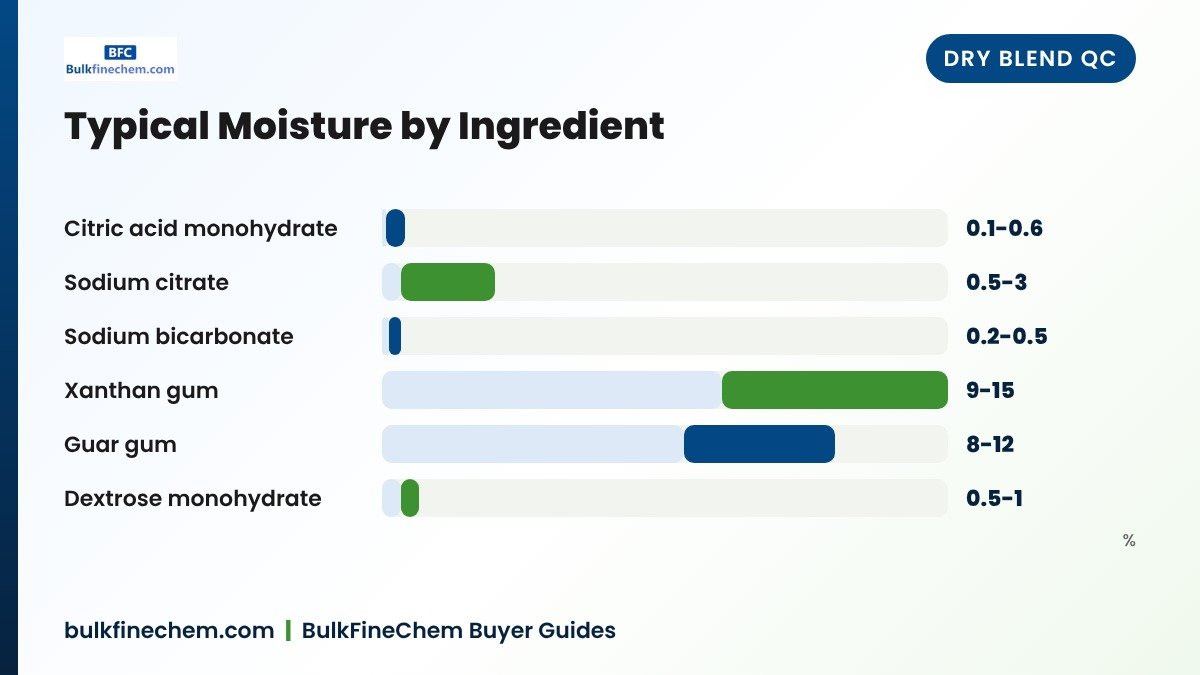
Hydrocolloids look wrong on that table until you remember they hold bound water as part of the normal specification. Judge a gum by its declared moisture band and its viscosity, not by how dry it feels.
Mesh and Particle Size in a Blend
Particle size drives three things at once: how fast a powder dissolves, how it flows, and whether it stays mixed. A ready mix sold as an instant drink needs a different distribution from the same formula sold as a cook-up mix, even when every ingredient is identical.
Two practical rules work without a laser sizer:
- Keep the spread narrow. When the coarsest ingredient is more than about four times the size of the finest, vibration on a conveyor or in a bag will separate them.
- Match the carrier to the active. A flavour, colour or high-potency ingredient is usually pre-blended onto a coarse sugar or salt carrier so that the carrier, not the fine, decides how the mix flows.
A sieve residue test on a stack of sieves for ten minutes tells you more than a certificate line. Log the retained percentage on your reference sieve for every lot and plot it. A drifting curve is an early warning that a supplier changed its mill settings and nobody told you.
Bulk Density and Fill Accuracy
Bulk density is the number that decides whether your sachet weight is right. Tapped density and loose density differ more on fine powders, and transport vibration changes what arrives in your hopper compared with what left the supplier's plant.
For a 5 g stick pack, a 6% swing in loose bulk density is enough to push fill weight out of tolerance and force a machine re-set. Weigh 100 ml of the blend loose, tap the cylinder 50 times and weigh it again. The ratio gives you the Hausner index, and it predicts flow better than any single density figure.
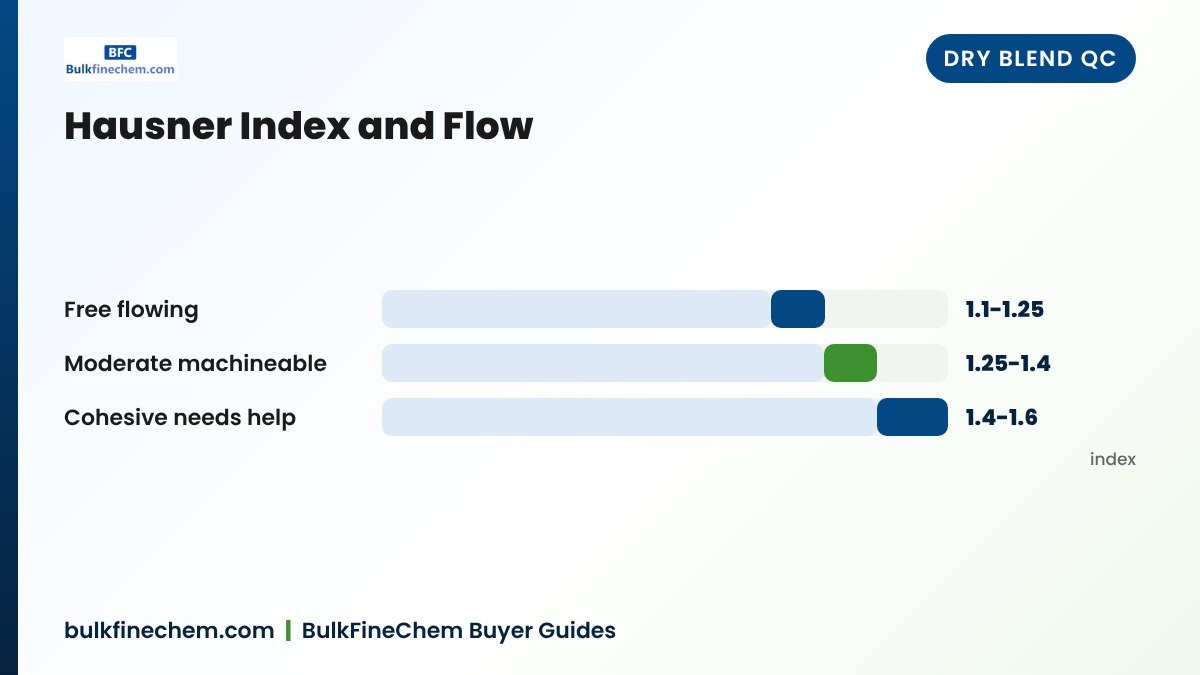
Above 1.6, expect bridging and vary your fill. The fix is usually a coarser grade of the same ingredient, a small proportion of a free-flow agent permitted for your application, or a change to the hopper geometry.
Static, Humidity and Segregation
Static is a seasonal problem in Gujarat and Maharashtra plants. In dry summer air, fine hydrocolloids and coated colours charge as they fall and stick to the first surface they meet. In monsoon humidity the same blend stops charging and starts to clump instead.
Watch for segregation in these places:
- Drop points. Every free fall from a hopper to a screw, or a screw to a bag, sorts fines from coarse.
- Vibratory feeders and conveyors. A short pulse at the discharge gate lifts fines to the top of the bag.
- Blending time. Past the optimum, more mixing in a dry system often increases separation rather than reducing it.
Run the blend to a uniformity sample at three points in the vessel, top, middle and discharge, and assay one marker such as the food acid by titration. If the three results sit within your label tolerance, the blend is done. Keeping it running longer is wasted machine time.
A One Day Bench Trial Before Production
You can prove a dry blend problem on a bench in a single shift. This is the sequence a plant chemist would follow.
- Record the baseline. Weigh loose and tapped density, run moisture on each lot and sieve the coarsest ingredient. Write the numbers before you change anything.
- Blend a small scale batch. Mix 2 to 5 kg in the same order you use on the plant, take samples from three positions and assay the marker ingredient.
- Stress the sample. Tumble a sealed bag for ten minutes, then re-sample from the top and bottom. A spread wider than your tolerance means segregation, not mixing failure.
- Store and retest. Hold a sample at 40 degrees C for a week, and another in open ambient air through a humid week. Retest flow and appearance, then decide whether the grade or the packing needs to change.
A dry blend that passes only on the day it was made has not been tested, only photographed.
What to Check Before Buying in Bulk
Dry ingredient buying is a document exercise as much as a price exercise. Before a bulk order of Citric acid monohydrate, Sodium citrate, Xanthan gum, Guar gum or Dextrose monohydrate, ask for and read the following.
- Assay and identity. Ask for the declared purity and the test method on the COA, and match the lot number on the COA to the lot number on every drum or bag.
- Mesh and bulk density. Ask for the sieve residue and loose bulk density as numbers with units, not as "as per standard".
- Moisture and water activity. Ask for the drying method and the value, and check it against your own inward reading on arrival.
- Packing and pallet condition. Food grade lined bags, sealed drums or IBCs as usual for that product, with intact liners and no stacked damage in monsoon shipments.
- Shelf life and storage note. Ask for the packing date, remaining shelf life and any statement about humidity-sensitive storage.
- Documents. A Certificate of Analysis, Safety Data Sheet and Technical Data Sheet with the order, plus the FSSAI or IP reference relevant to the grade you bought.
Our own guide to How to read a certificate of analysis covers which lines on that page actually bind a lot to a specification. The COA versus SDS versus TDS breakdown explains which document should carry the mesh and density numbers.
On the ingredient side, grade choice drives the same behaviour. The Food versus industrial grade citric acid buyer guide covers purity and packing differences, the Sodium bicarbonate food grade spec checks cover purity and mesh, and the Xanthan gum food grade versus industrial grade guide covers viscosity grades that decide how a gum disperses. For the thickener decision itself, see Xanthan gum versus guar gum in food formulations.
Safety and Handling
Dry powder handling is low risk but not zero risk. Fine dust in a breathing zone is an irritant and, in a confined mixer, a housekeeping and explosion concern.
- Follow the product's SDS for PPE. At minimum use dust-rated respiratory protection, safety goggles and gloves when charging or cleaning a mixer.
- Ground and bond the blender, hopper and drums when handling fine powders in dry weather, both for static control and for ignition safety.
- Keep ignition sources away from a mixer during charging and dust-generating work, and control dust with extraction rather than compressed air blow-down.
- Store hygroscopic ingredients in a cool, dry, covered store, off the floor, with bags and drums resealed the moment they are opened. In monsoon months, keep incoming stock out of the open yard and allow a wet floor area away from the blending room.
- Segregate oxidising and acidic ingredients from alkaline powders such as carbonates, and never store food grade material beside technical grade stock. Cleaning spills promptly avoids cross-contamination and slippery floors.
Frequently Asked Questions
What moisture content is acceptable in a dry blend ingredient?
Most crystalline food ingredients sit comfortably between 0.1% and 1% moisture, while hydrocolloids are specified higher, often 8% to 15%, because they hold bound water. Treat any lot more than about half a percent above its usual figure as a signal to check flow before blending.
How do I check mesh size without a lab sieve stack?
You can weigh the residue left on a single reference sieve after ten minutes of hand sieving and record it as a percentage. It will not replace a full particle size distribution, but a rising residue or a falling residue against your logged trend shows a mill change at the supplier.
Why does my blend segregate after mixing?
Segregation follows a size or density difference, and conveyor vibration or free falls do the sorting. Keeping the coarsest ingredient within about four times the size of the finest, and pre-blending fines onto a coarse carrier, reduces it more than extra blending time.
How long should a dry blend run in a ribbon blender?
Run to uniformity, not to a fixed clock. Sample the top, middle and discharge, assay one marker ingredient, and stop when all three sit inside your tolerance. Past that point, longer blending often increases separation in a dry system.
What causes static cling in blending rooms in summer?
Low humidity in hot dry months lets fine powders charge as they fall and stick to hoppers, liners and walls. Grounding the vessel and drums, reducing drop heights and controlling room humidity reduce it.
Which documents should I ask for before a bulk dry ingredient order?
A Certificate of Analysis with lot-specific numbers, a Safety Data Sheet, a Technical Data Sheet carrying mesh and bulk density, and the packing list with batch and expiry details. Match the COA lot number to the marking on every drum or bag before you accept.
How should bulk dry ingredients be stored in monsoon?
Keep them in a covered, dry store off the floor, reseal bags and drums the moment they are opened, and avoid holding hygroscopic acids or salts in the open yard. Run inward moisture checks on every lot during June to September.
Conclusion
Most dry blend complaints resolve to three measurable things: moisture out of its usual band, a mesh distribution that no longer matches the rest of the formula, and static or density spread that lets the blend separate after it leaves the mixer. Fixing dry blend ingredient specifications at inward QC, with your own moisture, sieve and density readings logged per lot, stops the problem before it reaches the packing line.
Need a quote? Send your requirement to the BulkFineChem team with grade, quantity and destination, or browse All products.
Disclaimer: This article is general technical and procurement information. Always follow the product's Safety Data Sheet, Technical Data Sheet and the regulations that apply to your industry, and confirm suitability with trials before full-scale use.