
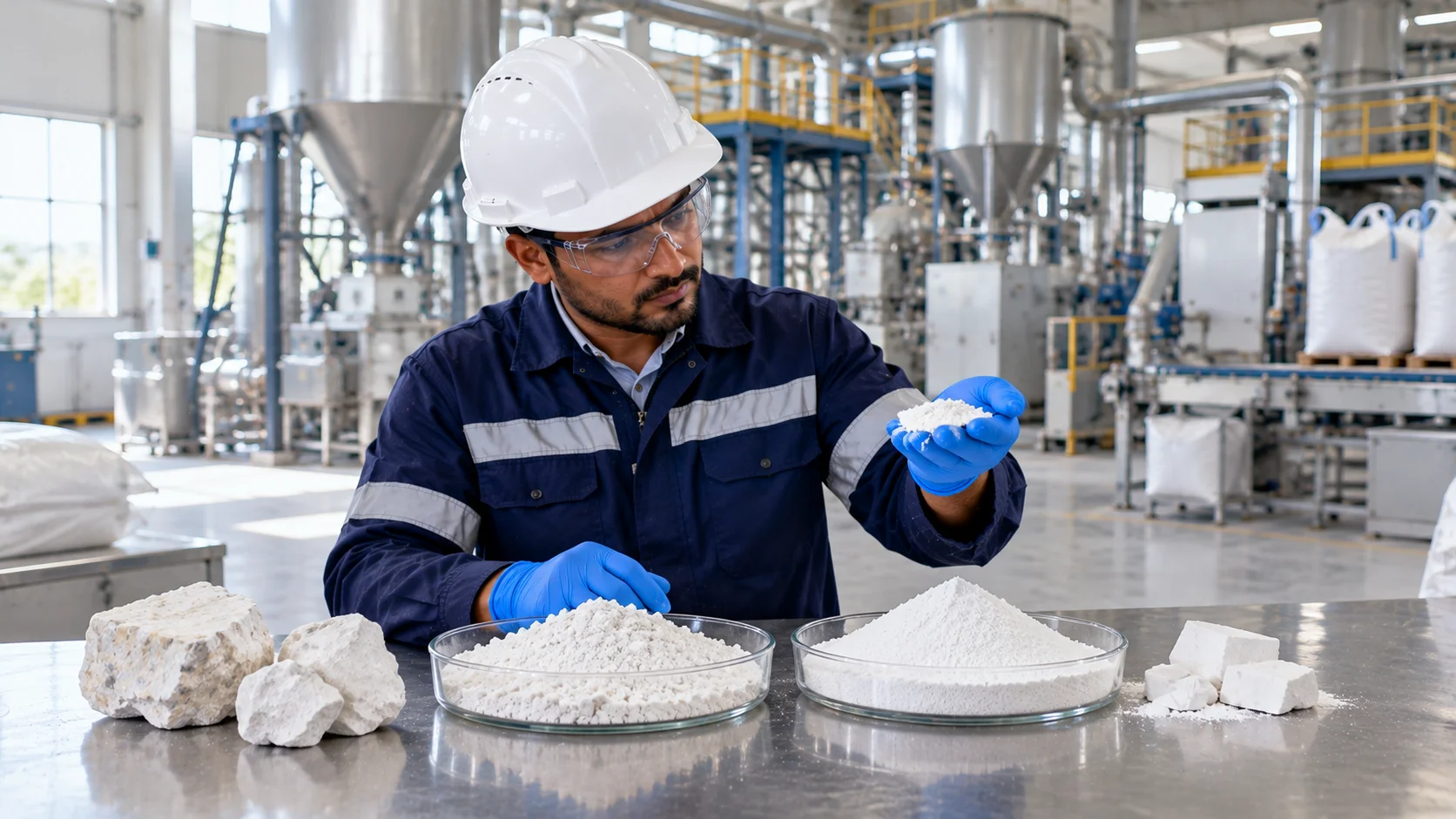
GCC vs PCC Calcium Carbonate: Differences, Uses and Bulk Buying Guide
GCC vs PCC calcium carbonate is a common material-selection question for plastics compounders, paint manufacturers, paper producers and rubber processors. Both are forms of calcium carbonate (CaCO3), yet the way they are produced affects particle morphology, size distribution, consistency and cost. Choosing the wrong grade can create dispersion problems, inconsistent surface finish or unnecessary formulation expense.
This buyer-focused guide compares ground calcium carbonate (GCC) with precipitated calcium carbonate (PCC), explores their typical industrial applications and highlights what to check on supplier documents before purchasing in bulk in India.
What Is Ground Calcium Carbonate (GCC)?
Ground calcium carbonate is obtained by mechanically processing naturally occurring calcium-carbonate-rich minerals, such as limestone, marble or chalk. Raw material is selected, crushed and ground, then classified to achieve the desired particle-size range. Some GCC grades are further refined or surface-treated to suit particular applications.
Why manufacturers choose GCC
GCC is commonly used as a cost-effective mineral filler and extender. It can add volume, modify mechanical and processing characteristics and reduce dependence on more expensive formulation ingredients. The final outcome depends on particle size, mineral purity, shape, coating and the host formulation—not on GCC being inexpensive alone.
Where GCC is commonly used
GCC grades appear in PVC pipes and profiles, polymer masterbatches, paints, putties, rubber products, adhesives and paper applications. Suitability varies widely: a coarse grade that works in one filled product may be unacceptable in a smooth coating or fine paper finish.
What Is Precipitated Calcium Carbonate (PCC)?
Precipitated calcium carbonate is manufactured by controlled chemical precipitation rather than simply grinding mineral rock. A common route involves reacting calcium hydroxide with carbon dioxide to form calcium carbonate. The production conditions allow manufacturers to influence particle characteristics and morphology.
What controlled precipitation offers
PCC can be specified with relatively narrow particle-size distributions and different crystal shapes, depending on the grade and process. These features make some PCC products useful where brightness, opacity, surface finish, reinforcing behaviour or controlled rheology matter. However, not every PCC grade is finer, brighter or higher performing than every GCC grade.
Typical PCC applications
Selected PCC grades are used in paper, paints, coatings, sealants, specialty polymers and other formulations. The grade must be evaluated in the actual process; the label PCC does not establish performance by itself.
GCC vs PCC Calcium Carbonate: Side-by-Side Comparison
Both materials share the same base chemistry. Their practical differences depend on manufacturing route and the supplier's precise specification.
| Factor | GCC | PCC |
|---|---|---|
| Production method | Mining, grinding and classifying natural minerals | Controlled chemical precipitation |
| Particle characteristics | Based on source mineral and grinding/classification | Particle form can be engineered during precipitation |
| Typical buyer priority | Cost-effective filling and reliable supply | Specialised particle properties or formulation effects |
| Typical applications | PVC, paints, rubber and commodity fillers | Selected paper, coating, polymer and specialty applications |
| Cost | Often lower for comparable commodity filler specifications | Often higher due to additional manufacturing steps |
| Critical documents | CoA, particle-size profile, whiteness and purity | CoA, morphology, particle-size profile and purity |
The distinction between mechanically ground and chemically precipitated products is described by industry mineral-filler suppliers and the British Calcium Carbonates Federation. Supplier-specific technical sheets should determine actual acceptance limits.
Which Calcium Carbonate Is Better for Plastic and PVC Manufacturing?
Plastic formulators often evaluate GCC first for economical filling, while specialised grades of GCC or PCC may be tested to achieve defined mechanical or processing properties. The appropriate choice depends on resin chemistry, loading, processing conditions and finished-product targets.
Particle size and dispersion
A powder with the wrong particle-size distribution or substantial agglomeration can disperse poorly, potentially affecting appearance and mechanical consistency. Request particle-size data using defined measurement methods rather than relying only on a label such as “micronised.”
Coated vs uncoated calcium carbonate
Surface-treated grades, commonly using fatty-acid treatments such as stearates, may improve compatibility and dispersion in some hydrophobic polymer systems. But a coating is not automatically beneficial in every formulation. Confirm coating content and test the powder under actual plant conditions.
What to evaluate in a trial
Track processing consistency, surface finish, dimensional performance and the properties most important to the finished product. The cheapest price per kilogram may be less useful than predictable quality at the required filler loading.
GCC and PCC in Paints, Paper and Rubber
Other industries weigh different performance properties. The same calcium carbonate grade need not work equally well across paint, paper and rubber.
Paints and coatings
Calcium carbonate can serve as a mineral extender and influence sheen, viscosity, hiding behaviour and surface texture. Fine, controlled powders may help meet appearance specifications, but formulation trials are needed to determine whether GCC or PCC provides the desired outcome.
Paper manufacturing
Both GCC and PCC are used in paper-related applications, with selection influenced by brightness, opacity, particle morphology, retention chemistry and the paper-production process. PCC's ability to be engineered into different particle forms can be valuable in some specialty applications.
Rubber products
Calcium carbonate may be incorporated into rubber compounds as a filler. Buyers should assess loading, dispersion, surface treatment and the mechanical properties of the final compound rather than assume a universal preference for GCC or PCC.
What Specifications Should Bulk Calcium Carbonate Buyers Check?
A clear specification prevents confusion between superficially similar white powders. Obtain a batch-specific Certificate of Analysis (CoA) and a technical data sheet identifying the actual grade.
- CaCO3 assay: stated purity and the test method used.
- Particle size: measured distribution such as D10, D50 and D90 where applicable, plus the measurement method.
- Whiteness or brightness: the specified metric and instrument method rather than an informal claim of “extra white.”
- Moisture: acceptance limits that support predictable dry handling and feeding.
- Impurities: iron, acid insolubles or other application-specific parameters.
- Surface treatment: coated or uncoated status, coating chemistry and content when relevant.
- Bulk handling: packing, flow characteristics, density and batch identification.
For more details on documents, see BulkFineChem's guide to reading a Certificate of Analysis.
Storage, Handling and Packaging
Fine calcium carbonate powder can generate airborne dust during transfer or mixing. Suppliers' current Safety Data Sheets (SDS) and the plant's occupational-safety procedures should guide protective equipment and dust controls.
Keep the powder dry
Store bags in a sheltered, dry location on appropriate pallets and protect opened material from moisture. Damp powders may cake or disperse inconsistently, affecting feeding into mixers or processing lines.
Control dust and avoid contamination
Use suitable local dust extraction and material-handling methods. Keep powders segregated from incompatible substances; calcium carbonate reacts with acids to generate carbon dioxide. Follow site rules for spill cleanup and material transfer.
Preserve batch identification
Clearly label GCC/PCC and coated/uncoated grades. A product substitution may require a documented approval process even when the main chemical formula remains CaCO3.
Bulk Calcium Carbonate Supply in India
BulkFineChem lists Calcium Carbonate – Precipitated and Ground, covering PCC and GCC grades for industrial buyers. Its current product listing describes a minimum 98% CaCO3 purity, 25 kg and 50 kg HDPE bags, 1 MT jumbo bags and a 1 MT minimum order quantity. These are listing specifications; confirm the particular grade, packaging, CoA and current availability before purchase.

For a useful quotation, include your intended application, GCC or PCC preference, particle-size and purity limits, coated or uncoated requirement, monthly volume, delivery location and documentation requirements. If you need help comparing suppliers, read our bulk chemical supplier checklist.
Frequently Asked Questions
1. Is GCC the same chemical as PCC?
Yes. Both are calcium carbonate (CaCO3). They differ mainly in production route and possible particle characteristics. Their quality specifications should be reviewed individually.
2. Is PCC always finer than GCC?
No. Both families include multiple particle-size grades. The supplier's particle-size distribution and product data should determine whether a grade is fine enough for the application.
3. Which calcium carbonate grade is best for PVC pipes?
Many PVC compounds use GCC, while specialised GCC or PCC grades may also be considered. Selection should be based on dispersion, mechanical testing and the approved formulation.
4. Should buyers choose coated calcium carbonate?
Coated grades can improve compatibility in some polymer systems, but they are not universally superior. Confirm surface-treatment chemistry and run representative formulation trials.
5. What is the difference between whiteness and purity?
Purity measures chemical composition; whiteness measures optical appearance using a specified method. One cannot safely be inferred from the other.
6. What documents should accompany bulk calcium carbonate?
Request a grade-specific TDS, a batch CoA and an SDS. Include any additional testing or regulatory documentation required by your sector.
Conclusion: Buy the Grade Your Process Actually Needs
The practical choice between GCC vs PCC calcium carbonate depends on formulation performance, particle characteristics, coating, manufacturing consistency and the full delivered cost. GCC is frequently a cost-effective starting point for general filling, while PCC may be valuable where controlled particle properties are needed.
Planning a bulk purchase? Explore BulkFineChem's calcium carbonate product range and send your required grade, particle-size specification, quantity and delivery destination. Request technical documents and evaluate a representative sample before approving bulk use.