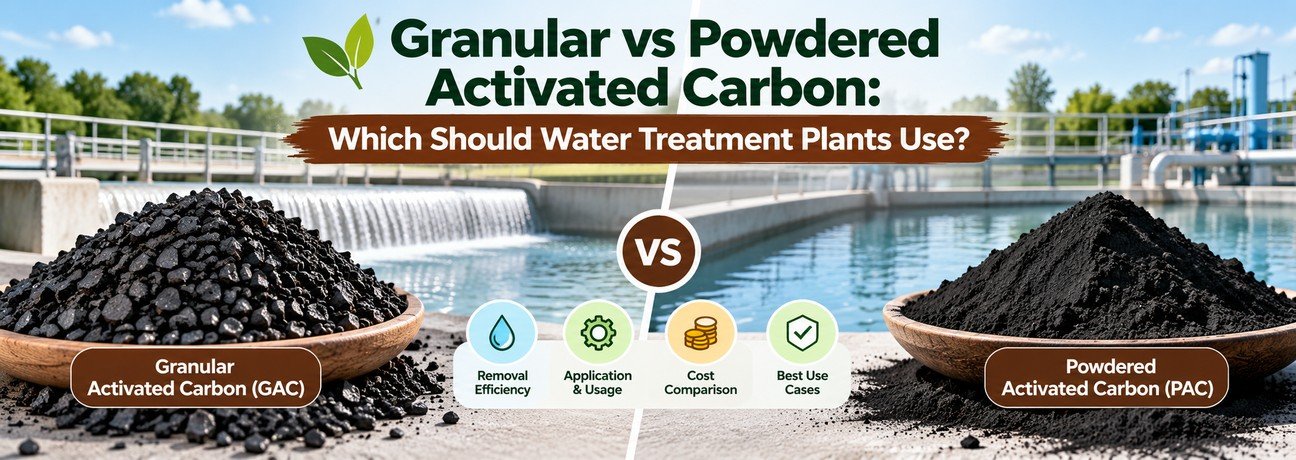
Granular vs powdered activated carbon is an important decision for water-treatment plants, industrial processors and procurement teams because both forms use adsorption, but they are applied in very different ways. Granular activated carbon (GAC) is typically used in fixed or flow-through beds, while powdered activated carbon (PAC) is dosed into water and then removed during clarification or filtration.
The right choice depends on the target contaminant, treatment objective, process design, contact time, carbon dose, downstream solids handling and total operating cost. This guide explains the practical differences so bulk buyers can choose the form that better matches their system.
Note: In this article, PAC means powdered activated carbon. It should not be confused with poly aluminium chloride, another water-treatment chemical that is also commonly abbreviated as PAC.
Granular vs Powdered Activated Carbon: Quick Comparison
| Factor | Granular Activated Carbon (GAC) | Powdered Activated Carbon (PAC) |
|---|---|---|
| Physical form | Coarser granules | Fine powder |
| Typical application | Fixed bed or filter-adsorber | Dosed directly into water |
| Removal from process | Retained in the treatment vessel until replacement or regeneration | Removed with clarification, filtration or membrane solids |
| Best suited to | Continuous adsorption treatment | Flexible, seasonal or event-based dosing |
| Operational focus | Bed depth, flow rate, contact time and breakthrough | Dose, mixing, contact time and solids separation |
| Sludge impact | Generally does not create a continuously dosed carbon sludge stream | Adds carbon solids that must be separated and handled |
What Is Granular Activated Carbon?
Granular activated carbon is a porous adsorbent made from carbon-rich raw materials such as coconut shell, coal or wood. Its pore structure gives it a very large internal surface area, allowing dissolved compounds to adsorb onto the carbon surface.
In water treatment, GAC is commonly installed in a vessel or filter bed. Water passes through the bed while target compounds are adsorbed. When the carbon reaches its working capacity, it must be replaced or, where suitable, regenerated.
Common GAC applications
- Taste and odour control
- Removal of natural organic matter
- Reduction of selected volatile and synthetic organic compounds
- Dechlorination ahead of downstream processes such as RO
- Polishing after primary treatment
According to U.S. EPA guidance, GAC is a well-established adsorption technology used for taste- and odour-producing compounds, natural organic matter, VOCs, synthetic organic compounds and disinfection-by-product precursors.
What Is Powdered Activated Carbon?
Powdered activated carbon is activated carbon in a much finer particle size. Instead of being retained as a fixed bed, it is dosed into the water, mixed for a defined contact period and then removed with the solids through clarification, filtration or low-pressure membrane treatment.
Common PAC applications
- Short-term taste and odour events
- Seasonal contamination problems
- Batch decolourisation
- Temporary treatment changes
- Processes where an existing coagulation or solids-separation stage can remove the spent carbon
Because PAC can be added only when needed, it offers operational flexibility. However, the plant must be able to disperse the powder safely, achieve adequate contact time and remove the spent carbon from the treated water.
Key Difference 1: How GAC and PAC Are Used
The biggest difference is not the carbon chemistry; it is the treatment configuration.
GAC works as a treatment bed
With GAC, water passes through a bed of carbon. Design parameters such as bed depth, flow rate, empty-bed contact time, pressure drop and breakthrough determine performance.
PAC is dosed like a process chemical
With powdered carbon, operators add a calculated dose to the water. The PAC must contact the target compounds long enough for adsorption to occur, after which the carbon is separated from the water.
Key Difference 2: Continuous Treatment vs Flexible Dosing
GAC is generally better suited to continuous operation where a plant wants an adsorption stage operating around the clock. PAC is attractive when the treatment need is intermittent or seasonal.
For example, a plant that experiences periodic taste-and-odour episodes may prefer to dose PAC only during those events. A facility requiring consistent polishing of an organic contaminant stream may prefer a properly designed GAC bed.
Key Difference 3: Contact Time and Adsorption Performance
Activated carbon performance depends on more than whether the product is granular or powdered. Important factors include:
- Target contaminant chemistry
- Carbon pore structure and source material
- Water pH and temperature
- Natural organic matter competing for adsorption sites
- Carbon dose or bed mass
- Contact time
- Flow rate for GAC systems
- Mixing and dispersion for PAC systems
EPA technical guidance notes that activated-carbon adsorption is influenced by water chemistry, contaminant properties, contact time and treatment configuration. Buyers should therefore avoid selecting carbon only from appearance or a single specification number.
Key Difference 4: Filtration, Sludge and Solids Handling
Powdered carbon becomes part of the solids stream after use. That means PAC dosing can increase the solids load entering sedimentation, filtration or membrane treatment. Plants should account for storage, dosing equipment, dust control, clarification and sludge disposal.
GAC is retained inside a vessel or filter and does not require continuous separation from the treated water. However, operators must manage bed backwashing where applicable, carbon replacement, regeneration and spent-media handling.
Key Difference 5: Operating Cost
A simple price-per-kilogram comparison can be misleading. The better economic choice depends on the full treatment system.
For GAC, include:
- Initial media loading
- Vessel or filter infrastructure
- Pumping and backwash requirements
- Replacement frequency
- Regeneration or disposal cost
- Downtime during media change
For PAC, include:
- Carbon dose per cubic metre
- Dosing and mixing equipment
- Operator handling time
- Additional sludge production
- Filtration or clarification load
- Storage and dust-control requirements
The lowest product price is not always the lowest cost per treated cubic metre.
Which Form Is Better for Taste and Odour Control?
Both forms are used for taste and odour treatment. GAC is well suited to continuous adsorption, while PAC can be particularly useful when taste-and-odour problems occur seasonally or unpredictably.
If the problem appears only during certain raw-water conditions, PAC may give the operator the ability to start and stop treatment as needed. If the issue is persistent, a GAC bed may be more practical.
Which Form Is Better for Organic Contaminants?
GAC is widely used for removing dissolved organic compounds in continuous treatment. EPA describes GAC as a proven treatment option for many organic contaminants. PAC can also adsorb organic compounds, but the achievable removal depends strongly on dose and contact time.
For complex applications, bench testing, pilot testing or supplier-supported adsorption testing is preferable to selecting a grade from generic claims.
How to Select Activated Carbon for Bulk Purchase
Once the plant has selected GAC or PAC as the preferred process format, the next step is specifying the carbon grade.
1. Define the application
State whether the carbon is being used for drinking-water polishing, industrial wastewater, dechlorination, colour removal, process purification or another application.
2. Identify the target contaminant
Activated carbon does not adsorb every substance equally. Tell the supplier what the carbon must remove and the approximate concentration or loading.
3. Select the appropriate particle size
For GAC, mesh size must suit the vessel, pressure drop and flow design. For PAC, particle fineness affects dispersion and solids handling.
4. Review adsorption-related specifications
Iodine value is commonly used as one indicator of activated-carbon adsorption characteristics, but it should not be treated as the only performance measure. Pore-size distribution and application-specific testing can matter just as much.
5. Request batch documentation
For commercial procurement, request the agreed specification, Certificate of Analysis, packing details and other documentation needed by your quality system.
BulkFineChem Activated Carbon Options
BulkFineChem lists Activated Carbon - Granular and Powdered for bulk industrial and water-treatment applications. Available product information includes granular and powdered grades, coconut-shell and coal-based options, granular mesh selections and batch documentation.
The current BulkFineChem product listing states a minimum order quantity of 500 kg, with 25 kg bags or 500 kg jumbo bags among the listed packing options. Buyers can request a batch Certificate of Analysis and TDS or SDS documentation as required.
For a broader overview of treatment chemicals and media, see the BulkFineChem Water Treatment Chemicals Buyer's Guide.
Frequently Asked Questions
What is the main difference between granular and powdered activated carbon?
GAC is normally retained in a fixed or flow-through bed, while PAC is dosed into water as a powder and later removed through clarification or filtration.
Is powdered activated carbon the same as poly aluminium chloride?
No. Both are commonly abbreviated as PAC in the water-treatment industry. Powdered activated carbon is an adsorbent, while poly aluminium chloride is an aluminium-based coagulant.
Which is better for continuous water treatment?
GAC is often better suited to continuous adsorption because it can remain in a treatment bed until its working capacity is reached. The final choice depends on the process and contaminant.
Which is better for seasonal taste and odour problems?
PAC can be practical for seasonal or short-duration events because operators can dose it only when needed, provided the plant has suitable mixing and solids-removal capacity.
Does a higher iodine value always mean better carbon?
No. Iodine value is useful, but the best carbon depends on the target molecule, pore structure, contact conditions and water chemistry. Application testing is more reliable than selecting on one number alone.
Can GAC be regenerated?
Some GAC applications use regeneration, depending on the carbon type, contaminant, economics and available regeneration service. Suitability should be confirmed for the specific spent media.
What should I send when requesting a bulk quote?
Provide the application, required form (GAC or PAC), preferred carbon source if known, mesh size or other specifications, quantity, packing requirement, destination and any COA parameters your process requires.
Conclusion
When comparing granular vs powdered activated carbon, the better choice comes down to how the plant operates. GAC is generally suited to continuous fixed-bed adsorption, while PAC provides flexible dosing for batch, seasonal or event-based treatment. The correct carbon grade should then be selected around the target contaminant, contact conditions, particle size, adsorption characteristics, documentation and total operating cost.
Need activated carbon in bulk? Review the BulkFineChem Activated Carbon product page and share your application, quantity, packing preference and destination for a commercial discussion.