

A batch of ice cream that came out smooth on day one and sandy by week six usually has one thing in common: the gum in the mix was never hydrated properly. Guar gum is cheap enough that nobody argues about the line cost, yet a lot of frozen food plants in India still buy it on the strength of a "food grade" line on the bag, then blame the freezer when syneresis shows up in the tray.
This guide covers Guar gum in frozen foods from the receiving dock to the blast freezer: what the gum actually does at sub-zero temperatures, which specifications decide whether it performs, realistic dose ranges, and the documents to ask for before you commit to a container.
What Guar Gum Does at Freezing Temperatures
Guar gum is a galactomannan from cluster bean endosperm, and its value in a frozen system is water management rather than thickness alone. Freezing concentrates the unfrozen phase, ice crystals grow during storage temperature swings, and the water that migrates out of that crystal structure is what you later see as whey in a yoghurt cup or as coarse crystals on the surface of a dessert.
The gum raises the viscosity of that unfrozen phase, which slows down how fast water can move and how fast crystals can grow. It also ties up free water, which shows up as lower freeze-off and a softer bite at serving temperature. Guar works well on its own in cold systems, but many formulators pair it with Xanthan gum because the two behave differently under shear and in acid.
One honest limit: guar is not a locust bean gum substitute in every frozen dessert. It hydrates fully in the cold, which is an advantage, but it gives a shorter, sometimes gummy texture at higher levels. Most frozen dessert stabiliser blends keep guar on the low side for that reason.
Specifications That Decide Performance in the Freezer
Two lots of guar gum can both read "food grade" on the label and behave completely differently in your mix. Viscosity is the number that matters most, but it is meaningless unless you know how it was measured.
| Specification | Typical Range | Why It Matters in Frozen Foods |
|---|---|---|
| Viscosity, 1% solution at 25 C (mPa·s) | 1200-3800 | Sets the water-holding and ice-crystal control you get at a given dose |
| Particle size, 100 mesh pass (%) | 95-99 | Finer powder wets faster and lumps less in cold mix |
| Moisture (%) | 8-12 | Above about 12% the powder cakes and hydrates unevenly |
| Protein (%) | 3-6 | Higher protein adds off notes and a beany smell in delicate bases |
| Acid insoluble ash (%) | 0.3-1.0 | Signals husk and hull residue left from milling |
| Bulk density (g/L) | 400-600 | Drives silo and hopper settings and dust during charging |
Read the viscosity figure together with the method and the concentration on the COA, not as a bare number. A 3000 mPa·s lot and a 1500 mPa·s lot at the same dose are not interchangeable, and switching between them without reworking your stabiliser blend is how a frozen dessert line starts weeping. For the document side of that check, this walkthrough on How to read a certificate of analysis is the practical version.
Particle size and moisture are the two specs that get quietly relaxed by mills. In a plant near Vadodara where the mix tank runs at 5-8 C, a coarse lot charged straight into a cold base will form fish eyes that no amount of mixing after the fact will open up. Ask for the mesh and the moisture on the same COA as the viscosity.
Dose Ranges by Frozen Product
Dose is where most buying decisions go wrong, because the gum is sold by weight and bought as if a single number covers everything. It does not.
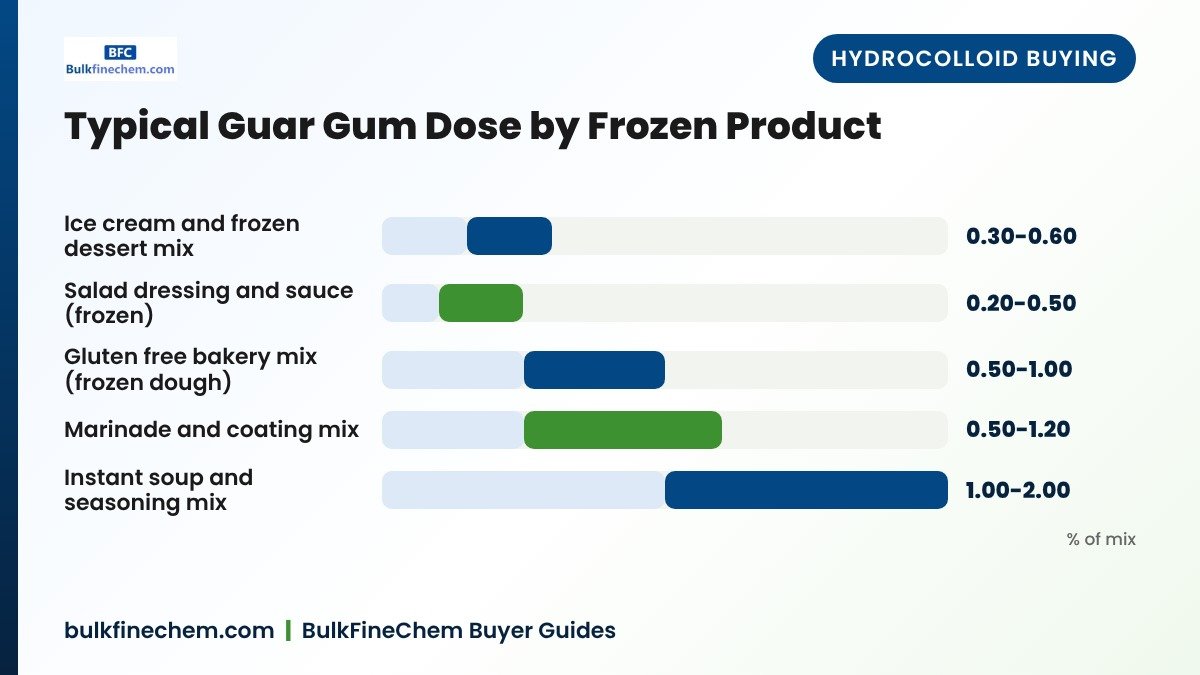
| Application | Typical Dose (% of mix) | Note |
|---|---|---|
| Ice cream and frozen dessert mix | 0.30-0.60 | Often blended with a smaller share of another gum |
| Salad dressing and sauce, frozen | 0.20-0.50 | Lower dose if the system is already high in solids |
| Gluten free bakery mix, frozen dough | 0.50-1.00 | Replaces some of the structure gluten normally gives |
| Marinade and coating mix | 0.50-1.20 | Binds free water during the chill and freeze hold |
| Instant soup and seasoning mix | 1.00-2.00 | Dosed on the dry mix weight, hydration happens at the consumer |
Keep the total hydrocolloid in a frozen dessert base under roughly 0.6 to 0.8 percent across all gums. Push guar past that on its own and the mix pulls through the freezer fill line sluggishly, the overrun drops, and the finished product chews rather than melts. If you are reformulating a base that already uses another thickener, run the comparison in Xanthan gum versus guar gum before you change the blend.
Hydration, Shear and Temperature Rules
Guar gum hydrates in cold water, which is exactly what a frozen food plant needs, since nobody wants to heat a 5000-litre batch just to wet a gum. Cold hydration is still not instant, and the schedule below is where a lot of plants lose performance without touching the specification.
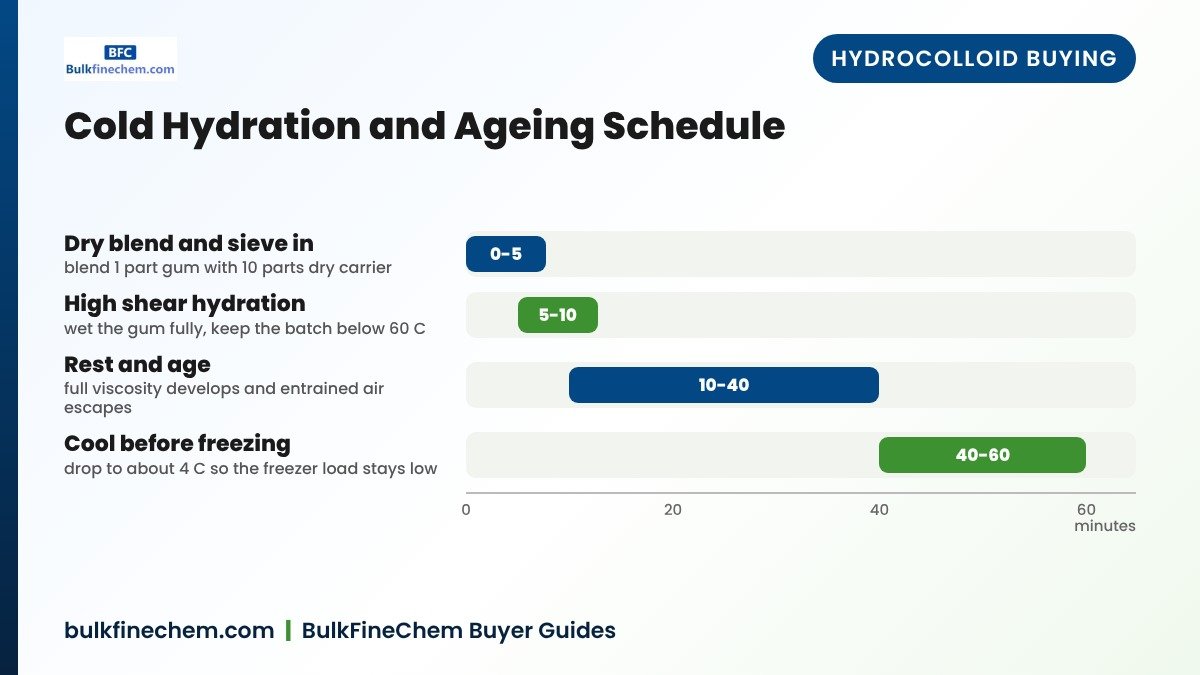
- Dry blend first. Mix the guar with sugar or another dry carrier in a ratio of about 1 part gum to 10 parts carrier before it ever meets the tank.
- Sieve on the way in. Pass the blend through a 40-60 mesh screen while charging to break up lumps formed in the bag.
- High shear briefly. Run the shear for 5-10 minutes at mix temperature, keeping the batch below 60 C so the gum chain does not start thinning.
- Rest and age. Hold 30-45 minutes for full viscosity and to let entrained air escape before freezing.
- Cool before freezing. Drop the mix to around 4 C so the freezer has less heat load to pull and crystal size stays small.
Guar gum does most of its work in the freezer, not in the mix tank, so judge it after storage and not on day one.
Heat is the other variable. Short pasteurisation is fine and normal for a dairy base, but a long hold at high temperature thins guar permanently, and the viscosity on your incoming COA no longer describes what is in the tank. If your process holds above 80 C for a while, measure the viscosity after the hold, not before.
Acidity changes the picture again. Guar is comfortable around neutral pH and loses some water-holding in a low-pH dressing or sauce. In those systems a small share of an acid-stable gum carries more of the load, and the Food versus industrial grade citric acid in the same formula affects the final pH more than most buyers expect.
Freeze-Thaw Stability and Storage Reality
A frozen product rarely sits at a steady minus 18 C in India. Reefer set points drift, doors stay open during loading, and a cold store in Gujarat in May runs a warmer pull cycle than the same store in December. Every warm-up melts the smallest crystals and refreezes them onto larger ones.
That recrystallisation is what guar is buying you. Run your own accelerated cycle rather than trusting a supplier claim: hold samples at minus 5 C to plus 5 C for 12 hours, return to minus 18 C, and repeat for three to five cycles. Then check for three things.
- Free serum. Weigh the liquid that drains from a thawed sample and record it as a percentage of the sample weight.
- Crystal coarseness. Cut a cross section and look at the fracture face; a smooth face means fine crystals, a gritty face means growth.
- Viscosity retention. Measure the hydrated mix before and after cycling; a large drop means the gum network has been torn by crystal growth.
Temperature abuse in the supply chain is the reason a gum that passed trials in January fails audits in June. Write your specification against your worst realistic storage case, not the laboratory case.
What to Check Before Buying in Bulk
Guar gum is a farm-derived, milled product, so lot-to-lot variation is a fact of life and the buying process has to absorb it.
- Viscosity and method. Ask for the 1% viscosity figure with the method, concentration and temperature stated, on every lot.
- Mesh and moisture. Confirm the pass percentage on 100 mesh and the moisture, since both control how it wets in your tank.
- COA and batch traceability. Require a lot-numbered COA that matches the bag marks, and keep retained samples per lot.
- Packing. Multi-wall paper bags with a poly liner in 25 kg are usual; check the liner is intact, since gum takes up moisture fast.
- Declared additives. Confirm whether the lot is straight milled guar or a blended stabiliser, and get the blend ratio in writing.
- Microbial and foreign matter limits. Ask for the total plate count and any treatment declaration relevant to your destination market.
For export lots, ask the supplier to confirm the FSSAI or destination-market food additive reference in writing on the invoice or specification sheet, and keep the SDS with the batch records. Gum in paper bags stored in an Indian warehouse during the monsoon will pick up moisture even on a pallet, so keep lots off the floor, away from outside walls, and rotate them within a few months.
Storage in Hot and Humid Indian Conditions
- Store below 30 C in a dry, ventilated room, never in the cold room itself.
- Keep bags on pallets with the original liner intact until the moment of opening.
- Close opened bags completely, because an open bag in a humid plant takes up water in days.
- Rotate stock first-in-first-out and re-check free-flow before charging an old bag.
Caking alone does not mean the gum is ruined, but a caked lot will not pass a sieve cleanly and will hydrate unevenly, so treat it as a rejected lot for a frozen line.
Safety and Handling
Guar gum dust is a combustible organic dust and a nuisance irritant in a bagging or charging area. Fit local extraction at the charging point, ground the equipment against static, and forbid open flame or hot work near the silo. Wear a dust mask, safety glasses and gloves when cutting open bags, and wash off skin contact with water. Follow the product's Safety Data Sheet, good housekeeping practice for combustible dust, and your local food safety and factory regulations. Store it away from strong oxidisers and from anything wet, and never use a gum bag that has been kept in a room where chemicals were stored.
Frequently Asked Questions
How much guar gum should be used in frozen foods?
Most frozen desserts and ice cream mixes use 0.30-0.60 percent of the mix weight, while frozen sauces and dressings sit lower at 0.20-0.50 percent and dry mixes run higher. Keep total hydrocolloid in a frozen dessert base under about 0.6-0.8 percent across all gums, and confirm the final level with your own overrun and melt-resistance trials.
Does guar gum need heat to hydrate?
No. Guar gum hydrates in cold water, which suits frozen food plants that cannot heat a full batch just to wet a gum. Cold hydration still takes time, so use a dry blend with sugar, apply high shear for 5-10 minutes, then rest 30-45 minutes before freezing.
Why does my ice cream turn grainy after a few weeks in storage?
Graininess usually comes from ice crystal growth during temperature swings in cold storage, not from the gum itself. Check your reefer and cold room pull cycles first, then verify the gum viscosity on the COA and whether the mix was fully hydrated before freezing.
What specifications should I ask for when buying guar gum in bulk?
Ask for the 1 percent viscosity with the test method and temperature, the 100 mesh pass percentage, moisture, protein and acid insoluble ash, each on a lot-numbered COA that matches the bag marks. Also confirm packing type, shelf life and whether the lot is straight milled guar or a blended stabiliser.
Is guar gum the same as locust bean gum in frozen desserts?
Both are galactomannans, but guar hydrates fully in the cold while locust bean gum needs heat to hydrate properly. Guar gives a shorter, sometimes gummy texture at higher levels, which is why many stabiliser blends keep guar on the lower side and combine the two.
Can guar gum be used in gluten free frozen bakery products?
Yes, it is commonly used at around 0.50-1.00 percent of the dry mix to hold water and give some structure in place of gluten. Frozen doughs are sensitive to overdosing, so test small batches and check the texture after baking rather than at the mixing stage.
How should guar gum be stored in an Indian plant?
Keep it below 30 C in a dry ventilated room, on pallets, with the poly liner intact until opening. Humidity during the monsoon is the main risk, so close opened bags fully and rotate stock within a few months.
Conclusion
Buying guar gum for frozen foods comes down to three numbers on the COA, a hydration schedule your plant can actually hold, and a freeze-thaw test you run on your own worst-case storage profile. Fix the viscosity method, the mesh and the moisture in your specification, dose in the 0.3-0.6 percent band for frozen desserts, and most of the syneresis complaints disappear without touching the recipe.
Need a quote? Send your requirement to the BulkFineChem team with grade, quantity and destination, or browse All products. You can also review our Food and industrial grade guar gum alongside Xanthan gum and Citric acid monohydrate if you are qualifying a full hydrocolloid and acid blend.
Disclaimer: This article is general technical and procurement information. Always follow the product's Safety Data Sheet, Technical Data Sheet and the regulations that apply to your industry, and confirm suitability with trials before full-scale use.