
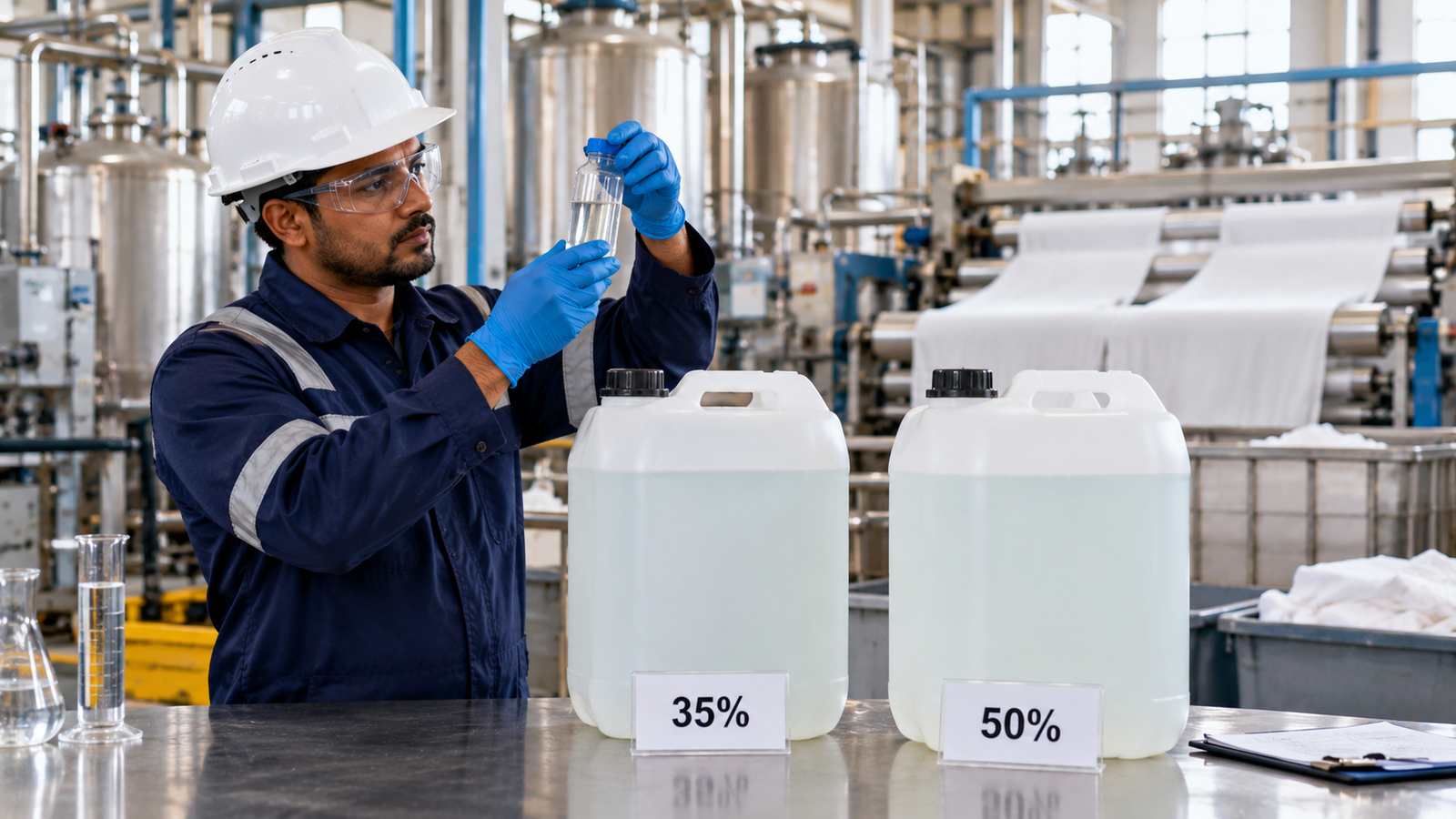
Hydrogen Peroxide 35% vs 50%: Uses, Safety and Bulk Buying Guide
Hydrogen peroxide 35% vs 50% is an important purchasing decision for textile mills, paper manufacturers, industrial processors and chemical distributors. Both concentrations contain the same active chemical, H2O2, but they differ in the amount of active ingredient delivered per kilogram of solution, the logistics of bulk transport and the precautions needed for handling.
A higher percentage is not automatically the better option. The right choice depends on the manufacturing process, approved equipment, chemical consumption and the safety systems in place. This guide explains practical differences and the technical documents to request before buying industrial hydrogen peroxide in India.
What Is Industrial Hydrogen Peroxide?
Hydrogen peroxide (H2O2; CAS 7722-84-1) is a clear, colourless oxidising agent. Depending on concentration and process conditions, it is used in bleaching, oxidation and selected treatment processes. It can decompose into water and oxygen, but the reaction can release significant heat and gas, especially when accelerated by contamination. That means the phrase “breaks down into water and oxygen” should never be mistaken for “safe to handle without controls.”
Why do industrial buyers purchase it in different strengths?
Industrial peroxide is generally ordered as an aqueous solution of a specified percentage by weight (w/w). The percentage expresses how much H2O2 is present within the total mass of solution. Buyers can then compare active content and select a concentration compatible with their process and site risk assessment.
What does “stabilised” mean?
Commercial products commonly contain stabilising additives to help manage decomposition during normal storage. Their type and suitability may differ by supplier or grade. Confirm the product's stabiliser system and impurity limits if downstream processing, product colour or manufacturing quality could be affected.
Hydrogen Peroxide 35% vs 50%: Key Differences
The two concentrations have similar industrial purposes, but a plant should consider more than the headline number. A simple mass comparison illustrates the difference: in 1,000 kg of solution, a 35% w/w product nominally contains 350 kg of H2O2, while a 50% w/w product nominally contains 500 kg. Actual delivered content should be checked against the batch Certificate of Analysis (CoA).
| Buyer consideration | 35% w/w solution | 50% w/w solution |
|---|---|---|
| Active ingredient per 1,000 kg | 350 kg nominal | 500 kg nominal |
| Freight per kg of active H2O2 | More water transported | Less water transported |
| Hazard and exposure planning | Concentrated oxidiser; strict controls required | Higher concentration can increase severity of exposure and decomposition consequences |
| Equipment suitability | Verify materials and equipment | Verify materials and equipment for 50% specifically |
| Buying decision | May suit a plant designed around this grade | May suit sites with approved systems for the stronger grade |
Important: this is a commercial comparison, not a recommendation to substitute 50% for 35%. Chemical storage, pumping, feed systems, operating procedures and emergency controls must be reviewed and approved before changing concentrations.
Where Is Hydrogen Peroxide Used in Industry?
Applications vary considerably by formulation, temperature, pH, process design and regulatory requirements. The following examples are common industrial categories, not process instructions.
Textile bleaching and preparation
Hydrogen peroxide is used in industrial textile operations, notably cotton and cotton-blend preparation. Plants select their peroxide grade according to their bleaching-process design, water quality, chemistry and operating controls. Stronger peroxide is not inherently synonymous with superior finished-fabric quality.
Pulp and paper processing
Hydrogen peroxide is an oxidising bleaching agent in certain pulp and paper operations. The appropriate concentration must be selected in conjunction with the manufacturer's process requirements and the site's chemical management system.
Wastewater and process-water treatment
Some industrial oxidation and effluent treatment systems use peroxide as part of engineered treatment programs. Results depend on the chemistry of the wastewater and any associated treatment method. Do not assume that hydrogen peroxide alone will consistently remove colour, reduce chemical oxygen demand or disinfect every wastewater stream.
Industrial chemical manufacturing
Manufacturers may use peroxide as an oxidising reagent in selected chemical syntheses. Grade purity, stabilisers, contaminants and process compatibility can be as important as concentration.
How to Choose the Right Hydrogen Peroxide Grade
A good purchase order should begin with a technical specification. Procurement and plant operations should agree on their requirements before obtaining quotes.
Confirm the process-approved concentration
Start with the actual concentration permitted by the plant's process design, equipment documentation and safety assessment. If a quotation offers a different concentration, have the technical team review the change before purchasing.
Compare total cost per unit of active ingredient
A price per kilogram of solution can be misleading because different grades contain different amounts of active H2O2. Evaluate the quote using verified concentration along with packaging, freight, unloading, storage, handling and potential losses. A more concentrated product may offer logistical advantages, but that benefit must be weighed against the site's safety and compatibility requirements.
Request batch-specific quality details
Ask for the CoA showing concentration, test date and any impurity parameters required for the application. Obtain the current Safety Data Sheet (SDS) and a suitable technical data sheet (TDS), and confirm whether the offered material is appropriate for the specified industrial use. A general industrial grade should not be assumed suitable for food, medical or pharmaceutical use.
Confirm packing and delivery arrangements
Before dispatch, specify quantity, packing, receiving arrangements, delivery location and document requirements. Confirm that approved packages and transport procedures meet the requirements applicable to the concentration being shipped.
Safe Storage and Handling of Concentrated Hydrogen Peroxide
Both 35% and 50% hydrogen peroxide require strict handling controls. It is a strong oxidiser and can cause serious injury. Contamination can accelerate decomposition, generating oxygen and heat. The applicable SDS, supplier instructions and site-specific hazard assessment should always govern operations.
Prevent contamination
Keep equipment, storage systems and transfer procedures compatible with the supplied grade. Avoid contact with incompatible metals, rust, combustible or organic materials, reducing agents and other substances identified by the SDS. Never return decanted solution to its original container.
Use appropriate approved storage arrangements
Store in conditions specified by the supplier, protected from excessive heat and direct sunlight. Containers and tank systems must be specifically designed for the product, including suitable provisions for oxygen release; do not seal a peroxide storage system airtight. Qualified engineers should specify the storage and venting system rather than improvising modifications.
Use suitable PPE and trained personnel
Handling requires a documented procedure, suitable eye/face and skin protection, appropriate emergency equipment and trained staff. Any indication of abnormal heating, leakage or pressure build-up calls for the site's emergency procedure, not routine manual intervention. Never attempt to open or repair a suspicious or pressurised container without a qualified emergency response assessment.
For background, see the NIOSH Pocket Guide entry for hydrogen peroxide and a current manufacturer SDS for the exact product being purchased.
Bulk Hydrogen Peroxide Supply: What to Ask Your Supplier
BulkFineChem lists Hydrogen Peroxide – 50 Percent Industrial Grade and describes stabilised 35% and 50% w/w grades for bulk procurement in India. Its existing product listing describes 35 kg and 250 kg vented HDPE pack options and a 250 kg minimum order quantity. These are listing details, not a guarantee of a particular delivery; confirm the current grade, packing and availability with the sales team.

Include the following in your enquiry:
- Required hydrogen peroxide grade: 35% or 50% w/w, with permitted tolerance
- Intended application and any relevant impurity limits
- Required quantity, delivery schedule and destination in India
- Preferred packaging and receiving-system restrictions
- CoA, SDS, TDS and applicable transport documents
- Request for a landed quotation and availability confirmation
For more procurement guidance, see our bulk chemical supplier checklist and Certificate of Analysis guide.
Frequently Asked Questions
1. What is the difference between hydrogen peroxide 35% and 50%?
They are different aqueous concentrations of the same oxidising chemical. A 50% w/w solution contains more active hydrogen peroxide per kilogram of product than a 35% w/w solution; their risks, logistics and equipment requirements must be assessed individually.
2. Is 50% hydrogen peroxide always better for textile bleaching?
No. The best grade depends on the mill's validated bleaching process, safety controls, compatible equipment and total procurement costs.
3. Can I replace 35% hydrogen peroxide with 50% in the same equipment?
Do not make that substitution without a formal engineering and safety review. The change can affect chemical feed systems, exposure hazards, materials compatibility and operating procedures.
4. How should concentrated hydrogen peroxide be stored?
Follow the exact product SDS and manufacturer guidance. Storage requires compatible, purpose-designed equipment, protection from incompatible materials and appropriate oxygen-venting provisions.
5. What is a CoA for bulk hydrogen peroxide?
A Certificate of Analysis identifies the tested properties of a specific lot or batch, such as concentration and other agreed specifications. Check that it matches the product being delivered.
6. Is industrial hydrogen peroxide suitable for pharmaceutical or food applications?
Not automatically. Specialized uses can require particular purity standards and approvals. Never substitute a general industrial grade without documenting suitability for the application.
Conclusion: Select on Process Fit, Quality and Safety
When comparing hydrogen peroxide 35% vs 50%, evaluate active content and total delivered cost alongside site-specific handling capability, concentration approval and traceable batch quality. A reliable supplier should help clarify the offered grade, documentation, packaging and logistics—not merely provide a headline price.
Need a quotation for industrial hydrogen peroxide? Visit BulkFineChem's hydrogen peroxide product page and send your concentration, required quantity, application and delivery destination. Request a current SDS and batch CoA before purchase.