
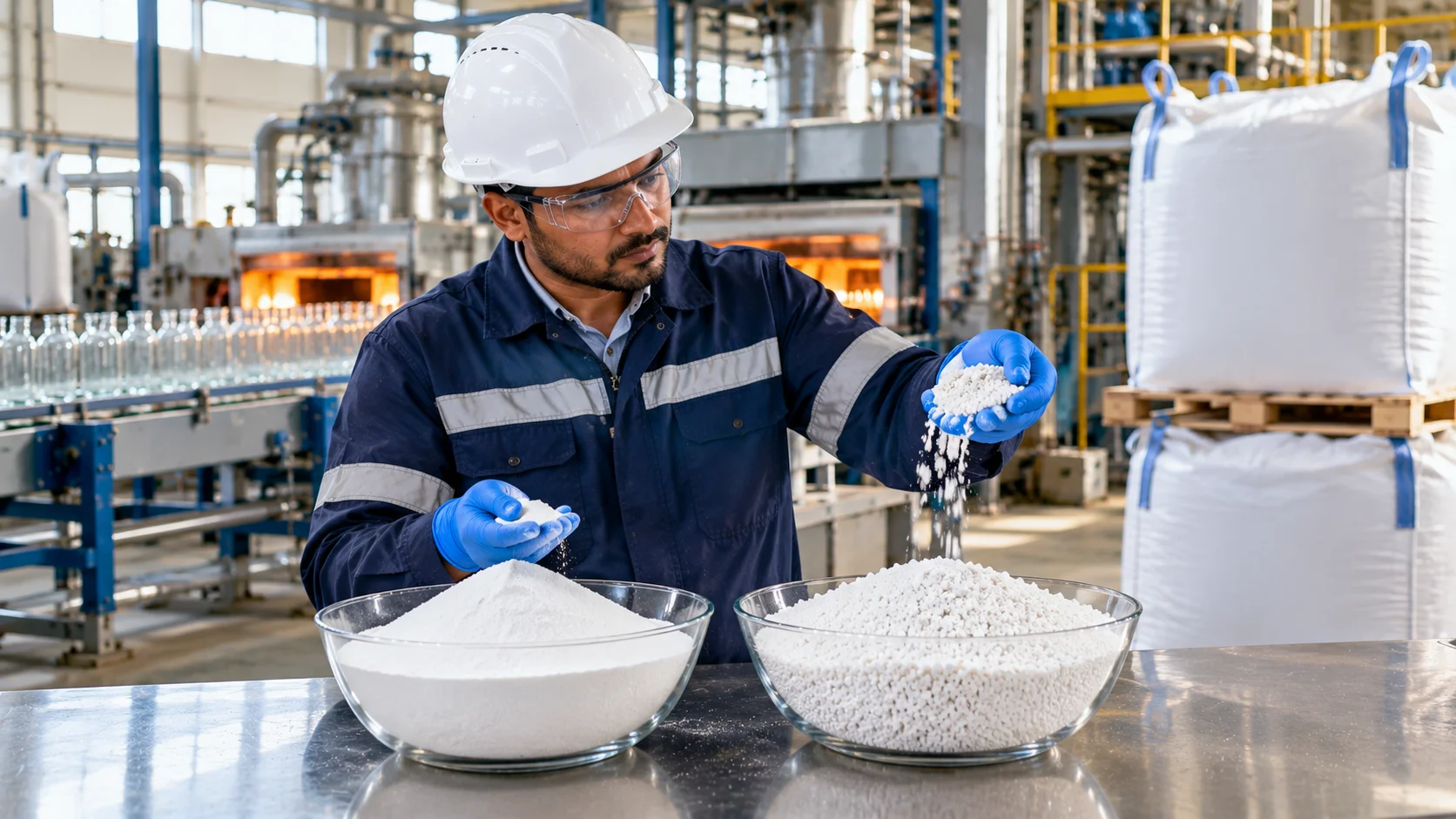
Soda Ash Light vs Dense: Differences, Industrial Uses and Bulk Buying Guide
Soda ash light vs dense is a common purchasing decision for glass manufacturers, detergent formulators, textile processors and other industrial chemical buyers. Both grades are sodium carbonate (Na2CO3), but they do not always behave the same way in a factory. Their physical form, particularly bulk density and particle size, affects feeding, mixing, dust generation, warehousing and freight planning.
That difference can matter even when the chemical assay is similar. If you buy solely on price per metric tonne, you may overlook a grade that is poorly matched to your production equipment. This guide compares light and dense soda ash, explains typical industrial uses and provides a practical bulk-purchasing checklist for buyers in India.
What Is Soda Ash (Sodium Carbonate)?
Soda ash is the common industrial name for anhydrous sodium carbonate, a white alkaline inorganic compound with the chemical formula Na2CO3 and CAS number 497-19-8. It is used in manufacturing glass, detergents, chemicals and various processes requiring alkalinity or pH adjustment. Its chemical identity is different from caustic soda (sodium hydroxide) and baking soda (sodium bicarbonate).
Why are there light and dense grades?
Light and dense soda ash are distinguished mainly by how the particles are processed and packed. Light soda ash is typically a finer, lower-bulk-density powder. Dense soda ash is generally coarser and packs more mass into the same bulk volume. The grades can share the same active chemical and similar assay while requiring different storage and feeding arrangements.
Do both grades have the same purity?
Not necessarily every batch or supplier, even though both are sodium carbonate. Different producers and specifications may impose different limits for assay, moisture, iron, chlorides, sulphates and insoluble matter. Confirm each quoted grade with a current technical specification and batch Certificate of Analysis (CoA).
Soda Ash Light vs Dense: Key Differences
The clearest distinction is bulk density—the mass of powder or granules occupying a given bulk volume, including spaces between particles. This is not the same as the solid's true material density. The following ranges are indicative of published manufacturer examples; your purchase specification should use the actual supplier's tested values.
| Buying factor | Light soda ash | Dense soda ash |
|---|---|---|
| Chemical formula | Na2CO3 | Na2CO3 |
| Typical physical form | Finer powder | Coarser, denser granules |
| Illustrative bulk density | Approximately 500–720 kg/m³ | Approximately 1,000–1,200 kg/m³ |
| Dust and conveying | Fine powder may create more airborne dust | Granular product can be easier for some bulk-handling systems |
| Common industrial preference | Detergents, chemical formulations and some water-treatment processes | Glass manufacturing and processes favouring granular bulk handling |
| Required checks | Assay, moisture, size distribution, bulk density | Assay, particle-size distribution, density, impurities |
For reference, Solvay describes dense soda ash at around 1 tonne per cubic metre and light soda ash at around 0.5 tonnes per cubic metre, with dense soda ash preferred in many glass operations. Tata Chemicals publishes a 550–720 kg/m³ bulk-density range for its light soda ash. These are examples of producer specifications, not universal guaranteed values.
Which Soda Ash Grade Is Better for Glass Manufacturing?
Dense soda ash is widely preferred for glass production because its granular size and handling behaviour can support more consistent batching with silica sand and other raw materials. Uniform mixing matters to furnace operation and finished glass quality.
Particle size and batch consistency
A granular grade may better match the handling system and particle characteristics of other glass-batch ingredients. Depending on plant configuration, reduced dusting and segregation can help achieve predictable feeding. The Tata Chemicals dense soda ash overview notes its suitability for blending with silica sand.
Do not change grade without a plant trial
The preferred grade is determined by the approved glass formula, conveying equipment, mixer and furnace conditions. A glass plant already qualified for one product should assess any proposed grade substitution through its normal technical and quality-change process.
Where Is Light Soda Ash Commonly Used?
Light soda ash is often selected when a finer powder is convenient for a chemical or detergent formulation, although density and powder flow must still be matched to the equipment. It is not automatically suitable for every application requiring alkalinity.
Detergents and cleaning formulations
Sodium carbonate acts as an alkaline builder and processing ingredient in a range of industrial cleaning and detergent products. Formulators may select light soda ash for its powder characteristics, but the full recipe, mixing sequence and permitted impurity levels control the final grade decision.
Chemical manufacturing
Soda ash is a feedstock in production of other sodium compounds, including some sodium silicates and bicarbonates. Product purity and physical handling can matter more than whether a supplier simply labels the material light or dense.
Water treatment and pH adjustment
Sodium carbonate can be used to add alkalinity and support certain water-softening or pH-adjustment processes. The required grade, purity and feed arrangement depend on the water's chemistry and the application. Do not assume an ordinary technical grade meets potable-water requirements without relevant certification.
Does Light Soda Ash Dissolve Faster Than Dense Soda Ash?
Finer powder often presents more surface area to water, so light soda ash may disperse or dissolve faster under some conditions. However, actual dissolution depends on water temperature, agitation, particle characteristics, wetting and the system design. Dense grades are not inherently chemically less soluble: both ultimately contain sodium carbonate.
For a plant preparing liquid solutions, compare powder feeding, clumping, dust, mixing time and equipment cleanability under its own operating conditions. Avoid relying on a supplier's generic “fast dissolving” claim without an application trial.
Bulk Density, Storage Space and Transport Economics
Bulk density affects the volume occupied by a given material mass. Using illustrative densities, one metric tonne of light soda ash at 600 kg/m³ occupies about 1.67 m³ of loose bulk space; one metric tonne of dense soda ash at 1,100 kg/m³ occupies about 0.91 m³. These figures are straightforward calculations, not guaranteed filling or shipping capacities.
Actual freight loading is also limited by vehicle payload, pallet configuration, package shape, legal transport limits and handling equipment. A denser grade can help when a shipment is volume-constrained, but a freight quote must consider all of those limits rather than bulk density alone.
Warehouse and hopper design
Use a grade that is compatible with the installed hopper, feeder, conveying lines and dust controls. Consider how moisture exposure, caking and variable bulk density could affect flow consistency. Equipment-specific review is important before a plant changes from one grade to another.
Buying cost versus operating cost
Compare the landed cost per usable tonne together with storage, dust collection, labour, formulation performance and off-specification risks. A small reduction in purchase price can be outweighed by changes in batching or handling costs.
What Should Buyers Check on a Soda Ash Certificate of Analysis?
A clear technical specification can prevent disputes during bulk procurement. Buyers should request a batch-specific CoA and a matching technical data sheet (TDS) that identify the actual grade offered.
- Sodium carbonate assay: the measured Na2CO3 content with reporting method and acceptance limits.
- Bulk density: a defined range relevant to the feeding and storage system.
- Particle-size distribution: sieve or other test data where consistent mixing or dust control is important.
- Moisture or volatile matter: important for storage stability and material handling.
- Chloride, sulphate, iron and insoluble matter: as required by the process or product-quality specification.
- Traceability: batch number, manufacturing or packing date, test date and appropriate supporting documents.
See our related guide on how to read a Certificate of Analysis for a practical approach to checking batch documentation.
Safe Storage and Handling of Soda Ash
Soda ash is alkaline and its dust can irritate the eyes, skin and respiratory tract. Always use the supplier's current Safety Data Sheet (SDS) and the facility's approved handling procedures.
Keep material dry
Store bags securely in a cool, covered and dry area, protected from leaks and high humidity. Keep opened material properly contained. Moisture exposure can encourage clumping or caking, affecting flow and accurate feeding.
Manage dust and incompatible materials
Use appropriate local dust-control equipment and personal protection according to the SDS and site risk assessment. Segregate from incompatible chemicals, including acids; carbonate reacts with acids and releases carbon dioxide. Never mix chemicals casually to “check” purity.
Identify the actual grade
Ensure dense and light grades are clearly identified in the warehouse and purchase records. If a batch appears altered, wet or unexpectedly clumped, follow the plant's quality-control procedure before use.
How to Buy Soda Ash Dense or Light in Bulk in India
BulkFineChem lists Soda Ash – Sodium Carbonate Dense and Light for industrial applications. Its product listing describes a 99.2% minimum Na2CO3 assay, 50 kg bags and 1 MT jumbo bags, with a minimum order quantity of 1 MT. These are website listing details; confirm the current stock, actual offered specification, packaging and delivery arrangements before ordering.

For a faster and more accurate quote, state:
- Required grade: light or dense, including any acceptable bulk-density or particle-size ranges.
- Application: glass, detergents, chemicals, textile processing, water treatment or another named use.
- Technical specification, assay requirement and key impurity limits.
- Purchase quantity, monthly consumption, packaging format and delivery location.
- Required CoA, SDS, TDS and any sector-specific compliance documentation.
- Any loading, unloading, storage or feeding-system restrictions.
If you are comparing multiple suppliers, also read our checklist for selecting a bulk chemical supplier in India.
Frequently Asked Questions
1. Is light soda ash chemically different from dense soda ash?
No. Both are sodium carbonate, Na2CO3. The primary differences are bulk density and particle characteristics. Actual impurity and assay specifications must still be checked batch by batch.
2. Which soda ash grade is typically preferred for glass?
Dense soda ash is commonly preferred because its granular characteristics are suited to many glass-batch mixing and handling systems. Always follow the glass plant's approved raw-material specification.
3. Why do detergent manufacturers often use light soda ash?
Finer powder characteristics can suit some detergent blending and formulation processes. The correct choice depends on the recipe, feeding equipment and quality requirements.
4. Is soda ash the same as caustic soda or baking soda?
No. Soda ash is sodium carbonate (Na2CO3), caustic soda is sodium hydroxide (NaOH), and baking soda is sodium bicarbonate (NaHCO3). They have different chemical behaviour and are not automatically interchangeable.
5. Does dense soda ash always cost less to ship?
Not necessarily. Higher bulk density can reduce the space required per tonne, but final freight cost depends on packaging, payload restrictions, destination and transport mode.
6. What documents should be requested before a bulk soda ash order?
Request the grade-specific technical specification, batch CoA and current SDS. Confirm packing, batch identification and any application-specific quality requirements.
Conclusion: Choose the Grade That Fits Your Process
The choice between soda ash light vs dense should start with the application and equipment, not just price. Dense soda ash often suits glass and high-volume granular handling. Light soda ash is frequently considered for detergent and chemical formulation work. Verify the offered batch specifications and evaluate the complete landed and operating cost before placing a bulk order.
Looking for soda ash in bulk? Visit BulkFineChem's soda ash product listing and share your required grade, quantity, industrial application and delivery location. Ask for the current batch CoA and technical documentation with your quotation.
Technical references: Solvay: dense and light soda ash properties; Tata Chemicals: Light Soda Ash; Tata Chemicals: Dense Soda Ash.