
A drum of lemon oil lands in your store in March, sealed and clean on paper. Four months of Gujarat heat later the batch smells flatter, the GC report shows limonene sliding down and oxygen climbing, and your fragrance customer wants to know why. That is not a bad supplier or a bad oil. It is ordinary essential oil storage going wrong in a warehouse that runs 38 to 42 degrees for four months of the year.
This guide covers what actually happens to an oil in the drum, how long each oil family keeps under Indian conditions, which container and handling choices slow it down, and which QC numbers tell you a lot is still acceptable before you release it into a batch.
Why Essential Oils Degrade in the Drum
An essential oil is not one molecule. It is a moving mixture of terpenes, alcohols, aldehydes, esters and phenolics, and the volatile parts react first. Heat speeds every one of those reactions, oxygen supplies the fuel, light starts them at the surface, and moisture from monsoon air gets in every time a drum is opened. The result is either oxidation, where a terpene turns into peroxides and then into aldehydes and acids, or polymerisation, where molecules join up and the oil thickens and darkens.
The smell you notice first is the loss of the top notes, because the most volatile molecules go first. A lemon oil that has lost limonene and citral does not smell like lemon anymore; it smells faintly of turpentine and cardboard. Underneath that, the acid value rises, which matters a lot if the oil goes into a food or pharma formulation.
Not every molecule behaves the same way. Monoterpenes such as limonene and pinene are the least stable things in the drum. Sesquiterpenes are slower. Phenolics such as eugenol and thymol are comparatively steady but darken with age and light. That difference is the whole reason shelf life by oil type exists rather than one blanket number on a label.
Which Oil Families Age Fastest
The first thing to sort out in your store is that oils do not share one shelf life. Citrus oils expressed from peel carry the highest load of limonene and oxidise faster than anything else on the list. Mint oils hold up better if menthol is stable and the storage is cool, but their aroma profile shifts noticeably once the ester fraction hydrolyses. Spice and woody oils sit at the calm end.
Say your store holds lemon oil, peppermint oil, clove oil and cedarwood in the same rack, in a Vadodara warehouse with no air conditioning. By the time Diwali stock planning starts, the lemon oil is the one that has moved the furthest from its original GC profile, and the clove oil has barely shifted in composition even though it looks darker.
Heat and oxygen do the damage. Light only shows you where it started.
Typical Shelf Life by Oil Family
The table below gives the ranges most suppliers work with when the oil is stored sealed, in the right container, away from light. Treat them as planning numbers for your own stock rotation, not as a guarantee, because a store that runs hot cuts every one of them.
| Oil Family | Typical Shelf Life (Months) | Main Change on Aging |
|---|---|---|
| Citrus (cold expressed) | 6-12 | Limonene drops, peroxides and acid value rise |
| Herbaceous and mint | 18-24 | Ester loss, aroma flattens, menthol mostly stable |
| Spice and phenolic | 24-36 | Slow darkening, composition largely holds |
| Woody and resinous | 24-48 | Slow thickening, note deepens |
| Carrier and fixed oils | 12-24 | Peroxide value climbs, off notes appear |

Citrus oils at 6 to 12 months are the tightest constraint in most stores, which is why they are usually bought against a firm order rather than held for stock. Herbaceous and mint oils at 18 to 24 months are comfortable if the drum stays closed and out of sunlight. Spice, phenolic, woody and resinous oils at 24 to 48 months are the ones you can carry as buffer stock. Carrier oils sit at 12 to 24 months and are governed by peroxide value rather than by aroma.
Storage Conditions That Actually Matter
Four variables decide how fast your stock ages, and in an Indian plant you can control three of them.
- Temperature. Hold the store as close to 15 to 25 degrees as your building allows and keep it out of direct sun. A drum on a tin roof floor in May sits far above that band and ages in weeks what would take months in a shaded room.
- Headspace and oxygen. Every time a drum is opened, air replaces the oil you drew out. Transfer to smaller containers as the level drops so the air gap stays small, and consider a nitrogen blanket on drums that will be drawn from repeatedly.
- Light. Store in opaque or amber containers and keep the lights off in the store room. UV starts oxidation at the surface, which then spreads inward through the drum.
- Humidity. Monsoon air carries enough moisture to hydrolyse esters in an open drum. Keep drums sealed, keep lids seated, and do not leave a drum standing open overnight on a wet floor.
For the full picture on humidity, PPE and segregation in a chemical store, the storage guidance in our Caustic soda flakes safety guide applies to oils just as it does to solids.
Choosing the Right Container for Bulk Oils
Container choice is where most buyers lose or gain six months of shelf life without realising it. The rule is simple: glass lined or stainless steel for anything that will be held, and never a container that leaches plasticisers into a terpene-rich oil.
| Container | Best For | Typical Hold (Months) |
|---|---|---|
| HDPE drum with liner | Short-term bulk, mint and herbaceous oils | 6-12 |
| Glass-lined MS drum | Long holding, spice and phenolic oils | 18-36 |
| Stainless steel 316 tank | Blending and large batch holding | 12-24 |
| Aluminium drum | Citrus oils for quick turnover | 3-6 |
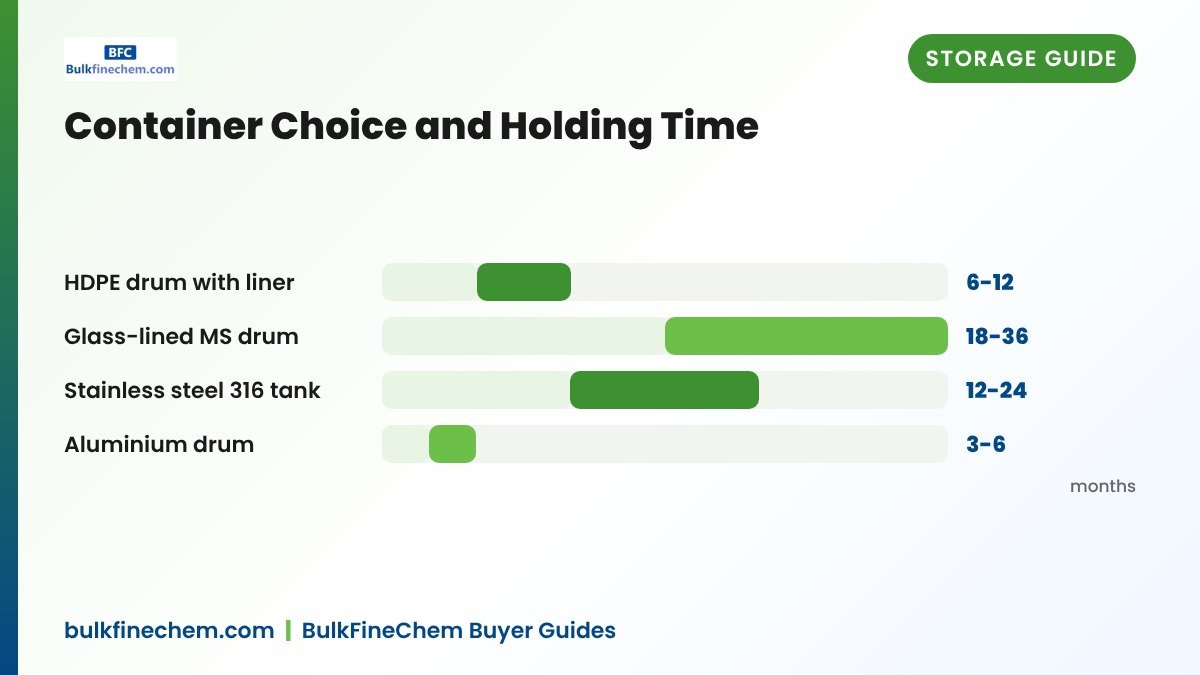
HDPE is convenient and cheap, but terpenes can pull plasticisers out of untreated plastic over long holds, so use it with a proper liner and only for stock that moves within a year. Glass-lined mild steel is the safest choice for clove, cinnamon and other phenolic oils that will sit. Stainless 316 works well for tanks you blend in, provided the gaskets and hoses are also solvent-rated. Aluminium is acceptable for citrus only when the drum is emptied quickly, because citrus oils attack aluminium linings over time.
Whatever you choose, the same container discipline applies whether you buy essential oils or the Carrier oils that go into the same formulation room.
A Receiving and Holding Checklist
Work through these steps on every inbound lot before the drums go to the rack.
- Check the paperwork. Match the batch number on the drum stencil to the COA and confirm the SDS and TDS are current for that grade, the way you would on any inbound lot covered in our COA versus SDS versus TDS guide.
- Inspect the drums. Look for swollen lids, weeping seams, rust staining or a sour smell at the bung. A swollen lid on a citrus drum means oxidation has already produced gas.
- Draw a retain sample. Take enough for a full GC run and keep a sealed duplicate labelled with the batch and the date. That retain is what settles a dispute in month eight.
- Run the opening tests. Record appearance, relative density, refractive index and odour against the specification before anything else.
- Assign a rack location. Write the rack, the shelf-life band from the table above and a retest date on the drum card the same day.
- Set a rotation rule. First in, first out by batch, with citrus oils pulled to the front of the queue and never held over a summer unless a fresh order is already placed.
Quality Checks Before You Release a Batch
Do not judge an aged drum by nose alone. Run the numbers and compare them to the retain sample from the day it arrived.
- GC-MS profile. Compare the major peaks against the original report and against the pharmacopoeial limits for the grade you bought, using the reading method in our How to read a GC-MS report for essential oils.
- Peroxide value. The clearest early signal of oxidation in citrus and carrier oils, well before the smell changes. Our Peroxide value in carrier oils guide explains the limits we work to.
- Acid value. Rising acid value means hydrolysis and oxidation have progressed. Important for any oil going into food or topical use.
- Relative density and refractive index. Cheap and fast, and a drift in either usually means volatile loss or adulteration.
- Colour and clarity. Darkening in eugenol and thymol oils is normal; cloudiness or a suspended layer is not.
A single small drift with a matching GC profile is normal ageing. A big drop in the main peak plus a rise in oxygenated byproducts is a different problem, and the adulteration checks in our Industrial uses of essential oils walkthrough help you tell the two apart.
Safety and Handling in the Store
Essential oils are flammable liquids and skin sensitisers, and they deserve the same discipline as any other hazardous stock. Keep the store ventilated, away from ignition sources, with the SDS at the point of use and a spill kit rated for flammable liquids. Wear nitrile gloves and eye protection when decanting; never pour from a drum at shoulder height.
Keep oxidisers, strong acids and strong alkalis in a separate bunded area, never on the same rack. Store oils below their flash point temperature wherever the building allows, and keep containers grounded when transferring in bulk to avoid static discharge. Rags soaked in citrus or spice oil must go into a closed metal bin the same shift, because oxidised terpene rags can self-heat.
Follow the SDS for each specific oil and the hazardous goods rules that apply in your state. Some oils carry transport classifications that change with concentration, so confirm the classification with your forwarder before moving stock.
What to Check Before Buying in Bulk
Order quantity should follow the shelf life of the oil, not the other way around. Before confirming a lot, ask for the grade and assay, the current COA for that batch, the SDS and TDS, the packing specification (drum size, liner material, headspace), the recommended storage band and the stated shelf life from the date of manufacture. Confirm the packing suits your own store: a 200 kg drum you cannot decant cleanly is a shelf-life problem waiting to happen.
Also agree the retest position in writing. A supplier who will re-run GC on a retained sample when a lot is queried is worth far more than a slightly lower rate on a lot you cannot defend.
Frequently Asked Questions
How long does lemon oil last in bulk storage in India?
Cold expressed citrus oils typically hold for 6 to 12 months in a cool, dark, sealed drum. In an unairconditioned store that runs above 35 degrees for months, expect the shorter end. Buy citrus oils against a firm order rather than holding them over summer.
Can I store essential oils in plastic drums?
Only for short holding, and only HDPE with a proper liner. Terpene-rich oils can extract plasticisers from untreated plastic over long periods, which shows up in the GC report. For anything you plan to hold beyond a year, use glass-lined or stainless steel 316.
How do I know if an essential oil has oxidised?
Check peroxide value and acid value first, then run GC-MS against the retain sample from the day it arrived. A drop in the main terpene peak with a rise in oxygenated byproducts confirms oxidation, often before the smell changes noticeably.
Does nitrogen blanketing help in bulk essential oil storage?
Yes, on drums and tanks that are drawn from repeatedly. A nitrogen pad over the oil keeps oxygen out of the headspace, which is where oxidation starts. It matters most for citrus and other high-limonene oils.
What temperature should an essential oil store be kept at?
Aim for 15 to 25 degrees and keep the stock out of direct sun. In most Indian warehouses that means a shaded, ventilated ground-floor store rather than a rack under a tin roof, and it is the single biggest lever on shelf life.
Do spice oils last longer than citrus oils?
Yes. Phenolic oils such as clove and oregano typically hold 24 to 36 months because eugenol and carvacrol are far more stable than limonene. They may darken with age, which is cosmetic rather than a quality failure.
How should I handle a drum that has swollen in storage?
Treat it as suspect. Gas in the headspace usually means oxidation has progressed. Do not open it near an ignition source, take a sample carefully, and run peroxide value and GC before deciding whether the lot can be used.
Conclusion
Getting essential oil storage right means matching each oil family to a realistic shelf life, a container that will not react with it, and a store that stays cool, dark and sealed. Citrus oils need the tightest rotation, spice and woody oils forgive the most, and a GC run plus a peroxide value on receipt tells you which drums are fine and which need to be used first.
Need a quote? Send your requirement to the BulkFineChem team with grade, quantity and destination, or browse All products.
Disclaimer: This article is general technical and procurement information. Always follow the product's Safety Data Sheet, Technical Data Sheet and the regulations that apply to your industry, and confirm suitability with trials before full-scale use.