
A drum of cold pressed almond oil can arrive smelling clean and tasteless on paper, then turn your cream batch musty three weeks after compounding. The number that usually predicts this before you open the drum is the peroxide value, and most buyers only look at it after a complaint lands.
If you buy carrier oils in bulk for cosmetics, pharma bases or food-adjacent use, this guide explains what peroxide value in carrier oils actually measures, the ranges that are normal for common oils, how to read it alongside the anisidine value, and what to check when a lot lands at your store in Indian heat and monsoon humidity.
What Peroxide Value Actually Measures
Peroxide value (PV) counts the hydroperoxides formed when oxygen attacks the double bonds in the fatty acids of an oil. It is reported as milliequivalents of oxygen per kilogram of oil, written as meq O2/kg, or sometimes as millimoles per kilogram. One meq O2/kg equals 0.5 mmol/kg, so a lab report that switches units without saying so can look like a failed lot when it passed.
Hydroperoxides are the first stage of oxidation. They are mostly odourless and invisible, which is why a drum can smell acceptable at 12 meq O2/kg and then collapse in a few weeks as those peroxides break down into aldehydes and ketones that smell like old paint. That is the reason PV is a warning signal, not a verdict on the smell in front of you.
The test is usually an iodometric titration, where the sample is dissolved in an acetic acid and chloroform mixture, potassium iodide is added, and the liberated iodine is titrated with sodium thiosulphate using starch indicator. Iodometric titration details are set out in the AOCS official method Cd 8-53 and in IS 14721 for oils and fats, so ask which method your supplier's lab follows.
Why It Matters More for Bulk Lots Than Retail Bottles
A 15 kg retail bottle turns over in weeks. A 190 kg drum may sit in a store in Gujarat for four months before it is decanted, and every degree above 30 C roughly doubles the rate of oxidation. The same oil that leaves the crusher at 2 meq O2/kg can reach 9 meq O2/kg by the time it reaches your tank.
Three things make bulk storage harder than the datasheet suggests:
- Headspace. A half-empty drum holds air against the oil surface, and the oxidation front moves inward from that surface, not from the bottom.
- Metal contact. Copper and iron traces from pumps, heating coils or old lines act as pro-oxidants and can push a stable oil into the double digits within a quarter.
- Temperature swings. Day heat and cool nights move air in and out of a breathing drum, which keeps bringing fresh oxygen to the surface.
For a formulator this shows up as a batch that fails an organoleptic check downstream. For a pharma or cosmetic buyer it becomes a stability study that has to be repeated, which costs more than the oil. That is the case for testing the incoming lot rather than trusting the COA alone.
Typical Peroxide Value Ranges by Oil Type
Oils rich in polyunsaturated fatty acids oxidise faster than those dominated by oleic acid or esters. Grapeseed and wheatgerm carry high linoleic loads, while jojoba is a liquid wax ester and barely oxidises at all. The bands below are the acceptance ranges commonly used for incoming bulk lots, and your own specification should be set against your finished product's stability target, not just these numbers.
| Oil Type | Typical Incoming PV (meq O2/kg) | Reject Level (meq O2/kg) |
|---|---|---|
| Cold pressed almond oil | 1-3 | Above 5 |
| Cold pressed grapeseed oil | 1-5 | Above 10 |
| Refined sunflower oil | 1-5 | Above 10 |
| Wheatgerm oil | 5-10 | Above 15 |
| Neem oil | 5-15 | Above 20 |
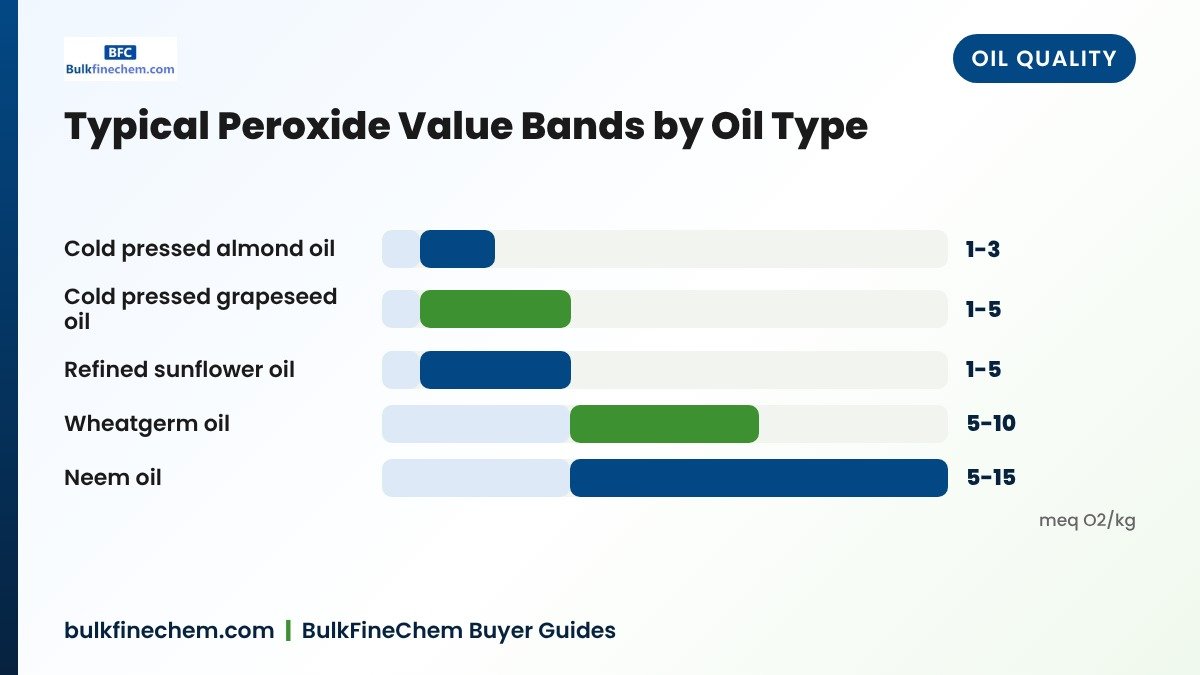
A refined sunflower oil at 4 meq O2/kg is comfortable, while a wheatgerm oil at the same number is unusually fresh for that oil. Wheatgerm and neem carry natural tocopherols and minor components that give a higher starting reading without meaning the oil is degraded, which is why a single cut-off applied to every oil in your store creates false rejections.
Neem deserves a note of its own. Cold pressed neem often arrives between 5 and 15 meq O2/kg with a strong characteristic odour that many buyers mistake for rancidity. Judge it against its own specification and trend it across lots instead of comparing it to a refined carrier oil.
Peroxide value tells you where the oil has been; the anisidine value tells you where it is going.
Reading PV With Anisidine Value and p-Anisidine Tests
Peroxides are unstable. Once an oil has passed its peak, peroxides decompose faster than they form, and the PV falls while the oil keeps getting worse. A drum reading 3 meq O2/kg that smells off is more suspicious than one reading 8, because the number has already peaked and dropped.
The anisidine value (AV) fills that gap by measuring the secondary aldehydic breakdown products. Combining the two gives the p-anisidine based oxidation score, commonly written as p-AV = 2 x AV + PV. For most edible grade vegetable oils a p-AV above 20 to 25 signals advanced oxidation, and a fresh oil usually sits below 12.
| Reading | What It Means | What to Do |
|---|---|---|
| PV low, AV low | Fresh oil, minimal oxidation | Accept and record the baseline |
| PV high, AV low | Recent oxidation, still early | Accept with limits, shorten your own shelf life |
| PV moderate, AV high | Old oxidation that has partly broken down | Reject or send for refining |
| PV high, AV high | Advanced deterioration | Reject the lot |
Ask for both numbers on the COA when you buy a heat sensitive oil. If only PV is reported, request the AV on the retained sample; the test is inexpensive and any competent oil lab runs it.
How to Test an Incoming Drum Lot
You do not need a full lab to screen lots, but you do need a repeatable method and a retained sample from every drum.
- Sample correctly. Draw from the middle of the drum after mixing, not from the bung. A drum that has stood for months has an oxidised layer at the top and a fresher body below.
- Split the sample. Keep half as a sealed, refrigerated retain in an amber glass bottle with minimal headspace so you can retest if a dispute arises weeks later.
- Run or send the PV titration. Do it within 48 hours of drawing, because peroxides keep forming in the sample bottle, especially in light and warmth.
- Record the trend, not just the value. Log lot number, manufacture date, PV, AV and the drum temperature on arrival. Two lots slightly over limit tell you more than one.
- Confirm with a smell and heat check. Warm a small amount in a closed glass vial at about 50 to 60 C and smell it. Heat accelerates the volatiles and reveals off notes that a cold sample hides.
- Quarantine before release. Hold new drums out of the compounding line until the PV is back. Releasing on paperwork alone is how one bad lot ends up in three production batches.
For a quick field screen, some buyers use peroxide test strips meant for frying oils. They are useful for spotting a badly oxidised drum but are not accurate enough to settle a specification dispute, so treat a strip result as a reason to run the titration, not as the result.
What to Check Before Buying in Bulk
Carrier oils are one of the few categories where a supplier's paperwork and the drum in front of you can both be honest and still disagree. Close that gap before the order, not after.
- Ask for the batch COA with PV and AV printed on it, plus the date of the test. A COA without a test date is not usable for a stability decision.
- Fix the specification in writing with a maximum PV at dispatch and a maximum at the end of shelf life, so both sides know which number governs.
- Confirm packing. Nitrogen flushed, fully filled amber drums or tin-lined drums with minimal headspace hold their PV far better than clear plastic containers under warehouse lighting.
- Check the free fatty acid and moisture figures on the same COA. High moisture accelerates hydrolysis and makes oxidation numbers climb faster.
- Ask about the refining route. Cold pressed, expeller and refined oils carry different starting PVs, and comparing them on one line is meaningless. Our Cold pressed versus refined carrier oil guide covers that split.
- Request the SDS and the grade declaration, and confirm whether the lot is BP, USP or food grade where that matters to your product. See How to read a certificate of analysis for the fields worth checking line by line.
For pharma facing purchases, the grade question comes first. The differences are laid out in IP vs BP vs USP grade oils, and the excipient choice between two common bases is covered in Sesame oil versus arachis oil.
BulkFineChem supplies carrier oils such as Almond oil, Grapeseed oil and Wheatgerm oil in bulk drums with COA and SDS available on request, with grade and specification confirmed before dispatch.
Storage Practices That Hold PV Steady
Good incoming numbers are easy to lose. The storage habits below keep a lot inside its specification for the full declared shelf life in most Indian plants.
- Keep drums full. Decant to smaller vessels as a drum empties so the headspace stays small instead of growing with every draw.
- Blanket with nitrogen on any tank you open more than once a week. A low pressure nitrogen blanket is the single most effective measure for polyunsaturated oils.
- Store cool and dark, ideally below 25 C and never near a wall that takes afternoon sun. Avoid racks near boiler returns or steam lines.
- Control humidity in the store. Gujarat monsoon air drives condensation on drum lids and corrodes the bung area, which introduces metal traces into the oil you draw next.
- Use the right pump. Avoid copper, brass and unprotected mild steel wetted parts. Stainless steel 316 is the safe default for oil transfer.
- Rotate strictly first in, first out and label every drum with the date it was opened, not just the date it arrived.
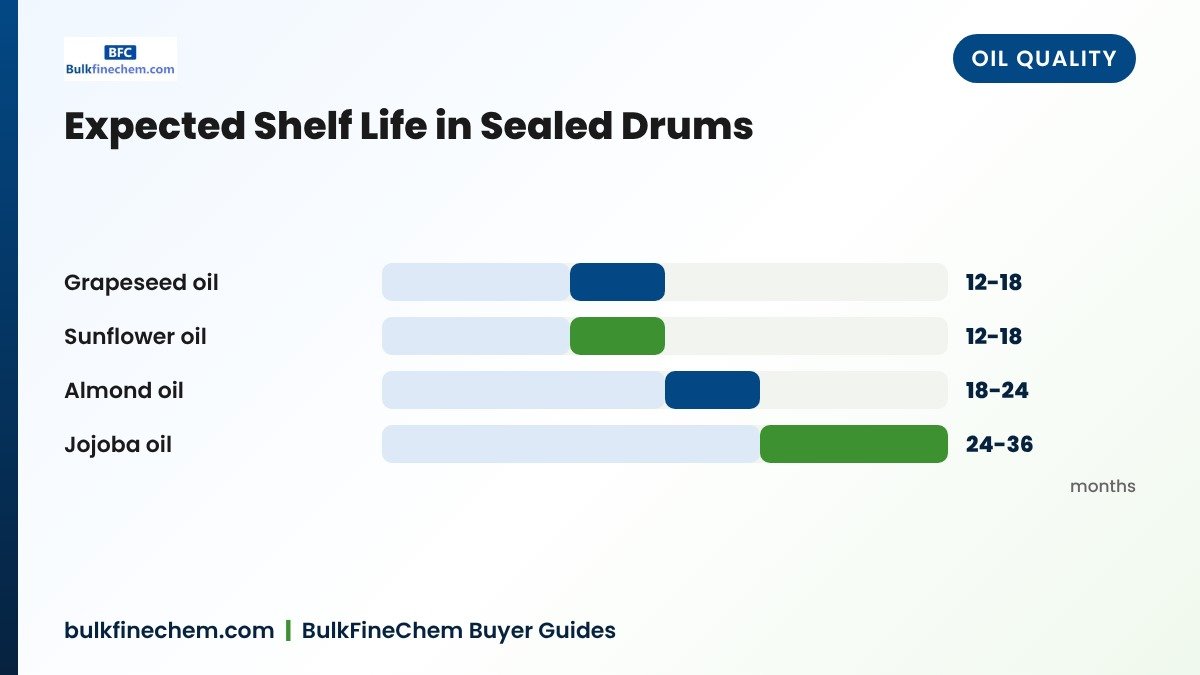
| Oil Type | Expected Shelf Life in Sealed Drums (months) |
|---|---|
| Grapeseed oil | 12-18 |
| Sunflower oil | 12-18 |
| Almond oil | 18-24 |
| Jojoba oil | 24-36 |
These assume sealed, nitrogen flushed, dark storage below 25 C. Once a drum is opened, treat the remaining oil as having a shelf life of two to three months regardless of the printed figure, because the headspace oxygen has already started the reaction.
Safety and Handling Notes
Oxidised oil is a housekeeping problem before it is a quality problem. Peroxide rich residues on rags and absorbent material can self-heat, so soak up spills with inert absorbent, place the waste in a metal bin with a lid, and do not leave oily rags in a heap overnight.
Wear nitrile gloves and safety glasses when sampling or decanting, and use a bunded area for transfers to contain a dropped drum. Never heat oil in an open vessel to speed up decanting in winter; use a warm room or a jacketed heater with a controlled set point.
Used or rejected oil must go to a licensed waste handler, not into the effluent line, since a film of oil upsets your ETP biology and can fail a CPCB discharge check. Always follow the product's Safety Data Sheet and the local hazardous waste rules that apply to your site.
Frequently Asked Questions
What is a good peroxide value for a bulk carrier oil?
For most refined and cold pressed plant oils an incoming reading below 5 meq O2/kg is comfortable, and below 10 is usually acceptable for oils like wheatgerm and neem that start higher. Set your own limit per oil rather than using one number for everything.
Can peroxide value go down during storage?
Yes. Once the oil passes its oxidation peak, hydroperoxides break down faster than they form and the PV falls while the smell and the aldehyde content keep rising. That is why a low PV on an old lot should be checked against the anisidine value.
What is the difference between peroxide value and acid value?
Peroxide value measures oxidation products from oxygen attack on double bonds. Acid value measures free fatty acids released by hydrolysis, usually from water or heat. An oil can have a low PV and a high acid value, so both belong on the COA.
How soon should a carrier oil sample be tested?
Within 48 hours of drawing it, stored cool and dark in a fully filled amber bottle. Peroxides keep forming in the sample bottle, so a delayed test reports higher than the drum actually was.
Does cold pressed oil have a higher peroxide value than refined oil?
Not necessarily at dispatch. Cold pressed oil keeps natural tocopherols that slow oxidation, while refining strips them out along with peroxides. Refined oil often starts lower and then rises faster once it is in your store.
How do I reduce peroxide value in a drum already received?
You cannot bring it down by filtering or deodorising at your plant. A lot over limit can be sent back for refining by the supplier, or moved to a non-critical application where the specification does not apply.
Conclusion
Peroxide value in carrier oils is the cheapest early warning you have against a rancid batch, as long as you read it with the anisidine value, against a limit set per oil type, and on a sample drawn and tested properly. Fix the specification before the order, test the incoming lot, and store drums full, cool, dark and nitrogen blanketed so the number you accepted is the number still in the drum at compounding.
Need a quote? Send your requirement to the BulkFineChem team with grade, quantity and destination, or browse All products.
Disclaimer: This article is general technical and procurement information. Always follow the product's Safety Data Sheet, Technical Data Sheet and the regulations that apply to your industry, and confirm suitability with trials before full-scale use.