

What Ferric Chloride Actually Does in the Clarifier
A lab report lands on your desk at eight in the morning. Suspended solids at the ETP outlet are above the consent limit again, and the supernatant in the clarifier looks grey and cloudy instead of clear. Before anyone orders more polymer, somebody has to ask what the coagulant dose was yesterday and what the pH was at the point of dosing. That is where ferric chloride dosing in an ETP clarifier earns its keep, because the same tank can run clean or dirty on a difference of thirty mg/L and half a pH unit.
This guide covers the coagulation chemistry in plain terms, typical dose ranges for mixed industrial effluent, the pH drop you have to plan for, sludge yield, and a jar test your own crew can run before the next shift. It is written for ETP operators, effluent chemists and the purchase managers who sign the coagulant indent.
How Ferric Chloride Coagulation Works
Ferric chloride is a low molecular weight metal salt. Dosed into water it hydrolyses fast, releasing ferric ions that neutralise the negative charge on colloidal solids. Once the charge is gone, fine particles stop repelling each other and stick together into floc that settles under gravity.
The hydrolysis reaction also produces hydrochloric acid, which is why ferric chloride is a strong acid coagulant. Alkalinity in the water absorbs that acid. When alkalinity runs short, pH falls and the floc stops forming properly. That single mechanism explains most of the complaints about turbidity creep after a coagulant changeover.
Coagulant dose and pH are one setting, not two. Change one and you have changed the other.
Three things decide how well the floc forms: the charge and size of the solids in the raw effluent, the alkalinity available to buffer the acid, and the mixing energy in the flash mix and flocculation zone. Dosing more chemical into a badly mixed tank only buys you more dissolved iron.
Typical Ferric Chloride Dose Ranges
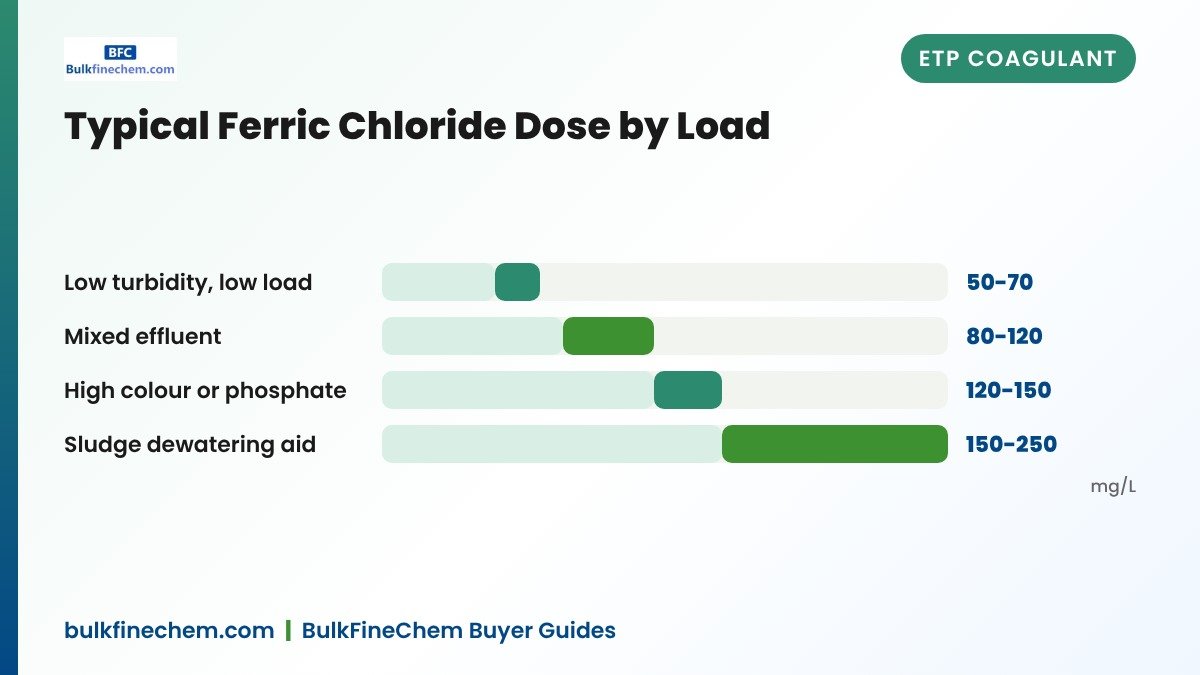
Dose depends on what is in the effluent, not on the design sheet. The table below gives ranges commonly seen in mixed industrial effluent treatment in India, for a plant dosing liquid ferric chloride made from the 95% hexahydrate slabs or from solution. Confirm every number with jar tests and the supplier's technical data sheet before you set a pump.
| Situation in the ETP | Ferric Chloride Dose (mg/L) | What to Watch |
|---|---|---|
| Low turbidity, low organic load | 50-70 | Overdosing gives clear but iron-rich water |
| Mixed effluent, typical daily load | 80-120 | Alkalinity may need topping up |
| High colour or phosphate load | 120-150 | PH often needs a lime or caustic boost |
| Sludge conditioning before dewatering | 150-250 | Raises filtrate iron, check downstream |
A textile or dye house running colour-rich effluent usually sits at the upper end of that range, since colour removal by ferric salts works best around pH 5. A food or distillery effluent with high alkalinity and low colour needs less coagulant but more attention to mixing. Say your plant treats 200 KLD and the load doubles during a festival-week production run: the dose that worked in March will leave carry-over solids in June unless you re-run the jar test.
The pH Drop and How to Manage It
Ferric chloride pulls pH down hard. A dose in the 100-150 mg/L range can move a poorly buffered tank by a full unit or more, and that shift decides whether you get fast-settling floc or a stable suspension that never settles.
The optimum band for ferric coagulation is roughly pH 5.0-6.5. Below 5.0 the ferric hydroxide redissolves and the settled sludge releases iron back into the water. Above 6.5 you waste coagulant on hydroxide that forms without capturing the colloids.
Practical ways to hold the band:
- Check alkalinity first. Measure raw effluent alkalinity as CaCO3 before dosing, since anything under about 50 mg/L means you have no buffer to spare.
- Dose alkali upstream. Add hydrated lime or caustic soda solution ahead of the coagulant so the pH correction happens before the floc zone, not after.
- Split the coagulant dose. Feed part of the ferric at the flash mix and part at the flocculation inlet to flatten the acid shock.
- Log pH continuously. A trending pH chart shows the exact minute the tank went out of band, which a manual reading once an hour never catches.
Neutralising that acid costs real money in lime or caustic, and it belongs in your cost comparison when you weigh ferric against a basic coagulant such as Poly aluminium chloride.
Jar Test Before You Touch the Dosing Pump
The jar test is the only honest way to set a dose. Run it on the actual effluent from the actual hour the plant is misbehaving, not on a sample drawn from the equalisation tank first thing in the morning.
- Collect a representative sample. Take it from the aeration or clarifier inlet, bring it to room temperature, and note the raw pH, turbidity and alkalinity before you start.
- Prepare a stock solution. Dissolve the ferric slab or dilute the solution to a working strength, then calculate so each millilitre you add equals a known mg/L in the beaker.
- Run a dose ladder. Test six beakers at spaced doses, covering roughly half to double the current pump setting, fast mix for one minute then slow mix for fifteen.
- Read the pH of every beaker. Write it down beside the dose, since the beaker that settles best is usually the one that landed in the pH band, not the one with the most chemical.
- Settle and measure. Let all beakers stand thirty minutes, then decant and measure supernatant turbidity and, if colour is the problem, colour.
- Confirm on the plant. Set the pump at the jar-test dose, run two hours, then recheck outlet suspended solids and sludge blanket depth before you walk away.
Six beakers on a Monday morning beats three weeks of pump tweaks. Keep the jar log with the batch records, since an auditor reading your consent report will want to see the basis for the dose.
Sludge Yield and What It Costs You
Every coagulant you add becomes sludge. Ferric chloride produces a dense, iron-rich sludge that thickens well in a gravity thickener but can turn sticky and hard to press if the polymer dose is mismatched.
As a working figure, ferric chloride typically yields around 0.30-0.40 kg of dry solids per kg of coagulant dosed, before polymer. Alum runs higher, often 0.45-0.60 kg, and PAC lower, around 0.25-0.35 kg. Treat these as planning numbers only, because the organic fraction of your effluent moves them about.
The practical consequences of a high ferric dose:
- Higher disposal tonnage. A dose cut from 120 to 90 mg/L removes roughly a quarter of your coagulant-derived sludge at the same treatment quality.
- More acid to neutralise. Less coagulant means less lime or caustic in the neutralisation stage.
- Iron in the filtrate. Return water from the filter press carries dissolved iron back to the front of the plant, so track it as a loop, not a one-way line.
- Sludge dewatering behaviour. Iron sludge releases water differently from aluminium sludge, so re-tune the polymer after any coagulant change.
If you are weighing ferric against the ferrous route, the oxidation step and the lime demand change the picture more than the per-kilogram coagulant price. The comparison is worked through in Ferric chloride vs ferrous sulphate for wastewater treatment.
Ferric Chloride, Alum and PAC Side by Side
Buyers often ask which coagulant to standardise on. The honest answer is that each has a job it does best, and many plants keep two on the shelf.
| Property | Ferric Chloride | Alum | PAC |
|---|---|---|---|
| Dose band (mg/L) | 50-150 | 80-200 | 40-120 |
| PH optimum | 5.0-6.5 | 6.0-7.5 | 6.0-7.8 |
| Alkalinity demand | High | Moderate | Low |
| Colour and phosphate removal | Strong | Moderate | Moderate |
| Sludge density | Dense | Medium | Light |

Ferric chloride wins where colour and phosphate have to come out together, and where the effluent is naturally alkaline enough to absorb the acid. Alum is forgiving in near-neutral water but leaves residual aluminium to worry about. PAC causes the least pH disturbance, which is why plants with tight discharge pH limits lean on it. For sludge and solids handling beyond the clarifier, the choice of Anionic or cationic polyelectrolyte matters as much as the metal salt.
Troubleshooting by Symptom
Most clarifier problems announce themselves before the lab report does. Learn to read the surface.
- White or grey cloud hanging in the supernatant. Usually under-coagulation or a pH that has crashed below the band; raise dose slightly and check alkalinity.
- Fine pin floc that will not settle. Over-shearing in the flash mix, or polymer overdosing; reduce mixing speed and cut polymer first.
- Rising sludge blanket with gas bubbles. Denitrification in the sludge zone; increase the sludge draw-off frequency rather than the coagulant dose.
- Yellow-brown clear water with high iron. Overdosing ferric at low pH; back the dose off and lift pH into the band.
- Carry-over only on one shift. Load shock from a specific production line, not a coagulant problem; look at the equalisation tank first.
Safety and Handling
Ferric chloride is corrosive, strongly acidic and attacks most common metals. Everything below follows the product Safety Data Sheet and your site's rules, not this article.
- Personal protective equipment. Wear acid-resistant gloves, goggles plus a face shield, a rubber apron and boots when handling slabs, drums or tank hatches.
- Never add water to the concentrate. Dilute by adding the chemical to a partly filled tank with the mixer running; the reaction gives off heat and can spit.
- Keep it away from incompatible materials. Store separately from alkalis, hypochlorite and other oxidisers, and never let it contact hypochlorite lines or tanks. The storage rules for chlorine products are covered in the Sodium hypochlorite storage guide.
- Protect the plant. Mild steel corrodes fast; dosing lines, foot valves and tank linings should be PVC, CPVC, PP or a suitably lined material, and the bund must be acid-resistant.
- Spills. Contain with inert absorbent, never with combustible sawdust, neutralise carefully with lime or soda ash and flush the residue to your neutralisation route.
- Fumes in the store. Slab rooms give off acidic vapour that eats pump bodies and instrument panels; keep the store ventilated and drums closed.
For the wider picture on storing acids and alkalis on the same site, the Sulphuric acid storage and handling guide covers segregation and bunding rules that apply equally here.
What to Check Before Buying in Bulk
Coagulant is a cheap chemical to buy and an expensive one to get wrong, because a weak batch shows up as a consent violation weeks later.
Ask for the Certificate of Analysis for the exact batch you are receiving, not a generic one. For ferric chloride the numbers that matter are assay as ferric chloride (the hexahydrate equivalent runs around 95% for slabs), water-insoluble matter, and free acid. Read the batch values against your specification the way the Guide to reading a Certificate of Analysis sets out, and reject anything where the insolubles are climbing, since those plug dosing pumps.
Also confirm before dispatch:
- Packing. Drums, carboys or IBCs for solution, and lined bags or drums for slab, matched to how your store actually unloads.
- Shelf life and storage. Solution loses strength in hot stores; in Gujarat and Maharashtra summer heat, keep the store cool and shaded.
- Documents. SDS, TDS and a GST invoice naming the grade and assay.
- Form on site. Decide between slabs you dilute yourself and ready solution, since dilution is a hazardous task that needs a trained crew and a proper dilution tank.
BulkFineChem supplies Ferric chloride for water treatment as a coagulant grade for effluent and clarifier duty, with COA and SDS available on order. Related inputs for the same circuit include Polyelectrolyte flocculant for the sludge side and Aluminium sulphate where a milder coagulant suits your pH limits.
Frequently Asked Questions
What is the typical ferric chloride dose for an ETP clarifier?
For mixed industrial effluent, doses commonly fall between 50 and 150 mg/L, with colour or phosphate-heavy loads at the higher end and low-turbidity effluent at the lower end. Set the actual figure by jar test on your own effluent.
Why does ferric chloride lower pH more than alum or PAC?
Ferric chloride hydrolyses in water and releases hydrochloric acid, so it consumes the natural alkalinity of the effluent. Alum does this to a lesser degree and PAC, being a pre-hydrolysed basic salt, disturbs pH the least.
What pH should I hold for ferric chloride coagulation?
Roughly 5.0 to 6.5. Below 5.0 the ferric hydroxide redissolves and iron returns to solution, while above 6.5 you waste coagulant on hydroxide that does not capture colloids.
Can ferric chloride replace polymer in my ETP?
No, they do different jobs. Ferric chloride destabilises the colloidal charge and forms the pin floc, while a polyelectrolyte binds those flocs into larger, faster-settling aggregates. Most clarifiers need both, correctly sequenced.
How much sludge does ferric chloride generate?
A useful planning figure is around 0.30 to 0.40 kg of dry solids per kg of coagulant, before any polymer contribution. Alum generally yields more and PAC less, but your organic load shifts these numbers.
How do I dilute ferric chloride slabs safely?
Always add the chemical to a partly filled tank with the mixer running, never the reverse, and wear acid-resistant gloves, goggles, a face shield and an apron. The dissolution is exothermic, so do it in stages and let the tank cool before topping up.
Which documents should I ask for before accepting a bulk coagulant order?
A batch-specific Certificate of Analysis showing assay and water-insolubles, a current Safety Data Sheet, a Technical Data Sheet with the grade and form, and a GST invoice that names the grade. Match the batch values against your own specification before unloading.
Conclusion
Getting ferric chloride dosing in an ETP clarifier right comes down to three measurements taken together: the dose, the pH at the floc zone, and the alkalinity you started with. Hold the pH in the 5.0-6.5 band, dose from a jar test rather than from habit, and watch sludge yield as your second check that the dose is not creeping upward. Re-run the jar test whenever the effluent changes, which in most Indian plants means at least with the season.
Need a quote? Send your requirement to the BulkFineChem team with grade, quantity and destination, or browse All products.
Disclaimer: This article is general technical and procurement information. Always follow the product's Safety Data Sheet, Technical Data Sheet and the regulations that apply to your industry, and confirm suitability with trials before full-scale use.