
A beverage line stops on a Thursday afternoon because the syrup pH has drifted two tenths and the batch will not pass QC. The formulator's first move is usually a citrate adjustment, and the second is a call to the supplier about the bag that just arrived. Sodium citrate sits in that kind of moment a lot more often than buyers expect: a small white salt that decides whether a drink tastes clean or flat, whether a cheese slice melts evenly, and whether an effervescent tablet fizzes in the glass or in the pack.
This guide covers sodium citrate bulk buying from the specification side: the three common grades, the numbers worth putting on your purchase order, how the salt behaves as a buffer in a drink or a tablet base, and what to check on the COA before you commit a batch. Doses and limits are typical ranges for guidance, so confirm them against your own trials and the supplier's Technical Data Sheet.
What Sodium Citrate Actually Does in a Formula
Sodium citrate is the sodium salt of citric acid, and it brings three jobs to a formulation at once. It buffers, meaning it holds pH in a narrow band instead of letting it swing when acid or alkali enters the system. It sequesters hardness ions such as calcium and magnesium, which keeps haze and scale from forming in a syrup line. And in melted cheese systems it pulls calcium out of the casein network, which is why it is the standard emulsifying salt in processed cheese.
That triple job is why a buyer cannot swap citrate for another acid salt without checking the label claim. Citric acid on its own drops pH. Sodium citrate raises or holds pH while adding the same citrate ion, so the taste profile stays rounded rather than sharp.
Sodium citrate buys you pH control you can taste: the same citrate ion, without the acid bite.
The Three Grades You Will See on a Quote
Most Indian enquiries resolve to trisodium citrate dihydrate, the familiar white granular salt with three sodium ions per molecule. Monosodium citrate and disodium citrate exist but are ordered far less often and usually only for a specific pH target. The difference is not cosmetic: the degree of substitution changes the pH the salt produces in solution, so a plant that switches from TSA to a mono or di form without reformulating will see the finished pH move.
Ask the supplier to name the grade as the molecule, not just as "food grade citrate". A quote that says trisodium citrate dihydrate, FCC grade, with a COA referencing the assay and heavy metals leaves you much less room for surprises at the gate.
Specifications Worth Writing on the Purchase Order
Assay on the dried basis, loss on drying, pH of a dilute solution and heavy metals as lead are the four numbers that decide whether a lot is workable. Particle size matters more than most buyers think, because a fine dust dissolves fast but dusts across the weighing room and can bridge in a hopper, while coarse granules need more mixing time in a cold syrup.
Write these into the PO with the units exactly as above, and ask for the COA to be lot-specific rather than a typical-values sheet. A typical-values sheet tells you what the plant usually makes; a lot COA tells you what is in your drums. For a refresher on reading those documents, this How to read a Certificate of Analysis walkthrough covers the columns that matter.
Typical Use Levels by Application
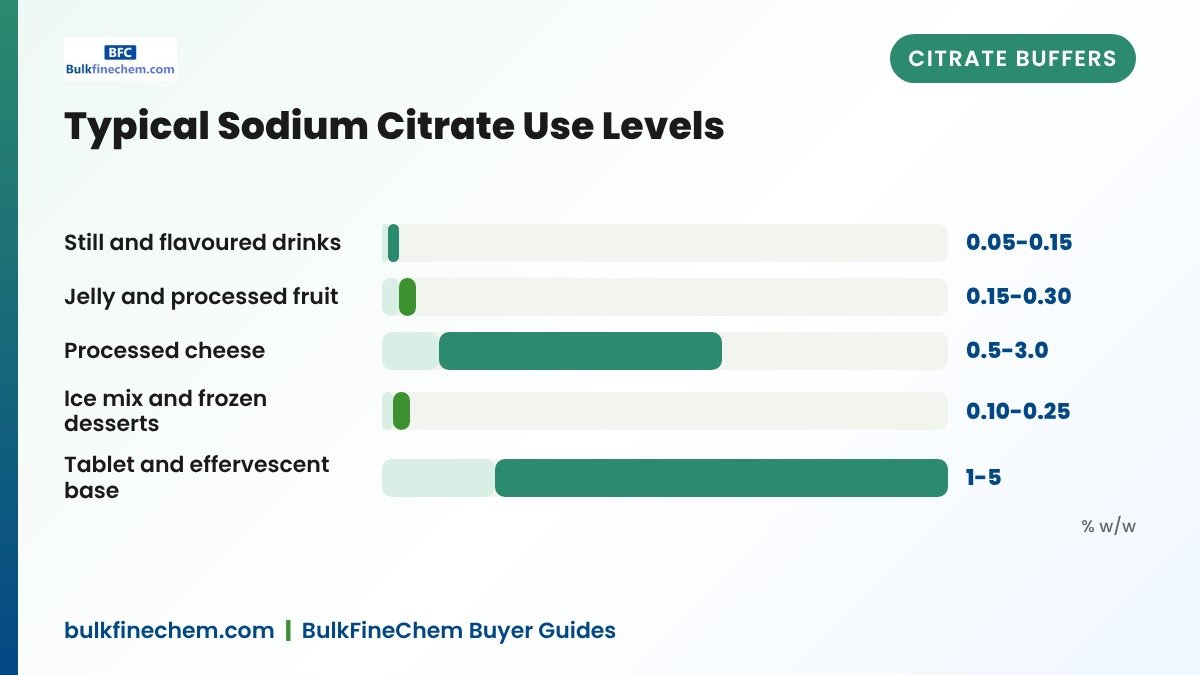
Use levels are small in drinks and larger where the citrate has to do structural work. In a still or flavoured beverage the salt is a buffer at a fraction of a percent. In processed cheese it is an emulsifying salt at a much higher inclusion, and in an effervescent tablet base it is part of the acid-alkali pair that drives the fizz.

Treat those as starting points from standard practice, not as finished formulas. A cheese plant moving from a phosphate blend to citrate will usually step the inclusion up in stages and run melt tests at each step. A beverage plant reformulating for a lower-sugar recipe often finds it needs slightly more citrate buffer to keep the same perceived freshness once the sugar body is gone.
Buffering Behaviour in a Beverage Syar
The practical value of sodium citrate in a drink is buffer capacity, not pH on its own. Citric acid plus sodium citrate forms a citrate buffer pair, and the ratio between the two decides where the pH settles. Say your concentrate runs at pH 3.2 with citric acid alone and the flavour drops off after two weeks on the shelf. Adding citrate at around 0.1% w/w holds the pH steadier across storage, and the acidity reads as smoother on the palate.
Three things change that balance in a real plant: water alkalinity, which eats buffer capacity before your acid even starts; the acid blend, since malic and phosphoric acids behave differently from citric; and heat load in the pasteuriser, which can shift measured pH a few hundredths. Measure the finished product at room temperature, because a hot reading is not comparable to your stability samples.
Sodium Citrate vs Citric Acid in a Syrup
Buyers often ask whether the two can be used interchangeably because both carry the citrate name. They are not interchangeable. Citric acid is the acidifier that pulls pH down and gives the sharp front note. Sodium citrate is the buffer salt that lifts or holds pH and rounds the same acidity.
In a syrup that has to hit pH 3.0, citric acid does most of the work and a small citrate addition keeps it there. In a low-acid drink or a dairy-based beverage, citrate does most of the work and the acid is trimmed back. If your current recipe uses only citric acid, this comparison of Citric acid anhydrous vs monohydrate is worth reading alongside the grade question, since the water content of the acid changes how much dry acid you dose.
Safety and Handling
Sodium citrate is a low-hazard food salt, but treat it as a fine chemical in the store. Wear a dust mask and safety glasses when decanting or charging a hopper, since the dust is an eye and respiratory irritant. Wash hands after handling and keep the bag closed between uses.
Store drums in a cool, dry, well-ventilated area off the floor on pallets, away from strong acids and oxidisers such as hypochlorite. In Gujarat and Maharashtra monsoon humidity from June to September, a torn inner liner lets the salt pick up moisture and block into lumps that will not pass a sieve. Keep it away from the acid store, since citrate with a strong acid gives an acidic solution with heat. Follow the product's Safety Data Sheet and your local food safety rules, and clean spills with water while the floor is still wet to avoid a slip.
What to Check Before Buying in Bulk
Confirm the grade and molecule before price enters the conversation. A working checklist keeps the wrong lot out of your plant:
- Name the molecule. State trisodium citrate dihydrate or anhydrous on the enquiry, with FCC or food grade as the standard you need.
- Ask for a lot COA. Assay, loss on drying, pH of a 2% solution and heavy metals as lead, with the lot number and date of manufacture printed on it.
- Check the packing. 25 kg multi-layer bags or HDPE drums with a poly liner, new and unopened, with the batch number on every unit.
- Fix the shelf life. Ask for the remaining shelf life at dispatch, not just the total, so your QC retest schedule lines up.
- Match the particle size. Coarse or fine, written as a sieve figure, so your dissolving tank and tablet compression step behave the same lot to lot.
- Keep the paperwork. GST invoice, SDS and Technical Data Sheet with the order, and export documents if the lot is for a re-export market.
For the wider supplier question, this Bulk chemical supplier checklist for India covers qualification points that apply to citrate as much as to any other ingredient.
Storage, Shelf Life and Monsoon Handling
Keep the store below 30 degrees C where you can, relative humidity under 70%, and bags or drums sealed the moment they are opened. Sodium citrate is not hygroscopic the way caustic soda is, but a fine powder in an open bag in a Vadodara July will still cake. Rotate stock on a first-in-first-out basis and retest anything that has sat past its pack date before it goes into a validated batch.
If your plant runs a humid pre-monsoo period, keep the drums under shrink wrap until the moment of use and avoid storing near a caustic soda or acid bay where vapour can reach the bags. This guide to Cold pressed vs refined carrier oils is a different subject, but its storage section shows the same discipline applied to another bulk ingredient line.
Frequently Asked Questions
What is the difference between trisodium citrate and citric acid?
Citric acid is the acidifier that lowers pH and gives a sharp sour note. Trisodium citrate is its sodium salt, which holds or raises pH while supplying the same citrate ion, so it works as a buffer and sequestrant rather than an acidifier.
Which sodium citrate grade should a beverage plant buy?
Most beverage buyers order trisodium citrate dihydrate, food grade, and specify assay on the dried basis, loss on drying, pH of a 2% solution and heavy metals as lead. State whether you need coarse or fine granules so it dissolves properly in a cold syrup.
How much sodium citrate is typical in a drink?
In still and flavoured drinks a typical inclusion is around 0.05-0.15% w/w, used as a buffer alongside citric acid. Treat that as a starting point and confirm it by jar tests against your target finished pH.
Is sodium citrate the same as an emulsifying salt in cheese?
In processed cheese systems sodium citrate is one of the standard emulsifying salts, typically at 0.5-3.0% w/w, because it binds calcium in the casein structure and helps the melt stay smooth. Phosphate blends do a similar job and are not directly interchangeable.
What documents should come with a bulk sodium citrate order?
Ask for a lot-specific COA with the batch number, the SDS, the Technical Data Sheet and the GST invoice. For export lots add the packing list and any certificates your destination market requires.
Does sodium citrate cake in storage?
It can in high humidity, especially in an opened bag during the June to September monsoon in western India. Keep packs sealed, store off the floor in a dry ventilated room, and retest any lot that has gone past its pack date before using it.
Can sodium citrate be used in effervescent tablets?
Yes, citrate salts are used in effervescent and buffered tablet bases as part of the acid-alkali pair, typically at 1-5% w/w of the base. Confirm the grade, particle size and moisture with your formulation and the supplier's TDS before compression trials.
Conclusion
Sodium citrate bulk buying comes down to four things: name the molecule you need, put the assay, loss on drying, pH and heavy metals numbers on the PO, dose from a jar or bench trial rather than a guess, and keep the store dry through the monsoon. Get those right and the salt quietly does its job as a buffer, a sequestrant and an emulsifying salt without ever becoming a QC problem.
Need a quote? Send your requirement to the BulkFineChem team with grade, quantity and destination, or browse All products. You can also look at the Food and industrial grade sodium citrate product page directly.
Disclaimer: This article is general technical and procurement information. Always follow the product's Safety Data Sheet, Technical Data Sheet and the regulations that apply to your industry, and confirm suitability with trials before full-scale use.