
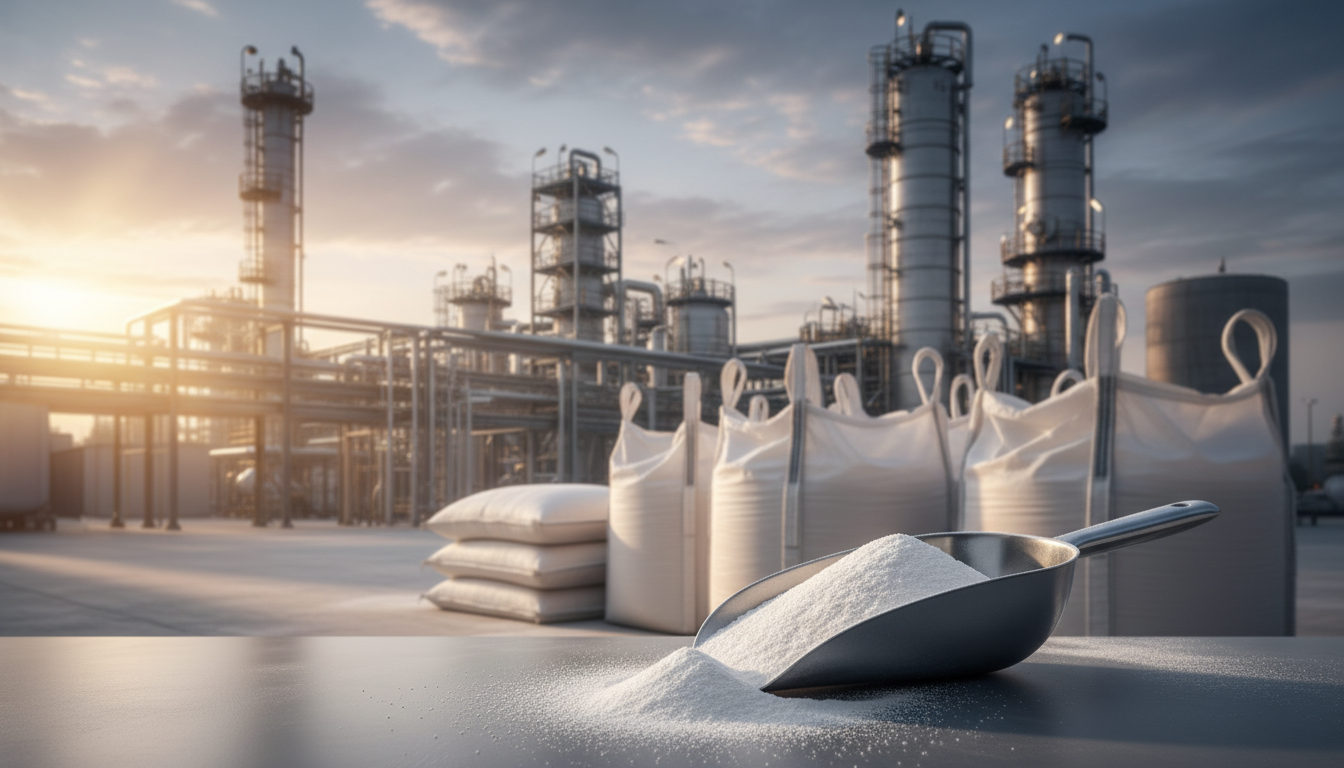
Sodium bicarbonate has a split personality. In your kitchen, it's baking soda — mild, food-safe, barely worth a second thought. In an industrial plant, the technical grade version is doing far more demanding work: scrubbing sulfur dioxide out of flue gas, suppressing Class B and C fires, and buffering pH during leather processing.
Both are the same molecule, NaHCO₃, but technical grade sodium bicarbonate is a different product from what goes into food — different purity target, different particle form, and definitely not approved for consumption. Here's what buyers sourcing it in bulk need to know.
What Is Technical Grade Sodium Bicarbonate?
Sodium bicarbonate is produced industrially through the Solvay process or as a co-product of soda ash refining, reacting sodium carbonate with carbon dioxide and water. Technical grade material typically runs 97–99% purity, a step below the 99.9%+ purity of pharmaceutical or USP grade, and it's manufactured without the additional purification steps that food-grade production requires.
That gap in purity isn't a flaw — it's a deliberate cost and process trade-off. Industrial buyers using bicarbonate for pH adjustment or gas scrubbing don't need pharmaceutical-level purity, and paying for it would be wasted money.
Grade Comparison at a Glance
| Grade | Typical Purity | Common Use |
|---|---|---|
| Technical/Industrial | 97–99% | Flue gas treatment, fire suppression, leather, water treatment |
| Food Grade | ≥99% | Baking, beverage carbonation, food preservation |
| Pharmaceutical/USP | 99.9%+ | Medical and pharmaceutical formulations |
Particle form matters here too — powder gives faster reactivity for applications like gas scrubbing, while granular or crystal forms reduce dust and handle better in bulk automated feed systems.
Where Technical Sodium Bicarbonate Gets Used
Once it leaves the food and pharma world, sodium bicarbonate shows up in some genuinely unexpected corners of industrial processing.
Flue Gas and Emissions Treatment
Power plants and waste incinerators inject finely milled sodium bicarbonate into flue gas streams, where it reacts with sulfur dioxide and acid gases to neutralize them before they reach the stack. It's become one of the standard dry-sorbent injection methods for emissions compliance.
- Dry sorbent injection for SO₂ and acid gas scrubbing
- Waste-to-energy plant emissions control
- Industrial boiler flue gas treatment
Fire Suppression
Sodium bicarbonate is a core active ingredient in dry chemical fire extinguishers rated for Class B (flammable liquid) and Class C (electrical) fires — it smothers flame by releasing carbon dioxide and interrupting the combustion reaction when heated.
- Dry powder fire extinguisher formulations
- Kitchen and industrial fire suppression systems
- Fire-retardant powder blends
Leather, Textile and Water Treatment
Tanneries use it to adjust pH during leather processing, textile mills use it in dye-bath buffering, and water treatment plants rely on it as a milder alternative to caustic soda for pH correction.
- pH buffering in leather tanning processes
- Dye-bath pH control in textile wet processing
- Water treatment pH adjustment
- General industrial cleaning and neutralizing agent
Technical Grade vs Food Grade: Why It Matters
It's tempting to think "it's all baking soda anyway," but that assumption can cause real problems if the grades get mixed up in your supply chain.
- Technical grade carries no food-safety certification and isn't approved for consumption
- Impurity limits are set for industrial tolerance, not ingestion safety
- Documentation and testing protocols differ between the two supply chains
- Using technical grade in a food or pharma application is a compliance risk, not just a quality shortcut
Always confirm the intended-use grade on the product listing before ordering, and keep technical and food-grade stock clearly separated in your warehouse if you handle both.
Sourcing Technical Sodium Bicarbonate in Bulk
Since this is typically bought by weight for continuous process use — dry sorbent injection systems can consume it by the tonne — consistency between batches matters as much as the initial spec sheet.
- Confirm MOQ by kg, MT or L based on your consumption rate
- Request a batch-wise Certificate of Analysis on every shipment
- Ask for particle size distribution data if you're feeding an automated dosing system
- Get TDS/SDS documentation on file for your safety and compliance records
- Check e-way bill and logistics requirements for large-volume, pan-India delivery
BulkFineChem ships technical grade sodium bicarbonate with a GST tax invoice and CoA on every order, so your QC team has the paper trail it needs before the material goes into your process.
FAQs About Technical Grade Sodium Bicarbonate
Is technical grade sodium bicarbonate safe to use in food?
No. It's manufactured and tested for industrial tolerance levels, not food safety. Use dedicated food-grade sodium bicarbonate for any food or beverage application.
What's the difference between powder and granular sodium bicarbonate?
Powder form reacts faster and is preferred for gas-scrubbing applications where surface area matters. Granular or crystal forms reduce dust and flow better through bulk automated handling systems.
Why is sodium bicarbonate used in flue gas treatment instead of lime?
It reacts efficiently with acid gases at lower temperatures than some alternatives and produces a byproduct that's often easier to handle downstream, though the right choice depends on your specific plant setup and gas composition.
Can technical grade sodium bicarbonate replace caustic soda for pH adjustment?
In some applications, yes — it's a milder alkali and safer to handle, though it has lower neutralizing capacity per kg. Confirm against your specific process requirements before substituting.
What documentation comes with a bulk order?
A GST tax invoice and batch-wise Certificate of Analysis as standard, with TDS/SDS available on request for compliance filing.
Does BulkFineChem supply other grades of sodium bicarbonate?
Check current listings for grade-specific products, or request a quote via Quick Order specifying your intended application so the right grade gets confirmed before dispatch.
The Bottom Line
Technical grade sodium bicarbonate does some of its most valuable work far away from any kitchen — cleaning up flue gas, suppressing fires, and keeping tannery pH in check. Match the grade to the application, insist on a batch CoA, and it'll do exactly what your process needs it to.
Related Products:
- Sodium Bicarbonate Technical Grade – Sodium Hydrogen Carbonate
- Soda Ash – Sodium Carbonate Dense and Light
- Caustic Soda Flakes – Sodium Hydroxide 98 Percent
Sourcing technical grade sodium bicarbonate for your plant? View the product listing for current specs, or go to Quick Order to request a quotation.