

A tanker fills your clear water storage tank after a monsoon flush, the turbidity reads clean, and two days later the lab reports total coliforms again. That is the moment plant engineers in Vadodara and Ankleshwar start asking about calcium hypochlorite shock dosing, because a steady low dose through a hypochlorinator is not going to fix a biofilm that is already established on the tank wall.
This guide covers what shock dosing actually means, how to read the available chlorine figure on the Certificate of Analysis, the typical dose ranges for tanks, lines, clarifiers and cooling towers, and the storage rules that decide whether your granular chlorine is still active after three months in a Gujarat store.
What Shock Dosing Means in Practice
Shock dosing means raising the free chlorine residual far above the normal operating level for a fixed contact period, then letting it fall back down before the water goes back into use. A routine dose might hold 0.2 to 0.5 mg/L free chlorine at the far end of a network. A shock dose starts at 10 to 50 mg/L at the point of application and is allowed to decay.
The difference matters because the target is not the water. It is the surface. Biofilm on a tank wall, slime inside a pipeline, or a filter bed that has gone septic needs a much higher concentration held long enough to reach the microorganisms hiding inside the matrix. Continuous low dosing only treats the water passing by.
A shock dose treats the surface. A routine dose only treats the water.
Calcium hypochlorite suits this job because it carries far more available chlorine per kilogram than liquid bleach, so you can hit a high concentration without dumping extra water volume into a tank you are already filling.
Reading Available Chlorine on the COA
Calcium hypochlorite is sold as granules or tablets, commonly at 65 to 70 percent available chlorine on a fresh COA. That number is the whole basis of every dose calculation, and it is not fixed. It falls with heat, with humidity and with time in a partially opened pack.
Say your COA reports 65 percent available chlorine on the date of packing, the drums have sat in a store room at 38 degrees through a Gujarat summer, and three months later the same lot tests at 55 percent. Your dose by weight is now short by about 15 percent, and the residual at the far end of the network quietly drops below the limit. This is why you test the residual, not just the dosing pump setting.
| Item on the COA | What to check | Why it matters |
|---|---|---|
| Available chlorine | 65-70% at packing, retest if the lot is old | Sets the dose by weight for any target mg/L |
| Moisture or insolubles | Low insolubles in granular grade | High insolubles mean sludge in your dosing tank |
| Packing condition | Sealed drums, no bulging, no caking | Caking means the lot has already lost strength |
| Shelf and batch number | Batch matches the delivery challan | Lets you trace a failed residual back to one lot |
Dose by weight is simple once the figure is confirmed. Divide your target mg/L by the available chlorine fraction, then scale to your volume. For 50 mg/L in a 500 KL tank at 65 percent available chlorine, that works out to roughly 38.5 kilograms of granular product. Confirm the number against the supplier's Technical Data Sheet and your own residual tests before you commit it to a procedure.
Typical Shock Doses by Application
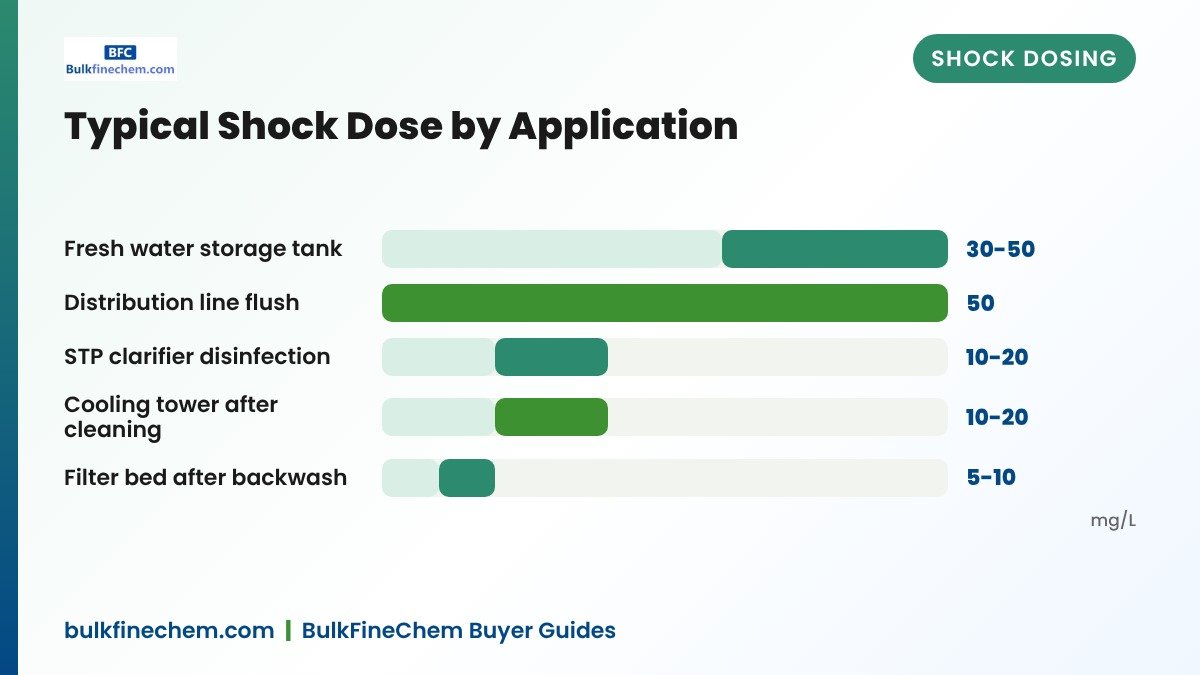
Doses differ by what you are treating, because the chlorine demand of a bare steel tank is nothing like the demand of a sludge-covered clarifier. The ranges below are standard practice for industrial and municipal water works, and every one of them needs a follow-up residual test to confirm.
| Application | Typical shock dose (mg/L) | Contact time (hours) |
|---|---|---|
| Fresh water storage tank | 30-50 | 12-24 |
| Distribution line flush | 50 | 8-24 |
| STP clarifier disinfection | 10-20 | 4-8 |
| Cooling tower after cleaning | 10-20 | 4-12 |
| Filter bed after backwash | 5-10 | 4-8 |
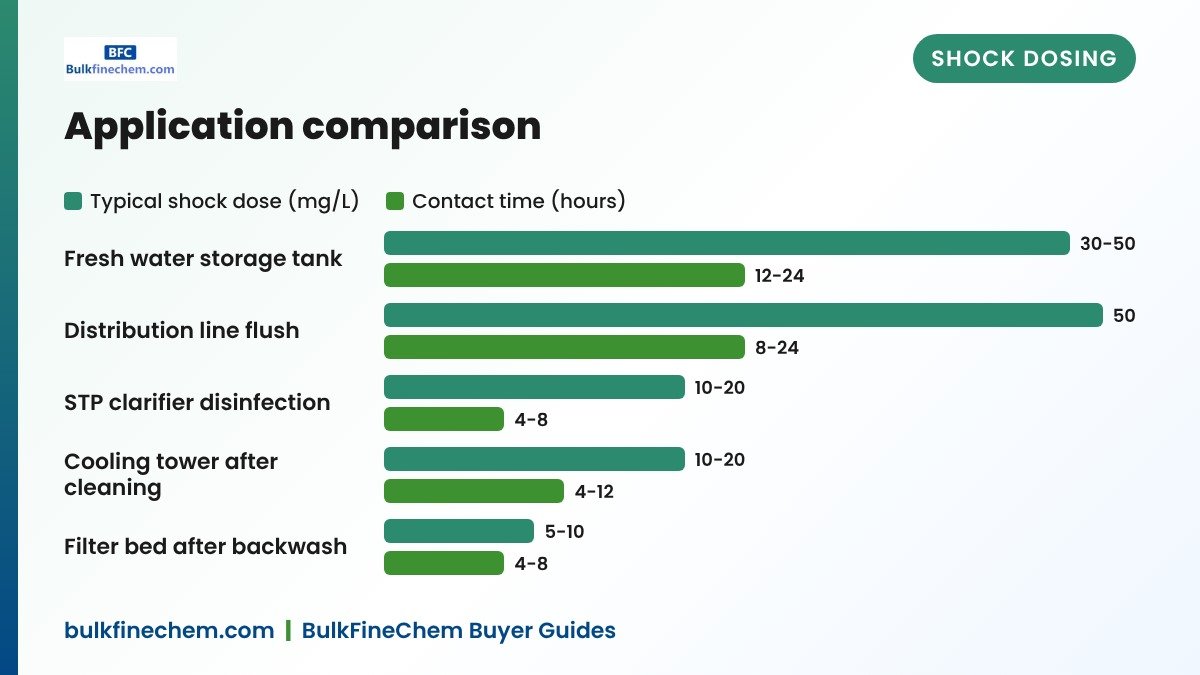
A new or recently cleaned storage tank sits at the lower end of 30 to 50 mg/L because there is little organic demand to consume the chlorine. A tank that has been out of service with visible slime needs the full dose, sometimes repeated after draining and scrubbing. Effluent-side applications such as an STP clarifier run lower, 10 to 20 mg/L, because the residual left in the discharge has to come back within your consent limits before release.
For a full comparison of coagulants and disinfectants across a treatment train, the Bulk water treatment chemicals buyer's guide covers where each chemical belongs.
How to Run a Tank Shock Dose Step by Step
The sequence below is the one most plant chemists follow for a clear water storage tank. Adjust it to your own standard operating procedure and to the interlocks on your plant.
- Clean and measure first. Scrub visible deposits, drain or note the exact working volume in cubic metres, and record the inlet and outlet valve positions before you touch any chemical.
- Calculate the dose from the COA. Take the available chlorine figure on the current lot's Certificate of Analysis, apply your target mg/L, and write the resulting kilograms down rather than eyeballing scoops.
- Pre-dissolve in water. Add granules to a full dosing tank of clean water, never water to a pile of granules, and circulate until the solution is clear with no grit at the bottom.
- Dose and circulate. Feed the solution into the tank inlet or through the recirculation line so the chlorine distributes, then sample from the far corner, not from the dosing point.
- Hold the contact period. Keep the tank off line for the contact time in your procedure, and re-check the residual at the halfway point to confirm it has not been fully consumed.
- Drain, rinse and re-test. Drain or dilute the high-chlorine water to a safe level, refill, and only return the tank to service once both free chlorine and microbiological results are within your limits.
Solids handling matters more than people expect. Granular calcium hypochlorite dissolves with some residue, and that residue is what blocks a dosing pump diaphragm at two in the morning. Filter the solution or let it settle and draw from the top.
Where Liquid Sodium Hypochlorite Still Fits
Granular calcium hypochlorite wins on strength and shelf life, but liquid bleach is easier to dose continuously and needs no dissolving step. Many plants run both: a hypochlorinator on a sodium hypochlorite day tank for routine maintenance, and granular for the quarterly shock, the commissioning dose and the monsoon recovery.
Liquid sodium hypochlorite at 10 to 12 percent degrades quickly in Indian summer heat, losing strength within weeks in a hot store. If your shock dosing is rare, a stack of sealed granular drums is the safer inventory. If you dose every day, the liquid is operationally simpler. The trade-offs are laid out in the Sodium hypochlorite water treatment guide.
Safety and Handling
Calcium hypochlorite is a strong oxidiser. Most of the incidents around it come from three things: water added to the product, storage near organics, and confined space entry into a tank where chlorine gas has collected.
- Wear the right PPE. Chemical splash goggles, a face shield for drum handling, a chlorine-rated respirator within reach, nitrile or neoprene gloves over an apron, and closed safety shoes.
- Never add water to granules. Add granules slowly to a large volume of water; adding water to a drum or pile of granules can heat violently and release chlorine gas.
- Keep it away from organics and acids. Sawdust, oil, cloth, solvents, acids and ammonia must never share a spill tray or a shelf, since mixtures can ignite or react.
- Ventilate before tank entry. A shocked tank holds chlorine and oxygen-deficient pockets; gas-test and follow your confined space permit before anyone goes in.
- Handle spills as oxidiser spills. Contain dry, do not hose into the drain, and follow the Safety Data Sheet for the lot you hold.
The Safety Data Sheet for the specific lot governs everything above. Local factory and pollution control board rules decide the discharge limits for the high-chlorine water you drain off, so confirm the neutralisation or dechlorination step with your ETP in charge. Dechlorination before discharge is normally handled with a reducing agent, and the choice of agent should match your effluent limits, not a habit.
Storage Rules That Decide Shelf Life
Storage is where most buyers lose their available chlorine without noticing. A sealed drum in a cool, dry, ventilated room keeps its rated strength for the normal shelf life of the lot. A drum opened in June and re-closed loosely in a 40 degree store in Ankleshwar will not.
- Keep the store dry and shaded. Humidity is the main enemy; monsoon air entering an opened drum causes caking and rapid strength loss.
- Store off the floor and away from walls. Palletise drums, keep them clear of any acid, amine, fuel or organic storage, and never share a bund with flammables.
- Segregate as an oxidiser. An oxidiser store needs its own bunding, its own signage and its own spill kit, separate from reducing agents and organics.
- Rotate stock by first in, first out. Log the packing date on each drum and open the oldest sealed lot first.
- Re-test old lots. Any lot past a few months in a hot store deserves a fresh available chlorine test before you trust your dose calculation.
For the wider question of how documents and lot traceability work when a residual test fails, see COA vs SDS vs TDS and the practical How to read a certificate of analysis.
What to Check Before Buying in Bulk
Ordering chlorine for shock dosing is a documentation exercise as much as a chemical one. Before confirming a bulk order, ask for the grade and available chlorine on the COA for the exact lot, the current SDS, the packing specification (sealed drums with an internal liner is usual for granular), the batch and packing date, and the recommended storage conditions and shelf life.
Check the packing on arrival. A bulged, split or warm drum is a warning sign of off-gassing and lost strength, and it should be quarantined and reported rather than put into the main store. Confirm insolubles if your dosing system has fine suction filters, because that determines whether you need a dissolving tank with a decant line.
For plants that also treat hardness alongside disinfection, the EDTA salts guide for boilers and cooling towers explains how sequestrants fit into the same water programme without interfering with the chlorine residual.
Frequently Asked Questions
What is a typical shock dose of calcium hypochlorite for a storage tank?
For a clean or newly commissioned potable storage tank, 30 to 50 mg/L available chlorine held for 12 to 24 hours is standard practice. A tank with visible slime or a history of coliform results needs the higher end and may need a second pass after scrubbing. Confirm against your own residual tests and standard operating procedure.
How do I convert mg/L into kilograms of granular chlorine?
Divide your target mg/L by the available chlorine fraction from the COA to get the mass of product per unit volume of water. For 50 mg/L in a 500 KL tank at 65 percent available chlorine, that is roughly 38.5 kilograms. Always recalculate when the lot changes or when a stored lot has aged in a hot store.
Why did my chlorine residual drop to zero overnight?
High organic or ammonia load, a biofilm, hot inlet water, or aged product with lower available chlorine than the paperwork states. Any of these consumes the dose. Re-test the product, check the contact tank for short-circuiting, and raise the dose only after you know which cause applies.
Can I store calcium hypochlorite in the same room as sodium hypochlorite?
Keep them segregated. Both are oxidiser or bleach products, but calcium hypochlorite is a dry oxidiser and must not share a spill tray or shelf with acids, organics, fuels or amines. Store granular drums dry, cool and ventilated, and keep liquid bleach in its own shaded, bunded area with its own spill kit.
How long does granular calcium hypochlorite keep?
In a sealed drum in a cool, dry, ventilated store it holds its rated available chlorine for the shelf life stated on the label. Once opened in humid monsoon air, strength falls quickly and the granules cake. Log the packing date, rotate first in first out, and retest any lot older than a few months before relying on it for a shock dose.
Is calcium hypochlorite better than sodium hypochlorite for shock dosing?
For a one-off high dose in a confined volume, granular calcium hypochlorite is usually better because it carries far more available chlorine per kilogram and stores longer. For daily continuous dosing, liquid sodium hypochlorite is simpler to handle and needs no dissolving step. Many plants keep both for those separate jobs.
What should I do with the high-chlorine water I drain from a shocked tank?
Do not send it straight to the drain or the effluent stream. Neutralise or dechlorinate it to meet your discharge consent, hold it in an aeration or equalisation tank until the residual falls, and follow the SDS plus the rules set by your pollution control board consent. Confirm the method with your ETP operator.
Conclusion
Calcium hypochlorite shock dosing is the reliable way to reset a tank, a line or a filter bed when routine chlorination has stopped working, provided you dose from the actual available chlorine on the COA, hold a real contact time, and store the drums so the figure stays true. Test the residual at the far end of the system, not at the dosing point, and treat storage conditions as part of the specification.
Need a quote? Send your requirement to the BulkFineChem team with grade, quantity and destination, or browse All products. Our Calcium hypochlorite 65 percent comes with COA and SDS, and we also supply Sodium hypochlorite solution for routine dosing and Granular activated carbon for the dechlorination step.
Disclaimer: This article is general technical and procurement information. Always follow the product's Safety Data Sheet, Technical Data Sheet and the regulations that apply to your industry, and confirm suitability with trials before full-scale use.