
Hard water in boilers and cooling towers is rarely announced. It shows up as a shell that takes longer to heat, a tube that has to be opened for cleaning earlier than planned, or a heat exchanger whose outlet temperature quietly drifts down over a quarter. For a plant in the Gujarat or Maharashtra chemical belt, where make-up water hardness can change between the pre-monsoon and post-monsoon months, the same dosing sheet rarely works all year.
BulkFineChem supplies EDTA and EDTA salts for water treatment, cleaning and formulation use, along with Trisodium Phosphate and Hydrated Lime for the softening side of the same problem. This piece looks at where EDTA salts genuinely help in a hard-water system, where they are the wrong tool, and what to verify on the paperwork before a drum is accepted.
What Hard Water Actually Does to Heat Transfer
Hardness is mainly dissolved calcium and magnesium bicarbonate. On heating, bicarbonate breaks down, carbon dioxide leaves and calcium carbonate is left behind as a solid on the hottest surface available, which is the tube wall. In a cooling tower the same salt concentrates as water evaporates, so a make-up water of a few hundred ppm can become several times that in the circulating loop.
The practical cost is thermal. Scale has far lower thermal conductivity than steel, so a thin continuous deposit raises fuel or steam consumption, pushes tube metal temperature up and, in a boiler, can lead to tube failure long before the design life. In a cooling tower the deposit insulates the fill and tubes, holds corrosion products against the metal and creates the conditions for under-deposit attack.
Chelation Versus Precipitation: Two Ways to Handle Calcium
There are two broad strategies, and mixing them up is the usual source of confusion in a dosing sheet.
Precipitation means converting dissolved calcium into an insoluble solid and then removing it, either in a softening plant (lime-soda ash precipitation, or an ion exchange resin) or as a controlled sludge inside the system. Chelation means holding calcium and magnesium in solution as a soluble complex so they cannot deposit on a surface. EDTA works by chelation: the EDTA anion wraps around the metal ion and the whole complex stays dissolved in the water.
That difference decides where EDTA belongs. In a boiler it keeps hardness in solution during the internal treatment phase and helps convert existing carbonate scale to a dispersible form that blowdown can carry out. In a cooling tower loop it is a supplementary tool for low-hardness trim systems and for cleaning, not a substitute for a properly run softener and a dispersion-based programme.

Which EDTA Salt to Buy for Water Work
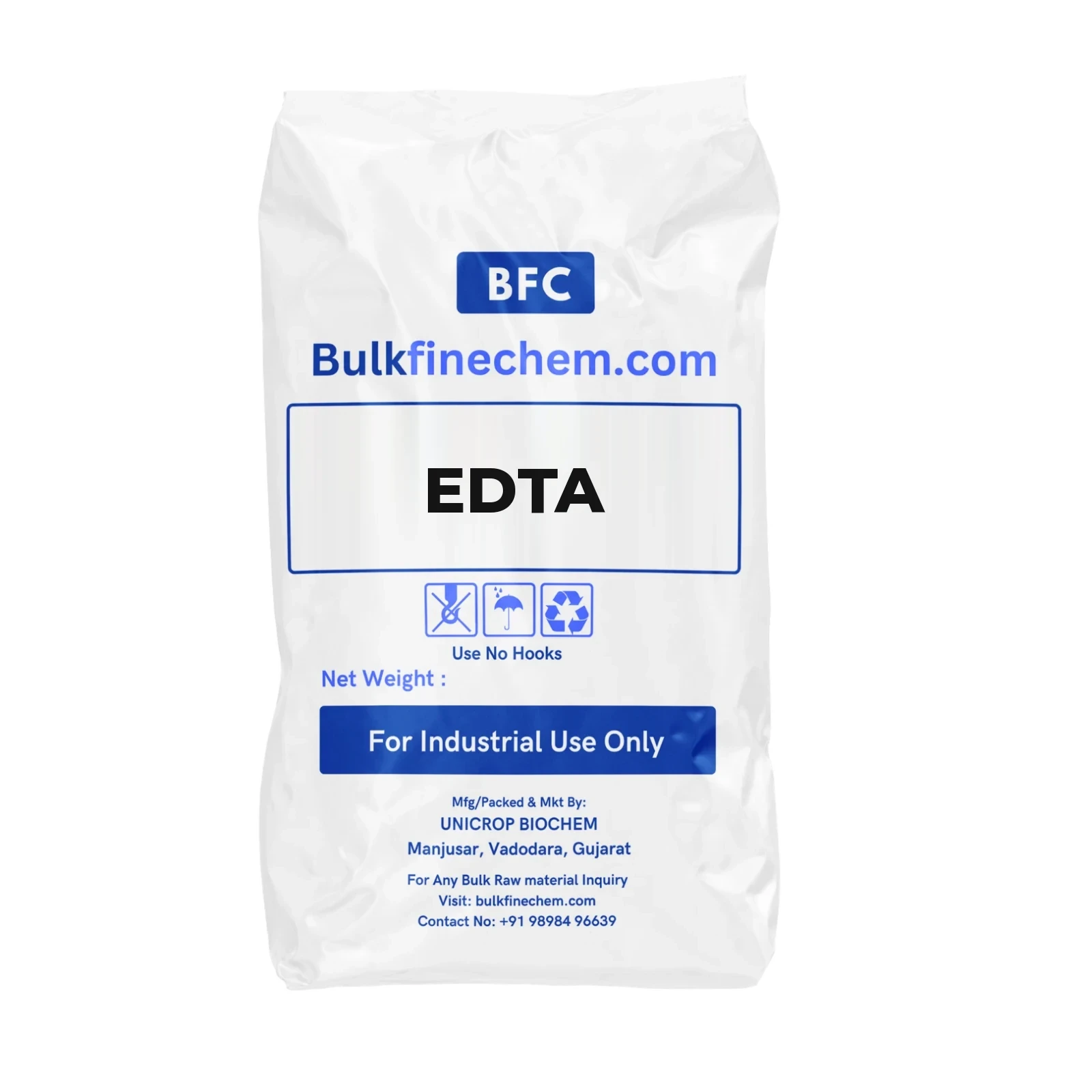
EDTA is sold as the free acid and as sodium salts. The free acid dissolves slowly and gives an acidic solution, which suits cleaning baths. Tetrasodium EDTA dissolves fast and gives an alkaline solution, which suits feed into a treated water stream. Disodium EDTA dihydrate sits between the two, with a near-neutral solution and very good solubility, and is the usual choice when pH matters to the rest of the process. A buyer comparing the two sodium salts will find the differences set out in our disodium versus tetrasodium EDTA guide.
The table below is what to ask for on the quotation, not a specification to copy.
| Parameter | EDTA free acid | Tetrasodium EDTA | Disodium EDTA dihydrate |
|---|---|---|---|
| Typical assay | 99% or higher | 99% or higher | 99% or higher |
| Solution pH (2% in water) | Acidic | Alkaline | Near neutral |
| Solubility in water | Low, needs stirring | High | High |
| Usual water role | Cleaning and descaling | Chelant feed | Chelant at controlled pH |
| Common packing | Bagged powder | Bagged powder | Bagged powder |
Where EDTA Fits in Boiler Water Treatment
In low and medium pressure boilers that run without a softener, or where softener breakthrough is a recurring risk, EDTA is used as part of the internal treatment. It complexes calcium and magnesium entering with the feed water, so they stay soluble and leave through blowdown instead of plating on the tubes. It is also used in boiled-out cleaning of new or refurbished plant, where an alkaline EDTA solution converts carbonate scale into a soluble calcium complex that can be flushed away.
Two limits matter. First, chelation is stoichiometric: you need enough EDTA to hold the hardness that enters, so the requirement is set by feed water hardness and evaporation rate, not by a fixed ppm. Second, calcium-chelate that reaches a hot, dry tube surface can still break down and leave a deposit, so EDTA is dosed where circulation keeps it diluted, and it is never a licence to run a softenerless boiler on hard make-up water.
Where an alkaline phosphate programme is already in place, check compatibility with your chemical supplier before adding a chelant; phosphate and chelant chemistries are usually run as one agreed programme rather than two independent doses. Our guide to trisodium phosphate in boiler water treatment covers the phosphate side, including COA checks and tank storage.

EDTA in Cooling Towers and Reverse Osmosis Cleaning
In cooling towers, hardness control is normally a matter of cycles of concentration, blowdown and a polymer dispersant scale inhibitor. EDTA appears in three narrower roles: as a chelant in a clean-up or pickling step before the tower is commissioned, in maintenance cleaning of a fouled heat exchanger, and in trim or low-hardness systems where a small residual chelant backs up the dispersant.
In reverse osmosis, EDTA is used on the cleaning side rather than as a continuous additive. Membrane cleaning baths of alkaline or acidic EDTA solution dissolve carbonate and metal-hydroxide fouling that citric acid alone will not touch. Two cautions apply: EDTA can attack membrane polymers at high pH and long contact time, so follow the membrane manufacturer's cleaning recipe; and any EDTA remaining in the permeate stream can complex residual hardness downstream, which matters if the permeate feeds a formulation.
If your scale dissolves in acid and fizzes, it is carbonate hardness; if it does not, chelants are the wrong first move.
Typical Use Ranges and How to Set the Dose
There is no single ppm figure that transfers between plants, because the requirement is set by the calcium load. The working method is to compute the hardness entering the system, dose on a molar basis with a small excess, and confirm the residual in the blowdown or bleed water. The ranges below are starting points for trials, to be confirmed by your own water analysis, plant trials and the supplier's TDS.

How EDTA Compares With the Other Hardness Options
For a plant deciding what to buy, the honest comparison is with the alternatives rather than with nothing.
- Lime and soda ash softening removes hardness in a clarifier before the water reaches the equipment. It is the right choice for large flows and high hardness, and it produces sludge. See our notes on choosing water treatment chemicals for how coagulants and softening chemicals fit together.
- Cation exchange softeners give very low hardness and are standard for boiler feed water, but they need brine regeneration and a resin service plan.
- Phosphate programmes precipitate calcium as a soft sludge that blowdown removes; they work well but add dissolved solids.
- Polymer dispersant scale inhibitors are the mainstay of cooling tower practice, holding crystals small and suspended rather than removing calcium.
- EDTA and other chelants hold hardness fully in solution. Precise, no sludge, but cost per gram of calcium held is higher, so they suit low loads, cleaning and trim duty.
What to Check on the EDTA COA
Before a first drum is accepted, ask for the Certificate of Analysis and read it against the agreed grade. A short list of what to look for:
- Assay or purity on a dried basis, and the test method reference.
- pH of a stated solution strength, which tells you how the salt will behave in the feed tank.
- Moisture or loss on drying, since a caked, wet bag of powder gives an unreliable dose.
- Heavy metals or iron on trace levels, which matters for pharma and food-adjacent loops.
- Water-insoluble matter, which shows up as residue in a dosing tank strainer.
- Batch number, manufacture and expiry dates, and packing description matching the delivery.
Our walkthrough on how to read a Certificate of Analysis explains how to reconcile these values with the COA your own QC issues, and the COA versus SDS versus TDS guide sets out which document answers which question during supplier qualification.
Safety, Handling and Storage
EDTA salts are low hazard compared with the acids and alkalis in the same store, but the free acid is a dust irritant and the tetrasodium salt solution is alkaline. Wear gloves and safety glasses when charging a solution tank, avoid breathing powder, and wash skin contact promptly. Work in a ventilated area and follow the SDS.
Storage points that matter in Indian conditions:
- Keep bags closed and off the floor on a pallet. Monsoon humidity makes EDTA powder clump, and a half-empty bag left open in a Gujarat July will be solid by August.
- Use HDPE or stainless steel for solution tanks. Avoid unlined mild steel, which the alkaline salt solution will attack.
- Do not store EDTA near strong oxidisers such as hypochlorite, or near strong acids. Chelant solutions and chlorine products belong in separate bunded areas.
- Label solution tanks with strength and preparation date, and do not keep prepared solution longer than your QC data supports.
- Clean spills of powder by wet method or vacuum, not dry sweeping, to keep dust out of the breathing zone.
One procurement note worth more than it looks: EDTA is poorly removed by conventional biological effluent treatment, so a plant dosing it in volume should confirm with its effluent team how the chelated metal load will be handled in the ETP, and keep dosing to the amount the water chemistry actually needs.
Frequently Asked Questions
Can EDTA replace a water softener in a boiler feed system?
No. EDTA holds hardness in solution rather than removing it, so the calcium load still leaves through blowdown and adds to dissolved solids. For sustained high hardness, a cation exchange softener or lime-soda softening plant is the correct solution, with EDTA used as a supplement or for cleaning.
Which EDTA salt is best for cooling tower dosing?
Tetrasodium EDTA is the common choice where an alkaline, fast-dissolving salt is acceptable, while disodium EDTA dihydrate suits systems that need a near-neutral feed. The decision should follow your loop pH and the rest of the treatment programme, confirmed with your chemical supplier.
How do I calculate the EDTA dose for my water?
Work from the calcium and magnesium entering the system, expressed as calcium carbonate, and dose on a molar equivalent basis with a small excess. Then verify by measuring hardness in the blowdown or bleed water. There is no fixed ppm that transfers between plants.
Does EDTA damage reverse osmosis membranes?
It can, at high pH, elevated temperature or long contact time. Membrane cleaning with EDTA should follow the membrane manufacturer's stated cleaning recipe and contact limits, and the bath should be checked before reuse.
What should I check on the COA before accepting an EDTA delivery?
Confirm assay on a dried basis, solution pH at the stated strength, moisture, heavy metals or iron at trace levels, water-insoluble matter, and that the batch number and packing match the order. Reject bags that are wet, caked or damaged.
How long does prepared EDTA solution last in a dosing tank?
That depends on tank material, strength, temperature and house hygiene practice, so set the holding time from your own QC data rather than a general rule. Store in HDPE or stainless steel, keep the tank covered and labelled with strength and preparation date.
Sourcing EDTA for Water Treatment From BulkFineChem
Hard water in boilers and cooling towers is a water chemistry problem before it is a chemical purchase problem, so the useful first step is your own analysis: hardness, alkalinity, pH, silica and conductivity of make-up, feed and bleed water. With that, the right EDTA salt, grade and packing can be confirmed against your actual load.
BulkFineChem supplies EDTA and EDTA salts in bulk for industrial water treatment, cleaning and formulation, with COA and SDS available with orders and the grade and specification confirmed before dispatch. Share your water analysis, grade and quantity through the BulkFineChem enquiry team, or browse the full product range.
Disclaimer: This article is general technical and procurement information. Always follow the product's Safety Data Sheet, Technical Data Sheet and the regulations that apply to your industry, and confirm suitability with trials before full-scale use.