
A morning in the ETP usually starts the same way. The pH probe on the equalisation tank reads 4.2, the clarifier has a milky plume drifting over the weir, and the shift supervisor wants to know why the neutralisation chemical lasted half as long this week. Choosing between caustic soda and hydrated lime is where that argument begins, and a jar test settles it faster than any datasheet.
This guide compares the two alkalis on the things that actually show up in your monthly consumption: dose per kilolitre, sludge volume, hardness added to the line, storage behaviour in Indian heat and monsoon, and the paperwork to check before a bulk order. It is a comparison for plant use, not a substitute for your own trials and the supplier's Technical Data Sheet.
What Neutralisation Actually Has to Achieve in an ETP
Neutralisation is not just lifting a pH number. Incoming effluent from dyeing, plating, food processing or chemical synthesis arrives anywhere from pH 2 to 12, and the biological stage downstream wants 6.5 to 8.5 with as little shock as possible. Get it wrong in one direction and your biology stalls; get it wrong in the other and your discharge parameters go out of limits at the outfall.
Three targets sit behind every dosing decision:
- Final pH in the band. Hold 6.5 to 8.5 at the clarifier outlet, not just in the neutralisation tank where the probe sits.
- Minimal sludge and scaling. The alkali you pick decides how much solids you pump to the filter press and how much scale you leave in pipes and heat exchangers.
- A stable, safe dose. A chemical that plugs the dosing line or cakes in the bag will be dosed badly, no matter how good the price per tonne looked.
How Caustic Soda and Hydrated Lime Behave in Water
Caustic soda flakes are sodium hydroxide at 98 percent purity. They dissolve fast and completely, give a clean strong alkalinity, and add sodium, which stays in solution and leaves with the treated water. That is why dosing is precise and sludge stays low.
Hydrated lime is calcium hydroxide, supplied as a dry powder around 74 percent available base. It dissolves only partly, so you dose it as a slurry, and the unreacted fraction plus the calcium it releases ends up as solids. The calcium is also the reason lime is good at knocking out phosphate, fluoride and silica, and the reason it hardens the water it touches.
Sodium carbonate (soda ash) sits between the two. It is a milder, fully soluble alkali that precipitates calcium and magnesium on the way up, so it is often used where hardness is the real problem rather than acidity alone.
Alkali price per tonne means nothing until you divide it by the neutralising value per kilogram and add what the extra sludge costs you.
Dose Comparison by Neutralising Value
The useful number is available hydroxide per kilogram, not the bag price. Pure NaOH carries about 0.50 equivalents per gram, while pure calcium hydroxide carries about 0.27, so on paper lime is roughly half as strong per kilogram. In the tank the gap narrows a little because lime keeps buffering as more of it dissolves, and a wide gap opens again if your lime has carbonated in the bag.
Say your plant treats 200 KLD of mixed effluent that needs a lift from pH 4 to pH 7.5. The jar test below is the kind of spread a plant chemist sees on that job; your own numbers depend on the acids present, alkalinity and temperature.
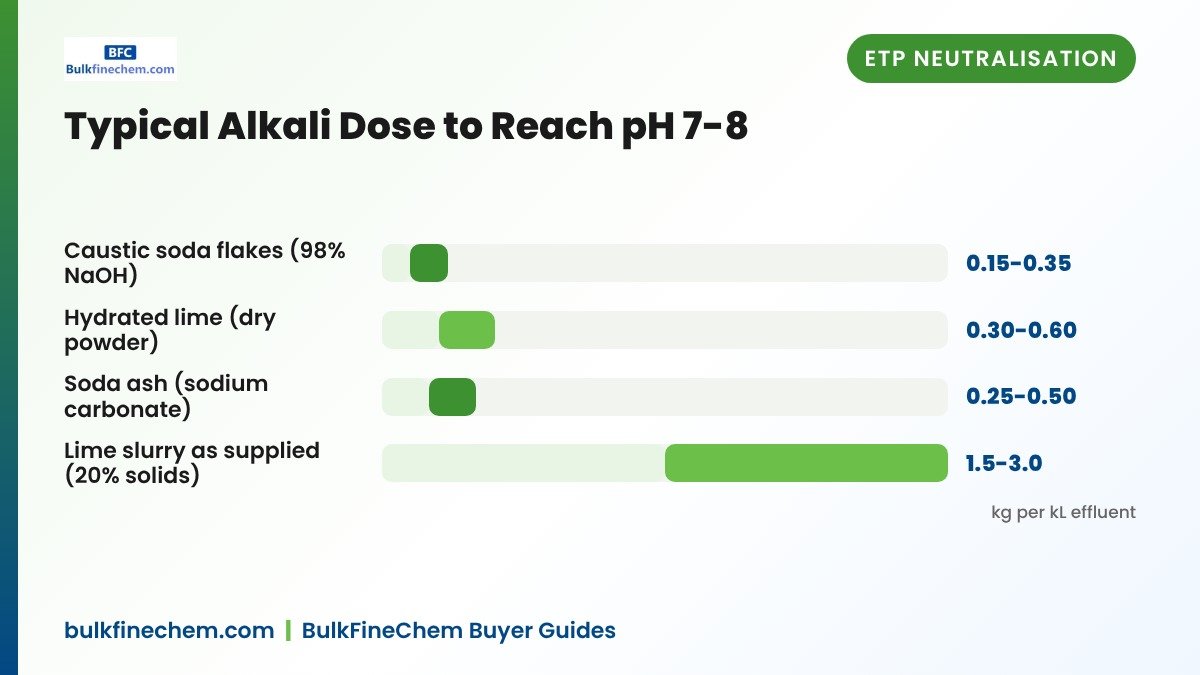
Take the caustic soda figure of 0.15 to 0.35 kg per kilolitre and the lime figure of 0.30 to 0.60 kg per kilolitre as the working range for a mildly acidic effluent. Highly acidic or metal-bearing streams run higher, and effluents with high bicarbonate alkalinity can need double. Confirm all of it with a jar test on the actual tank grab sample, and re-run it whenever the upstream batch changes.
Sludge Volume, Hardness and Downstream Effects
This is where the two chemicals part company most visibly. Lime brings calcium into solution and then dumps it as calcium carbonate and calcium sulphate, plus whatever base it did not dissolve. That means bulk.
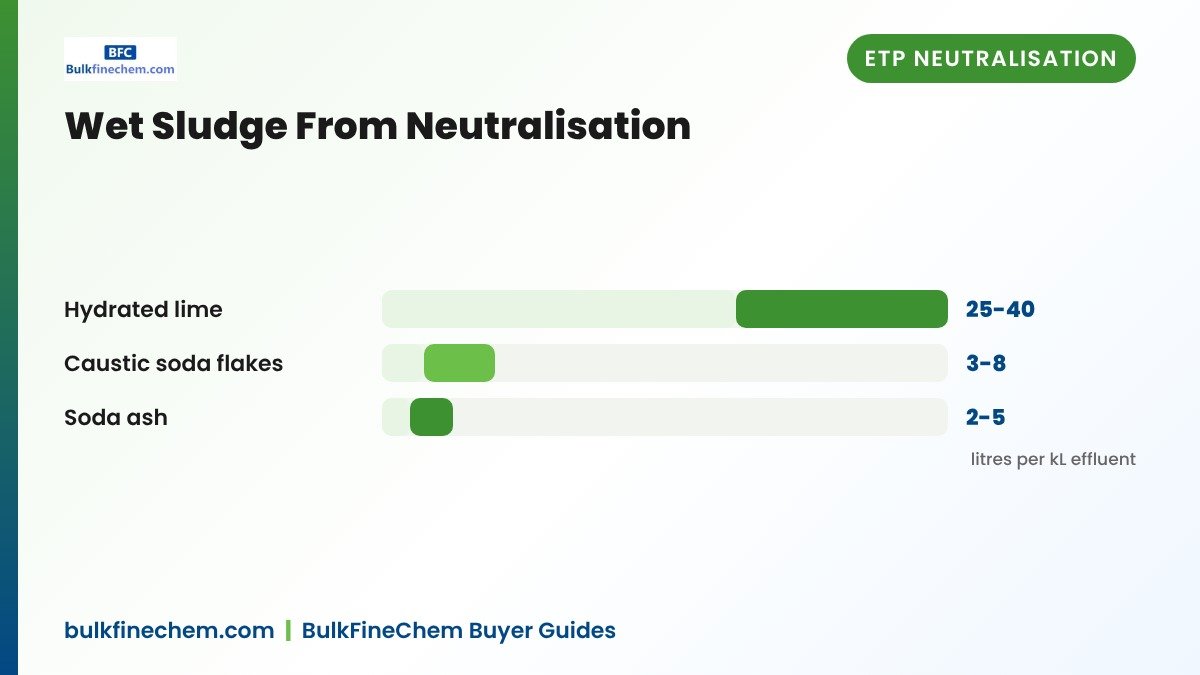
A plant moving 200 KLD on lime can be looking at 5,000 to 8,000 litres of wet sludge a day from neutralisation alone, against a few hundred litres on caustic soda. Filter press cycles, tarpaulin handling, disposal cost per tonne of sludge and the polymer dose that goes with it all scale with that number. If your disposal route is expensive or your press is the bottleneck, the more expensive alkali per tonne is often the cheaper plant overall.
Hardness matters in a different way. Lime-treated water that later passes through a cooling tower, boiler feed line or RO skid will scale. Sodium from caustic soda does not scale, but it raises TDS in the discharge, which some consent conditions now watch. Neither chemical is clean on both counts.
Cost per Unit of Neutralising Value
Nobody should switch chemicals on a per-tonne quote. Work it through in four lines, with your own numbers.
- Divide by strength. Take the price per tonne and divide by available base per kilogram from the COA (about 0.98 for good flakes, 0.65 to 0.74 for lime), to get price per unit of real alkali.
- Add the solids bill. Multiply the extra wet sludge litres per kilolitre by your handling and disposal cost, and add the polyelectrolyte dose needed to dewater it.
- Add the dosing overhead. Lime needs a slaking or slurry system, more housekeeping and line flushing; caustic needs a proper dissolving tank, correct PPE and a leak-proof transfer.
- Check the storage loss. Lime that has sat open in a humid store loses strength to carbon dioxide and shows up as a higher dose next month, which never appears on any invoice.
Run those four lines for your own effluent and the answer is usually site-specific rather than universal. That is exactly why a supplier who pushes one chemical as always cheaper is telling you about their stock, not your plant.
Which One Fits Which Job
Both chemicals earn their place, and many plants run both on different streams. Use the pattern below as a starting point, then let the jar test overrule it.
- Pick caustic soda when you need tight pH control on a continuous line, low sludge, no hardness, and dosing straight from a solution tank.
- Pick hydrated lime when the effluent carries phosphate, fluoride, sulphates or metals that lime helps precipitate, or when bulk price per unit of base is the binding constraint and you have the sludge handling for it.
- Pick soda ash when hardness and acidity arrive together and you want a soluble alkali that will not feed scale downstream.
- Run both when one stream is strongly mineral acid and another is alkaline: neutralise the strong acid with lime, then trim to final pH with caustic for control.
For the coagulation step that follows neutralisation, the choice of coagulant interacts with your alkali choice, so read Poly Aluminium Chloride vs Alum before changing both at once. Where the treated water feeds a boiler or cooling circuit, the hardness you add here shows up there, covered in Hard Water in Boilers and Cooling Towers.
Jar Test and Dose Trial in Six Steps
A one-litre jar test costs ten minutes and prevents a week of off-spec discharge.
- Grab and mix the sample. Take it from the equalisation tank after recirculation, note its temperature and record the starting pH and alkalinity before you touch anything.
- Prepare two dosing solutions. Make 10 percent caustic soda and a 20 percent lime slurry in labelled vessels, and keep the lime vessel agitated since it settles within minutes.
- Dose in small increments. Add 0.1 millilitre at a time to separate 1 litre jars with stirring, and let each jar rest 2 minutes between additions because lime keeps reacting after the probe stops moving.
- Mark the endpoint early. Stop at pH 7.5 to 8.0 rather than chasing 8.5, since lime continues to dissolve and overshoots once the buffer breaks.
- Read the sludge. Pour each jar into a graduated cylinder, let it settle 30 minutes and read the settled volume. That number is your sludge comparison, made on your water.
- Scale and verify. Convert the best jar to kg per kilolitre, set the dosing pump, then check pH at the clarifier outlet for a full shift before you trust the setting.
Keep the jar test record with your ETP log. CPCB and state consent inspections increasingly ask for the neutralisation record alongside the flow and pH trend, and a documented trial is a much better answer than a chemical invoice.
Safety and Handling
Both chemicals are corrosive and both cause avoidable injuries in the dissolving area, mostly because people get casual after the first month.
- Caustic soda flakes. Wear chemical goggles, a face shield, alkali-resistant gauntlets and an apron. Always add flakes to water slowly with agitation, never water onto a heap of flakes, since the heat of solution can boil and spit. Store in a dry, sealed place off the floor: flakes go cakey and sticky in monsoon humidity and stop flowing through the hopper.
- Hydrated lime. Wear a dust mask or respirator, goggles and gloves. Lime dust irritates eyes and airways, and slaked lime on skin with sweat is a slow burn people underestimate. Keep bags covered and off the ground; carbonation from damp air turns powder into inert carbonate that does nothing in the tank.
- Keep them apart from acids and aluminium. Both react violently with mineral acids and give off heat, and caustic attacks aluminium containers and fittings. Store alkalis on their own bunded area, well below any acid store, with the SDS on the shelf, not in a drawer.
- Fix spills properly. Neutralise a caustic spill with a mild acid on the SDS and collect the residue as hazardous waste; sweep lime spills dry and bag them, since hosing lime around spreads a slippery hazard.
For the full dilution and receiving routine on the acid side, see the Sulphuric Acid 98 percent storage and handling guide, and for the polymer that follows in the sludge line, the Anionic vs cationic polyelectrolyte guide.
What to Check Before Buying in Bulk
Ask for the paperwork before the tanker or the pallet reaches your gate, and check it against what you will actually dose.
- Assay and available base on the COA. For flakes, sodium hydroxide around 98 percent with low carbonate; for lime, available hydroxide and a low percentage of unslaked or carbonated material. Compare it to the grade you specified, not the trade name on the bag.
- Impurities that matter to your stream. Chloride and iron in alkalis can upset a biological stage or stain treated water; ask for the numbers rather than a tick.
- Mesh, bulk density and packing. Lime powder that is too fine goes airborne in the slaking hopper; flakes stored in wet jute arrive as a brick. Confirm 25 kg bags, 50 kg bags, jute or HDPE woven laminate, or bulk as usual for the product and your volume.
- Shelf life and store conditions. Ask what the supplier expects the material to do over a Gujarat summer in your store, and buy lime closer to the date you will use it.
- SDS, TDS and invoice details. A current SDS, a Technical Data Sheet with the dosing basis, and a GST invoice with the grade named as agreed. The COA vs SDS vs TDS guide explains which document should carry which number, and the Supplier qualification checklist covers what to verify before you shift an order.
BulkFineChem supplies Caustic soda flakes at 98 percent and Hydrated lime powder with grade and specification confirmed before dispatch and COA and SDS available with the order.
Frequently Asked Questions
Which is cheaper for ETP neutralisation, caustic soda or hydrated lime?
Lime is usually cheaper per unit of available base, but it produces several times more wet sludge and adds hardness. Work out price per neutralising equivalent and add your sludge handling and disposal cost before calling either one cheaper.
How much caustic soda flakes do I need per kilolitre of effluent?
For a mildly acidic stream lifted to pH 7 to 8, a typical jar test result is 0.15 to 0.35 kg of 98 percent flakes per kilolitre. Strongly acidic or metal-bearing effluent can need more, so confirm on your own sample.
Why does my lime dose keep increasing month after month?
Carbonation. Hydrated lime left open in a humid store reacts with carbon dioxide and turns partly into carbonate, which has almost no neutralising value. Keep bags covered, off the floor, and buy closer to the date of use.
Does hydrated lime damage a cooling tower or boiler downstream?
It can. Lime raises calcium hardness, which scales heat exchangers, tower fill and boiler tubes. If treated water reaches such equipment, check hardness at that point and consider a soluble alkali for the final trim.
Can I use both caustic soda and hydrated lime in the same plant?
Yes, and many plants do. Lime handles a strongly acid or phosphate-rich stream in bulk, then caustic soda trims the final pH precisely because it dissolves cleanly and is easy to meter.
How do I store caustic soda flakes through the monsoon?
In a dry, ventilated store, sealed and off the floor on pallets, away from acids and from any aluminium fittings. Flakes that absorb moisture cake together and bridge in the hopper, so the dose you set is not the dose you get.
What documents should I ask for before a bulk order of alkali?
A Certificate of Analysis showing assay and impurities, a Safety Data Sheet, a Technical Data Sheet with the dosing basis, and a GST invoice naming the grade exactly as agreed. Match the COA numbers to what you specified, not to the trade name.
Conclusion
For caustic soda vs hydrated lime in ETP neutralisation, the deciding numbers are dose per kilolitre, wet sludge volume and the hardness or TDS you pass downstream, not the price printed on the quote. Caustic soda gives fast, clean, low-sludge pH control; lime gives cheaper base per unit and helps precipitate phosphate, fluoride and metals, at the cost of sludge and scale. Run the jar test on your own effluent, log the dose and the settled solids, and let that decide the switch.
Need a quote? Send your requirement to the BulkFineChem team with grade, quantity and destination, or browse All products.
Disclaimer: This article is general technical and procurement information. Always follow the product's Safety Data Sheet, Technical Data Sheet and the regulations that apply to your industry, and confirm suitability with trials before full-scale use.