
A plant chemist walks past a clarifier, watches the weir for a minute and sees pin floc carrying over into the outlet launder. The first reaction is usually to turn up the coagulant pump. That is the move that makes the problem worse, because the pump setting nobody has verified in six months is rarely the number written on the tag.
Coagulant dosing pump calibration is the boring habit that separates a stable ETP from one that keeps chasing its own tail. This guide covers how to set the dose from a jar test, how to turn that into a real stroke and frequency setting on a metering pump, how to verify it volumetrically, and what to check when the numbers drift. It applies to poly aluminium chloride, alum, ferric chloride and the polyelectrolyte flocculant that usually follows them.
Why Dosing Accuracy Costs More Than Chemical Price
Most ETP operators buy coagulant on rate per kilogram and then lose more than that in sludge, pH correction and rework. A dosing pump running 20% above its tag setting on a 200 KLD plant burning 40 mg/L of PAC throws away roughly 1.6 kg a day, and that chemical has to leave as sludge. Over-dosing also restabilises the colloids you were trying to settle, so turbidity rises even though consumption has gone up.
Under-dosing has its own cost. Solids carry through to the biological stage or into the filter beds, downstream chemical demand climbs, and the final discharge creeps toward your consent limits. Calibration is a maintenance task that costs a couple of hours and pays back in chemical alone.
How a Coagulant Dose Reaches the Clarifier
The dose is a chain of four steps, and each one can drift independently. The jar test sets a target in mg/L. That target converts to a volumetric feed rate in litres per hour for your flow and your make-up dilution. The metering pump converts that feed rate into a stroke length and stroke frequency. The injector and the foot valve have to actually deliver what the pump head displaced.
Say your ETP treats 200 KLD of mixed industrial effluent and a jar test points to 35 mg/L of PAC on the 10% liquid you dose. That is 7 kg of product a day, about 70 litres of a 10% make-up spread over 24 hours, or roughly 2.9 L/hr. A pump sized at 6 L/hr running at about 48% stroke delivers it. Miss the dilution ratio and every number after it is wrong by the same factor.
For background on how the coagulant itself is chosen, this comparison of Poly aluminium chloride and alum covers the trade-offs in alkalinity and sludge volume.
Reading the Jar Test Before You Touch the Pump
Nothing justifies a pump setting better than a six-jar test done on the actual feed water, on the day, at the actual pH. Take the sample from ahead of the clarifier, not from a clear tank. Record the raw pH, temperature and turbidity before you dose anything.
Run the jars across a spread around your expected dose rather than a tight cluster. Fast mix at about 200 rpm for one minute, then slow mix at 30 to 40 rpm for ten minutes, then settle for fifteen. Look at the settled water, not the floc.
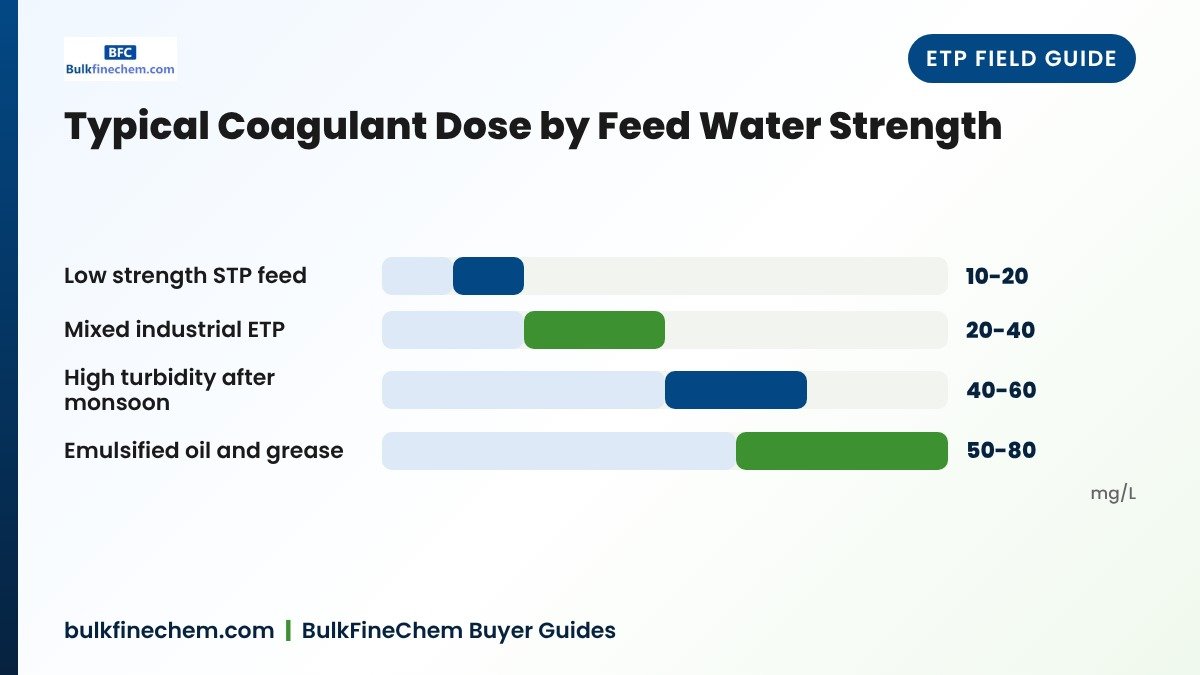
Pick the lowest dose that meets your clarity target, not the dose that gives the prettiest floc. In the table above, 30 mg/L is the answer, and 40 mg/L is what most plants end up running because it settles faster and looks reassuring. The same spread pattern holds across strengths: a low strength STP feed often settles at 10-20 mg/L, mixed industrial ETP at 20-40 mg/L, high turbidity after the monsoon at 40-60 mg/L, and emulsified oil and grease loads up at 50-80 mg/L before the flocculant takes over. Those numbers are typical ranges only, and your own jar test always outranks them.
Converting a Jar Test Dose to a Pump Setting
Work the conversion in one line so you can check it later:
Feed rate (L/hr) = Flow (m3/hr) x Dose (mg/L) / (Make-up strength (%) x 10)
For 8.3 m3/hr at 35 mg/L dosing a 10% solution: 8.3 x 35 / 100 = 2.9 L/hr. Then set the pump against its own capacity curve, not against the dial.
- Find the pump capacity. Read the maximum stroke output stamped on the pump head or in the manual, in litres per hour at 100% stroke and maximum frequency.
- Set the stroke first. Turn the stroke adjustment to the calculated percentage and let the frequency run at maximum, since stroke is the finer control on most diaphragm pumps.
- Prime and bleed. Open the priming or vent valve and run the pump until the discharge is free of air, then close it. An air pocket alone can cost 30% of the stroke volume.
- Confirm against the calibration scale. Most pumps carry a graduated scale on the stroke knob. Note the reading, not just the percentage.
- Verify volumetrically. Put a graduated measuring jug on the discharge line and time it. That is the only measurement that counts.
The Volumetric Check That Proves the Setting
This is the part most plants skip, and it is the whole point of coagulant dosing pump calibration. Isolate the pump discharge into a graduated cylinder, run a known number of strokes or a timed interval, and convert.
- Divide by strokes. Volume in millilitres divided by the number of strokes gives you the ml per stroke, which you compare with the pump's stated stroke volume.
- Divide by time. Volume divided by minutes and multiplied by 60 gives litres per hour, which you compare with your target feed rate.
- Repeat three times. Take the average, and treat a spread wider than 10% between runs as a valve or air problem rather than a setting problem.
- Check the low end. If the pump runs below about 30% stroke, verify it there rather than at full stroke, because turndown is where accuracy disappears first.
Anything more than about 5% away from the target gets corrected on the stroke knob and rechecked. Keep the logbook entry with the reading, the jug size and the time, so the next shift can see the drift rather than guess at it.
Typical Dose Ranges by Duty
The dose you are calibrating toward depends on what the plant is fed. These are working ranges for coagulants in common Indian industrial practice, always to be confirmed by your own jar test and the supplier's technical data sheet.
Dilution matters as much as the dose. PAC make-up is usually run at 5-10% w/v, alum at 5-10%, and ferric chloride liquid at 5-15%. Anionic polyelectrolyte for sludge conditioning is prepared much weaker, commonly 0.05-0.2%, because a stronger solution never wets out properly. A flocculant dosed at 1-5 mg/L does almost all its work after the coagulant has neutralised the charge, so check the coagulant first when floc looks weak. Our Poly aluminium chloride ships with a COA giving alumina content and basicity, which are the two figures your conversion depends on. For the polymer side, see the Anionic and cationic polyelectrolyte selection guide.
Diagnosing a Dose That Has Drifted
When the numbers no longer match the logbook, the cause is usually mechanical, not chemical. Work through the likely ones in order of how fast they are to check.
- Air in the head. The pump delivers a slug of liquid then a slug of compressible vapour, so the stroke sounds uneven. Fit a foot valve with a priming spring and check the suction line for a weeping joint.
- Worn or fouled valves. Diaphragm pumps meter by one-way valves. Crystallised PAC salt on a ball seat is common where a pump sits idle for a week. Flush with clean water before you strip anything.
- A cracked suction strainer. The pump draws more air than liquid and the volume check comes out wildly low and erratic.
- Wrong make-up strength. Someone prepared the tank to a different dilution than the tag says. Check the density with a hydrometer, since strength errors are silent.
- Feed flow changed. The dose is per cubic metre, so a flow meter reading low makes you over-dose while the pump itself is perfectly accurate.
There is a field version of this for one specific coagulant in the Ferric chloride dosing field guide, and the wider chemical selection starts with the Bulk water treatment chemicals buyer's guide.
Calibration Interval and Record Keeping
Duty severity sets the interval, not the calendar of the last audit. A pump dosing clean water into a softener can go a long time; a pump dosing caustic or acid around the clock will not.
The intervals above assume continuous service at design flow. A pump that has sat idle for a month needs its valves wetted and a volumetric check before it is trusted on a live line, which matters in plants that shut down for the monsoon or for an annual turnaround.
A dosing pump that has never been volumetrically checked is a dial, not a meter.
Keep one page per pump with the date, the setting, the measured output, the deviation and the corrective action. Auditors and new operators both read that page, and it is the cheapest evidence you can produce that the dose is controlled.
Safety and Handling
Coagulant make-up tanks are not harmless. PAC and alum solutions are acidic, typically pH 3-4 at working strength, and ferric chloride is stronger and stains everything it touches. Wear chemical splash goggles, a face shield when charging dry product, acid-resistant gloves and an apron. Add chemical to water, never water to concentrated chemical, and never charge a dry powder into a full tank in one go.
Keep coagulants segregated from hypochlorites, alkalis and cyanide-bearing streams. Never let an acid coagulant stream meet a hypochlorite line, since chlorine gas is released on contact; this is covered in the Chemical store layout and segregation guide. Ferric chloride and acid dosing lines need proper EPDM or fluoropolymer wetted parts, not plain PVC seals. Fix bunds, keep a spill kit at the tank farm, and flush the line before breaking any joint. Follow the product's Safety Data Sheet and your site's permit-to-work rules for every task above.
In Gujarat and Maharashtra plants, monsoon humidity makes dry PAC powder cake in the bag and clump in the make-up tank. Keep bags sealed and off the floor, and expect a slightly different dissolution time in July than in December.
What to Check Before Buying in Bulk
Chemical quality shows up directly in dosing accuracy, so the purchase order is part of the calibration loop.
- Alumina content and basicity. For PAC, the Al2O3 percentage and basicity range decide how much of your make-up tank is actually active coagulant.
- Insolubles. Grit in alum or PAC fouls pump valves and blocks injectors, and it collects in the foot valve first.
- COA and SDS with the order. Ask for the Certificate of Analysis for the specific lot, not a generic one; the COA, SDS and TDS comparison explains which document proves what.
- Packing and shelf life. Confirm bags, drums or IBCs and the storage life, and check the make-up dilution the supplier recommends.
- Lot consistency. A shift in alumina between lots looks like a pump fault on your logbook, so ask the supplier to hold one lot for a full quarter.
Frequently Asked Questions
How often should a coagulant dosing pump be calibrated?
For continuous ETP duty, a full volumetric check every three months is a sensible baseline. Clean water duty can stretch to six months, while acid and alkali dosing pumps should have their diaphragms and seals inspected monthly. Standby pumps need a wetting run and a check before they are trusted again.
What is the typical PAC dose for an ETP clarifier?
Common working ranges are 10-20 mg/L for weak STP feeds, 20-40 mg/L for mixed industrial effluent, and 40-60 mg/L when monsoon turbidity is high. Oil and emulsion loads can need 50-80 mg/L with a flocculant behind it. Confirm your own number with a jar test on the day's feed water.
How do I check if a metering pump is actually delivering its set rate?
Isolate the discharge into a graduated cylinder, run a timed interval or a counted number of strokes, and convert to litres per hour. Repeat three times and average. If the spread between runs is more than 10%, suspect air ingress or a fouled one-way valve rather than the stroke setting.
Why does turbidity rise when I increase the coagulant dose?
That is restabilisation. Past a certain dose the excess coagulant reverses or over-neutralises the particle charge and the colloids stay suspended. A jar test across a wide dose spread will show clarity improving and then falling again, which is how you find the real optimum.
Should I calibrate at the pump's working stroke or at full stroke?
Calibrate where the pump actually runs. Many plants run at 30-50% stroke, and turndown below 30% is where accuracy drops off fastest. A check at 100% stroke tells you the pump is healthy, not that your set point is right.
What make-up strength should PAC be dosed at?
PAC and alum are usually made up at 5-10% w/v, and ferric chloride liquid at 5-15%. Polyelectrolytes are far weaker, commonly 0.05-0.2%, because a stronger polymer solution will not wet out. The dilution factor sits in your dose conversion, so a wrong strength throws off the whole calculation silently.
Which documents should I ask a coagulant supplier for?
Ask for the Certificate of Analysis for the specific lot, showing alumina content, basicity and insolubles, plus the Safety Data Sheet and Technical Data Sheet. Lot-level documents matter because a shift in alumina between lots looks exactly like a dosing pump fault in your logbook.
Conclusion
Coagulant dosing pump calibration is a short loop: jar test for the target dose, convert it to a volumetric feed rate, set the stroke, then prove the output with a jug and a stopwatch. Do that on a fixed interval and log it, and the clarifier stops being a source of surprises. If your coagulant lot changes and the dose has to move with it, make sure the supplier's COA gives you the alumina and insolubles you need to recalculate honestly.
Need a quote? Send your requirement to the BulkFineChem team with grade, quantity and destination, or browse All products.
Disclaimer: This article is general technical and procurement information. Always follow the product's Safety Data Sheet, Technical Data Sheet and the regulations that apply to your industry, and confirm suitability with trials before full-scale use.