
A drum of clove oil lands at your dock with a clean COA, a good price and a smell that is a little too flat. The GC report attached to it shows eugenol at 82%, which looks right on paper until you notice the peak list stops at four compounds and the minor peaks that give clove oil its character are simply not there. Essential oil adulteration of that kind is the reason a fragrance or flavour batch drifts off note, and it is mostly caught at the receiving bay, not in a dispute months later.
This guide covers the practical side of essential oil adulteration for bulk buyers in India: the common ways oils are doctored, which marker compounds to look for in a GC report, the quick checks you can run in your own plant before unloading, and the specification lines that make a supplier's claim testable.
How Oils Get Adulterated Before They Reach You
Most adulteration is not malicious fraud. It is reconstitution, fractionation and cost management working their way into a drum. A supplier who lost margin on a crop year may "restore" the top note. A processor who sold off the terpene fraction may bring the balance back with a purchased isolate.
- Dilution with a carrier. A fixed oil or an odourless solvent is added to raise volume, which thins every peak in the GC trace by the same proportion.
- Isolate topping up. A single compound such as linalool or eugenol is added to hit a specification number while the natural balance is lost.
- Fraction stripping. The expensive fraction is removed first and sold separately, leaving an oil that still smells close but tests short.
- Reconstituted or blended oil. Terpenes and isolates are mixed to imitate the profile, then sold as a natural distilled oil.
- Wrong species or adulterated blend. A cheaper species or a related oil is blended in, common in citrus, lemongrass and clove lots.
The commercial damage shows up downstream. A soap or detergent batch that needs 0.4% lemongrass oil for its note will need more of a diluted oil, and the cost saving on the drum disappears in the first production run.
The Marker Compounds That Give Adulteration Away
Every oil has a handful of compounds that a blender cannot fake convincingly, because their ratios to each other and to the small minor peaks are what make the profile natural. Chasing a single number is the most common buyer mistake.
Say you receive a lavender oil with linalool at 38% and linalyl acetate at 32%. Both sit inside a normal range, yet the ratio is off for a good Grade A lavender, and the trace esters that normally trail behind linalyl acetate are missing. That combination, a correct headline number with an empty tail, is the fingerprint of an topped-up oil.
A single headline percentage proves nothing; the ratio of markers and the presence of minor peaks is what tells a natural oil from a mixed one.
Typical marker ranges for commonly traded oils are below. These are indicative natural ranges for sound distilled oils, not limits from a specific pharmacopoeial monograph, so confirm them against the standard your product must meet and against the supplier's own TDS.
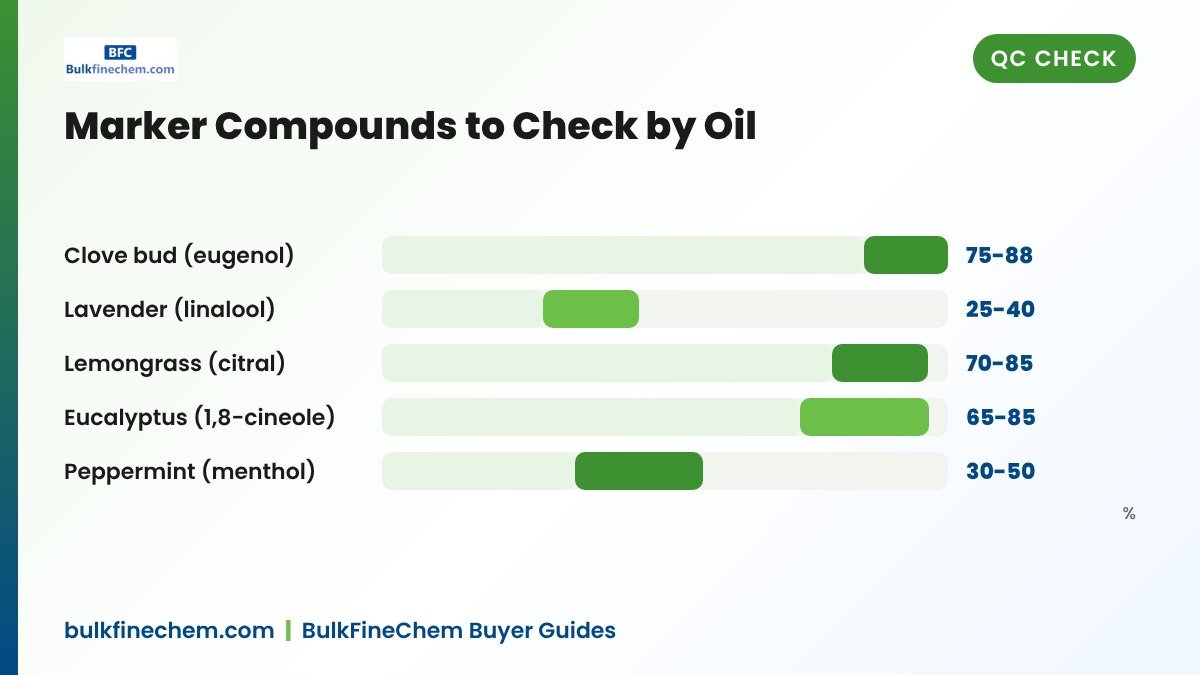
Clove, lemongrass and eucalyptus are the three most often bought on a single number, which is exactly why they are the three most often adjusted. A lemongrass oil at 88% citral with almost no myrcene and no geraniol is worth a second look, because a genuine steam distilled oil carries those trails.
Reading a GC Report Line by Line
You do not need to be a chromatographer to get most of the value out of a GC report, but you do need the report to be complete. A trace with four peaks and a total of 100% tells you almost nothing.
- Ask for peak area percentages, not just a pass mark. The compound list with its percentage against each peak is where the profile lives.
- Check that the peaks add up to at least 95%. A report that totals 70% has either cut the tail or run the wrong method.
- Look for the minor peaks, not only the markers. Compounds below 1% are the hardest to fake and the easiest to spot missing.
- Compare retention times against the standard, not against last month's lot. Column and method changes shift times, so ask for the column type, film and run time on the report.
- Demand the analysis of the actual lot, not a type approval. A generic profile picture is not evidence about the drum in front of you.
Our full checklist for pulling these details out of a chromatogram is in How to Read a GC-MS Report for Essential Oils, and the documents that should travel with the lot are covered in COA vs SDS vs TDS: Which Documents Do Chemical Buyers Need?.
Simple Checks You Can Run at Receiving
GC instruments are not in every plant, and you cannot wait three days for an external lab before accepting a truck. Four checks at the dock catch most of the crude adulteration and every case of a wrong lot.
- Seal and label first. Match lot number, drum count and seal condition against the packing list before anything is opened, and note the distillation date.
- Weigh and measure density. Fill a clean 100 mL pycnometer at the stated temperature and compare against the TDS; citrus oils run light around 0.841-0.850 while clove and cinnamon leaf run heavy around 1.030-1.060.
- Check refractive index. A hand refractometer reading taken at 20 C against the supplier's stated range flags a diluted lot in under a minute.
- Do a filter paper test. One drop on clean white filter paper left at room temperature should dry fairly clean; a persistent greasy ring points to a fixed oil carrier.
- Sniff the tail, not the top. Pass the strip after the first flash dies down; a flat or waxy tail on a "high marker" oil usually means isolates were added.
- Draw and store a retain sample. Seal about 20 mL per lot, label it with the lot number and keep it for the shelf life of the oil so any later dispute has a reference.
Density and refractive index are the two numbers that catch dilution with a cheap carrier, because a fixed oil shifts both. For a fuller picture of what those physical numbers mean in fixed and carrier oils, see Fatty Acid Profile in Carrier Oils: A Bulk Buyer's Spec Guide.
Spotting Adulteration Oil by Oil
Each trade oil has its own usual trick, so a general checklist works better when you know what to expect in the drum you actually bought.
Citrus oils are usually cut with the cheapest thing at hand: a fixed oil, a solvent, or a terpene blend from a related peel. A cold pressed orange oil with a low limonene peak and an unnaturally strong aldehyde note has been worked on, and a "cold pressed" oil with a refractive index well above the range is a sign of a expressed and reconstituted blend.
Clove bud, leaf and stem oils are usually adjusted upward on eugenol. Clove leaf oil naturally runs lower than bud oil, so a bud oil priced like leaf oil and testing at 85% eugenol with a thin tail is the pattern to question. Our comparison of the two cinnamon cuts, Cinnamon Bark Oil vs Cinnamon Leaf Oil, shows the same logic in a spice oil where the cut drives the cinnamaldehyde content.
Mint oils are usually adjusted on menthol or on the menthone to menthol ratio, and peppermint is often bulked up with spearmint or with added menthol. The profile differences are laid out in Peppermint Oil vs Spearmint Oil. Tea tree is a different case, where the problem is usually degradation rather than addition, since terpinen-4-ol must sit in range while the peroxide value stays low; that is the subject of Tea Tree Oil BP: What Pharma and Cosmetic Buyers Should Check.
For oils sold against a pharmacopoeial monograph, the adulteration question becomes a compliance question, and the grade claims are worth reading properly. IP vs BP vs USP Grade Oils: What Pharmaceutical Buyers Should Know explains what each grade actually commits the supplier to.
Build the Specification So Testing Is Possible
A specification that only names a marker percentage cannot be enforced, because a blender can meet it. Write the spec so that a passing lot must be the oil you asked for.
- Name the species and the plant part, for example Syzygium aromaticum bud, distilled, not "clove oil".
- Set a range for the marker and a ratio, such as eugenol 75-88% with a stated acetyl eugenol presence.
- Require a minimum GC total and the full peak list with area percentages attached to the lot COA.
- Fix the physical numbers: density at 20 C, refractive index at 20 C, optical rotation where the oil has one.
- Cap the peroxide value and require an assay on retention samples for oils stored beyond one season.
- State the sampling and dispute method, including which lab's result governs and who pays if it fails.

A marker pinned at the very top of the range or above it, a low GC total and an empty tail together are the pattern to hold a lot on. One flag alone is usually a crop or distillation difference, not fraud.
Safety and Handling When Testing Samples
Testing means opening drums, so treat the sample point as a chemical handling step, not a formality. Wear nitrile gloves and splash goggles, work in a ventilated area and never pipette by mouth. Many of these oils are flammable with flash points well below 100 C, so keep samples away from hot work and store them in a cool, dark, tightly closed glass container away from oxidisers.
Clove, cinnamon and oregano oils are skin and eye irritants and need careful labelling even in the QC corner. Citrus and other terpene-rich oils oxidise on exposure to light and air, which changes both the smell and the test result, so keep retain samples full, sealed and cool. Storage practice by oil family is covered in Essential Oil Storage: Shelf Life by Oil Type in India. Always follow the product's SDS and local rules for disposal of test residues.
What to Check Before Buying in Bulk
- Grade and origin on paper. Distillation method, plant part, crop season and state of origin should be on the COA, not only in the email.
- Lot-level documents. A COA with the actual GC peak list for that lot, plus SDS and TDS, before dispatch.
- Retention sample policy. Agree that a sealed retain is drawn at loading and one is kept by each side.
- Packing that protects the oil. Dark glass-lined drums, tin-lined or suitably lined drums, tight bungs and headspace kept low for oils that oxidise.
- Shelf life and retest date. Peroxide-sensitive oils should carry a retest date, not only a best-before date.
- A stated dispute route. Which lab, which method, and what happens to a failed lot.
Ask for the COA and SDS with the quotation, not after payment, and check the GC peak list against your own specification line by line before you confirm the order.
Frequently Asked Questions
What is the fastest way to check if an essential oil is adulterated?
Take density and refractive index at 20 C and compare them with the supplier's TDS, then do a filter paper test for a greasy residue. These three take minutes and catch most dilution with a fixed oil or solvent. Confirm anything doubtful with a GC analysis of the lot.
Is a high marker percentage always a sign of adulteration?
Not always, but a marker sitting at or above the very top of its natural range is a reason to look closer. A natural oil carries minor compounds around the marker, so check the GC total and the number of peaks below 1% rather than the marker alone.
What is the difference between GC and GC-MS in an essential oil report?
GC separates the compounds and gives peak areas, while GC-MS adds identification of each peak by mass spectrum. For a buyer, GC-MS is stronger evidence that a peak is what the label claims, especially when an unexpected peak appears.
Which essential oils are most often adulterated?
Oils bought on a single number, such as clove, lemongrass, eucalyptus, citrus and mint oils, are the most commonly adjusted. Any oil with a high-value single compound in it attracts topping up with that isolate.
How much sample should I keep from each drum?
Keep about 20 mL per lot in a sealed, labelled glass container, drawn as the lot is opened and stored cool and dark. Retain one sample at your plant and agree that the supplier keeps one, so any later dispute has a reference from the same lot.
Can oxidised oil look like adulterated oil on a report?
Yes. Oxidation creates new peaks and lowers the marker, which can look like a blend on a chromatogram. Peroxide value, the storage history and the distillation date separate degradation from deliberate adulteration.
What documents should I ask for before confirming a bulk oil order?
Ask for a lot COA with the full GC peak list and area percentages, the SDS, the TDS with density and refractive index, and the packing and shelf life details. Check them against your specification before the order is confirmed, not after dispatch.
Conclusion
Essential oil adulteration is caught by knowing which markers matter, insisting on a full GC peak list for the actual lot, and running density, refractive index and a retain sample at the dock. Most of the cost sits in accepting a lot that met one headline number and failed the profile, so a specification that tests ratios and minor peaks protects a batch long before it reaches your formulation.
Need a quote? Send your requirement to the BulkFineChem team with grade, quantity and destination, or browse All products.
Disclaimer: This article is general technical and procurement information. Always follow the product's Safety Data Sheet, Technical Data Sheet and the regulations that apply to your industry, and confirm suitability with trials before full-scale use.