
A drum of grapeseed oil arrives at your plant with a clean COA, low peroxide value and a "cold pressed" label. The batch smells fine in the lab sample and only shows up as a thin, fast-going-rancid base once it is in a 500 kg batch of serum three weeks later. Nine times out of ten the fatty acid profile on the gas chromatograph tells the story before the batch ever reaches production, if anyone bothers to ask for it.
This guide covers what a fatty acid profile carrier oils report actually contains, the ranges that separate one oil from another, and the specific numbers to write into your purchase specification so a blended or substituted drum gets caught at the gate instead of on the shop floor.
What a Fatty Acid Profile Actually Measures
A fatty acid profile is a gas chromatography result, usually GC-FID with a flame ionisation detector, that breaks the triglycerides in an oil into the individual fatty acids they are built from. The instrument separates them by chain length and degree of unsaturation, then reports each one as a percentage of the total fatty acids.
For most vegetable carrier oils you will see eight to twelve peaks: palmitic (C16:0), stearic (C18:0), oleic (C18:1), linoleic (C18:2) and linolenic (C18:3) do most of the work, with myristic, arachidic and eicosenoic showing in smaller amounts. Because each plant lays down a characteristic mix, the profile is close to a botanical fingerprint.
Jojoba is the useful exception. It is not a triglyceride oil at all but liquid wax esters, so the "fatty acid" and fatty alcohol profile looks nothing like a seed oil. That difference is exactly why it is a common bulking agent and why the profile catches it.
Why This One Number Settles Most Oil Disputes
Buyers usually rely on appearance, odour and peroxide value. Peroxide value tells you about oxidation, and the Difference between cold pressed and refined carrier oils is about processing. Neither one tells you what the oil is made from.
Three practical problems the profile settles:
- Botanical identity. A drum labelled sweet almond oil that shows 60 percent linoleic acid is not sweet almond oil, whatever the label says. Sunflower is the usual suspect.
- Hidden blending. Cutting a costly oil with 15 percent of a cheaper one barely shifts the smell but moves the minor acids noticeably, especially the ratio between oleic and linoleic.
- Wrong fraction of the same plant. Fractionated and fully hydrogenated oils are legal products but behave completely differently in a cream. The profile shows the missing unsaturated acids straight away.
If you already work through a GC-MS on essential oils, the Buyer's checklist for reading a GC-MS report applies here with one change: a fatty acid run is normalised to 100 percent of total fatty acids, so a missing peak means something was removed, not just that it is small.
Reading the COA Columns Without Wasting Time
The numbers that matter on a carrier oil COA sit in a short block. Read them in this order and you can clear a drum in a couple of minutes.
- Total fatty acid purity. The sum of all identified fatty acids, normally 93 to 99 percent depending on the oil. Anything much below that means unidentified material, unsaponifiable matter or a poor run.
- Individual acid percentages. Each acid as a share of the total. Compare against the ranges in the table below, not against the supplier's own marketing sheet.
- Retention time and method. Whether the run used a methyl ester (FAME) method or a direct free fatty acid method, and the column used. Two labs that ran different methods will not agree to a decimal.
- Unsaponifiable matter. A separate wet-chemistry figure. A high value in a supposed seed oil points to wax esters or sterols from another source.
- Moisture and insolubles. Small numbers, but they explain a cloudy drum faster than anything else.
The Guide to reading a certificate of analysis covers how to compare a COA against your own retained sample rather than trusting the printed figure.
Typical Ranges for Six Common Carrier Oils
The table below gives the ranges you should expect for unadulterated oils. Values are typical for cold pressed or expeller material and vary with crop origin, season and extraction, so treat them as a screening band rather than a pharmacopoeial limit.
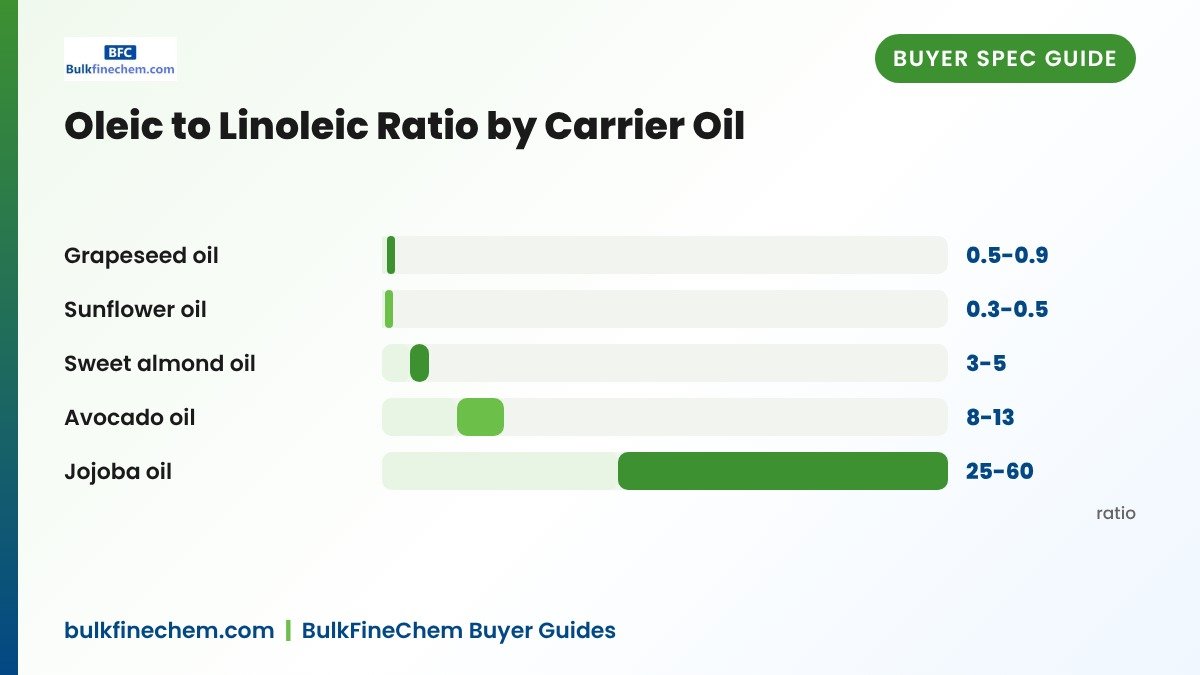
Grapeseed and sunflower both sit low on the ratio because linoleic dominates, which is why blending the two is hard to detect by smell and easy to detect here. Sweet almond sits in the middle with oleic clearly ahead. Avocado pushes higher still, and jojoba, being a wax ester, sits far above everything else.
Two readings to take from this. A ratio inside the band does not prove an oil is genuine on its own, it only clears that one test. A ratio outside the band is a genuine reason to hold the consignment and ask for a second run.
Oleic, Linoleic and Why the Ratio Matters for Your Formula
The ratio between these two acids predicts how an oil behaves in a finished product far better than any single acid does.
Oleic acid is monounsaturated and relatively stable. Oils high in it feel richer, spread slowly, and hold up well in a cream that sits on a shelf through a Gujarat summer. Avocado, almond and olive-type bases sit on this side.
Linoleic acid is polyunsaturated with two double bonds. It feels lighter and drier on skin, but it oxidises faster because those double bonds are easy targets for oxygen. Grapeseed and sunflower sit here, and they are the oils that most often come back with a rancid complaint.
That is the practical link to the Peroxide value limits for carrier oils. The fatty acid profile sets how fast a drum will climb toward its peroxide limit. A high-linoleic oil received at 2 meq O2/kg in April will not still be at 2 meq O2/kg in August in a warm store, and no certificate can promise that it will.
For a leave-on serum where a light feel matters, a high-linoleic oil is the right choice and you manage the shelf life. For a massage base or a night cream, the high-oleic oils cost less in complaints.
The Tests to Write Into Your Purchase Specification
Verbal assurances do not survive an audit. Put the numbers in the order so the lab has something to reject against.
- State the ranges, not the label. Write the accepted minimum and maximum for each named acid into the PO, taken from the table above or from your own approved reference sample. "As per standard" is not a specification.
- Ask for the full chromatogram, not a summary table. A summary lists eight numbers. The chromatogram shows the peaks between them, including the ones a supplier may not have chosen to report.
- Require a batch-specific COA. A generic profile printed once a year tells you nothing about the drum on your dock. Match the COA batch number to the drum marking before unloading.
- Keep a retained sample from every consignment. Seal 100 ml from each drum, label it with the batch, and hold it for the shelf life of the oil. When a downstream batch fails, the retained sample tells you whether the fault came in with the oil or developed in your store.
- Run a third-party check on high-value lots. For jojoba, avocado, pomegranate seed and other costly oils, an independent FAME run once or twice a year against your own supplier's COA is cheap compared to one recalled batch.
- Set a hold rule in advance. Agree with QC what happens when a value falls outside the band: reject, retest, or accept with written concession. Decide it before the truck is at the gate.
A fatty acid profile cannot tell you an oil is perfect, but a profile outside its botanical range tells you it is not what the label claims.
Blending, Substitution and the Squalene Question
Most carrier oil disputes in India are not about poisoned product. They are about a cheaper oil quietly doing the job of a costlier one, and about a byproduct stream being sold as a primary press.
The patterns worth knowing:
- Sunflower under almond or apricot. Sunflower is cheap, pale and low odour. It raises linoleic sharply and is the most common substitution in the almond and apricot bracket.
- Grapeseed under pomegranate seed or evening primrose. Similar light texture, a fraction of the cost, and a linoleic peak that swamps the marker acids of the dearer oil.
- Jojoba as a thickener in cheap bases. Jojoba's wax ester profile is distinctive, so look for an eicosenoic or gondoic peak that is too large for the declared oil.
- Deodorised oil sold as cold pressed. Deodorisation strips the unsaponifiable fraction and part of the tocopherols. The fatty acids look correct while the minor components that justify the price are gone.
This is the same logic behind the Comparison of almond and jojoba in cosmetic formulations, where the two oils are chosen for opposite reasons and are not interchangeable in a serum.
One honest caveat: natural variation is real. Two legitimate lots of grapeseed from different seasons can differ by a point or two on linoleic. A single value slightly outside a band is a question, not an accusation. A value far outside it, or a ratio that flips the two main acids, is a different matter.
Safety, Handling and Storage of Carrier Oil Bulk
Carrier oils are not hazardous in transport terms, but a warm warehouse ruins them quietly and a poor decanting practice contaminates them fast.
- Store cool and dark. Keep drums between 15 and 25 degrees Celsius, off the floor, out of direct sunlight. Monsoon humidity in June to September encourages surface mould on paper-lined drums and corrodes closures.
- Blanket with nitrogen. Headspace oxygen is the main driver of peroxide rise in an opened drum. A nitrogen blanket on part-used IBCs and a closed drum pump beat topping up with an open funnel.
- Avoid copper and brass contact. Trace copper accelerates oxidation at levels far below what you can see. Use stainless steel or approved plastic wetted parts.
- Use clean, dry decanting gear. Water introduced during decanting raises moisture, promotes hydrolysis and shows up as free fatty acids on the next test.
- Rotate stock strictly. First in, first out, with a retest on any drum older than six months for high-linoleic oils and twelve months for high-oleic ones.
- Follow the SDS for the specific product. Each product page carries its own Safety Data Sheet and Technical Data Sheet. Where a product carries an IP, BP or USP monograph, that monograph governs over the general ranges in this article.
For pharma-facing work, the Explanation of IP, BP and USP grade oils sets out which monograph applies and what extra documentation it brings.
What to Check Before Buying Carrier Oil in Bulk
Before confirming a bulk order, ask the supplier to confirm these points in writing:
- Botanical name and part used. Prunus amygdalus dulcis, seed, and whether the press was cold or solvent. A trade name alone is not a specification.
- Fatty acid profile with ranges. The full list of named acids with the accepted minimum and maximum for this contract, plus total fatty acid purity.
- Peroxide value and free fatty acid figure for the specific batch, with the test method named.
- COA, SDS and TDS against the batch number printed on the drums, with a Certificate of Analysis that matches the marking on the dock.
- Packing and filling date. New steel drums, HDPE or IBC as agreed, with the filling date and net weight documented. Bulk carrier oils ship in drums and IBCs, and the packing material affects shelf life as much as the storage temperature does.
- Shelf life and retest point stated on the COA, and whether the supplier holds a retained sample of the same lot.
BulkFineChem supplies carrier oils in bulk with COA and SDS documentation and confirms grade and specification before dispatch. Send your requirement with the grade, quantity and destination so the specification can be matched to your application before packing.
Frequently Asked Questions
What is a normal fatty acid profile for a carrier oil?
There is no single normal value. Each botanical has its own band, with oleic and linoleic usually making up 80 to 95 percent of the total. Grapeseed is linoleic-dominant while avocado and almond are oleic-dominant, so judge a result against the range for that specific oil, not against a generic figure.
Can a fatty acid profile prove an oil is adulterated?
It can show that the composition does not match the declared botanical, which is grounds to hold a consignment. It cannot by itself name the adulterant. A suspicious result usually leads to a second run, a sterol or unsaponifiable test, or a third-party confirmation.
What is the difference between a fatty acid profile and a GC-MS report?
A GC-MS report on an essential oil identifies volatile aroma compounds such as linalool or thymol. A fatty acid profile, usually run on a GC-FID, measures the non-volatile fatty acids that make up a fixed oil. They answer different questions and are not interchangeable documents.
How often should I test a carrier oil consignment?
Most buyers test every incoming lot for peroxide value and appearance, and run a full fatty acid profile on each new supplier, each new crop origin, and periodically on high-value oils. Reputable suppliers supply a batch-specific profile with the COA, which reduces how often you need to run it yourself.
Does cold pressing change the fatty acid profile?
Cold pressing does not change the ratio of fatty acids in any meaningful way, since heat alone at pressing temperatures does not rearrange them. What it preserves is the minor unsaponifiable fraction, tocopherols and sterols. Deodorised and refined oils show the same main acids with a thinner minor-component profile.
Which carrier oils go rancid fastest?
Oils high in linoleic and linolenic acid, such as grapeseed, sunflower, hempseed and wheatgerm, oxidise faster than high-oleic oils like almond, avocado and olive. Store high-linoleic oils below 20 degrees Celsius, blanket opened drums with nitrogen, and retest anything older than six months.
What fatty acid numbers should go into my purchase order?
Put in the minimum and maximum for each named acid you care about, the total fatty acid purity, the test method, and a clause requiring a batch-specific COA with the full chromatogram. Also state the hold rule for any value that falls outside the agreed band.
Conclusion
The fatty acid profile is the cheapest identity test available for a carrier oil, and the one most often skipped. Set the ranges in your purchase order, insist on the chromatogram with the batch-specific COA, keep a retained sample, and a blended or substituted drum stops being an unpleasant surprise three weeks into production.
Need a quote? Send your requirement to the BulkFineChem team with grade, quantity and destination, or browse All products.
Disclaimer: This article is general technical and procurement information. Always follow the product's Safety Data Sheet, Technical Data Sheet and the regulations that apply to your industry, and confirm suitability with trials before full-scale use.