

A grab sample from the equalisation tank reads pH 3.8 on a Monday morning, the line has just drained a reactor wash, and the pH trim loop downstream is already swinging past 10. That swing is where hydrated lime for ETP neutralisation either earns its place in your chemical store or gets quietly dropped for caustic. The chemistry is cheap and forgiving. The slaking tank, the sludge volume and the scaling on the dosing line are where it costs you.
This guide covers the practical side for an ETP or STP operator and the purchase team behind them: how lime actually neutralises acid effluent, how to slake it into a stable milk, the dose ranges to start a jar test with, what to check on the COA before a bulk order, and how to store it through Gujarat monsoon humidity.
Where Lime Fits in the Neutralisation Train
Most mixed industrial effluent reaches the ETP as a dilute mineral acid, an organic acid, or an alkaline stream that needs trimming down. Lime is the base of first choice when the effluent is acidic and carries metals, because it does two jobs at once: it raises pH and it precipitates. The calcium salts it forms are heavy and settle well, which is why lime shows up ahead of the clarifier rather than in a polishing step.
Caustic soda or soda ash do a cleaner job when you only need pH and nothing else. Lime wins when you also want phosphate and some metals pulled out with the sludge. It loses when you cannot carry the extra dissolved solids, or when the downstream biological stage is sensitive to a sodium spike. For a full picture of where each chemical sits in the train, the Bulk water treatment chemicals buyer's guide maps coagulants, bases and disinfectants stage by stage.
What Lime Actually Does to Acid Effluent
Hydrated lime is calcium hydroxide, Ca(OH)2, and it dissolves only modestly in water, around 1.7 g/L at ordinary plant temperatures. That low solubility is not a drawback in practice. You dose it as a suspension, the milk, and the solid keeps dissolving as the acid consumes what is already in solution. The result is a buffer that resists overshoot far better than a strong caustic solution does.
Three reactions matter in an ETP:
- Acid neutralisation. Hydroxyl ions combine with hydrogen ions, and the heat of reaction is small compared with caustic dilution, so the sump does not steam.
- Metal precipitation. Iron, aluminium, copper and zinc drop out as hydroxides in the pH band each metal prefers, usually between 8 and 10 for the common ones.
- Phosphate and hardness removal. Calcium reacts with phosphate to form a settleable solid, and it also strips carbonate hardness, which is why lime is common ahead of a cooling tower blowdown line.
Say your plant discharges phosphated blowdown at pH 5.2 with 12 mg/L ortho-phosphate. Lime takes the pH to 8.5 and pulls most of that phosphate into the sludge, which a caustic dose cannot do.
A lime milk that is kept moving stays reactive for hours; a lime milk left standing turns into a scaling problem overnight.
Dose Ranges to Start Your Jar Test With
Never set a lime pump from a rule of thumb alone. Alkalinity, the acid involved, temperature and the presence of metals all shift the number. Use the ranges below as the starting bracket for a jar test, then fine tune from the pH curve.

Run the jar test on the real sample, not on a diluted one. Take a litre, stir fast for a minute, then slow for fifteen minutes, and read pH at the end of both phases. A sample that reads 6.0 after slow stirring but 9.4 after fast stirring is under-reacted, not under-dosed, and more pump time will fix it where more lime will not.
Two figures worth carrying: 100% pure calcium hydroxide neutralises roughly 2.5 times its weight in sulphuric acid, and commercial hydrated lime is usually 90-95% Ca(OH)2. So a stream carrying 1,000 mg/L of free H2SO4 needs on the order of 400-450 mg/L of lime as a floor, before you add anything for metals and phosphate.
Slaking, Milk Preparation and Dosing Practice
Lime arrives as a dry powder. It has to become a smooth milk before a metering pump can do anything useful with it, and this is where most plant complaints start.
- Charge water first. Fill the slaking or slurry tank about three quarters full with water before any powder goes in. Dry lime dropped into an empty tank bridges on the hopper and blocks the feed.
- Add lime slowly with agitation running. Keep the mixer on throughout. Aim for a solids content of 5-10% by weight for dosing; heavier milks thicken and drop out in the pipe.
- Let it hydrate for ten minutes. Even bagged hydrated lime needs a short wetting period before the particle is fully wet through and the dose is predictable.
- Screen or recirculate before pumping. Pass the milk through a coarse screen or keep a recirculation loop to the tank. Grit and unhydrated particles are what kill a diaphragm pump.
- Dose from the pH probe, not the flow rate. Put the probe in the neutralisation sump after the mixing zone, with enough residence time, 10-20 minutes, for the reaction to finish before the probe reads.
- Log the curve, not just the set point. A pH trace that rises slowly then jumps tells you the reaction is complete. A trace that hangs high and falls back means you are over-dosing on the leading edge.
If you are running a batch neutralisation instead of continuous, dose in two splits: the first to about pH 4, the second to the target. One large dose to an acid batch creates a local high-pH pocket where calcium salts flash onto the tank wall.
PH Control and the Overshoot Problem
Lime overshoot looks like a caustic overshoot but behaves differently. Because undissolved solid is still sitting in the sump, the pH keeps climbing after your pump has stopped. Operators call this the tail, and it is the reason a lime loop must be tuned slower than a caustic loop.
Set the controller with a dead band of 0.5 pH units and a long derivative time, or run simple two-step control with a timer between doses. Keep the probe clean. Calcium carbonate and hydroxide scale on a glass bulb gives a lazy reading that makes the loop overfeed, so check and calibrate the probe every shift in a lime plant.
Watch the temperature too. Neutralisation warms the sump slightly, and warmer water holds less dissolved calcium hydroxide, which shifts the plateau pH a little. If your plant runs hot blowdown into the same sump, expect the plateau to sit lower than the jar test suggested.
Sludge, Solids and What Lime Costs Downstream
Lime is not a silent additive. Every kilogram you dose leaves as a solid somewhere, and the numbers below decide whether your clarifier can take it.
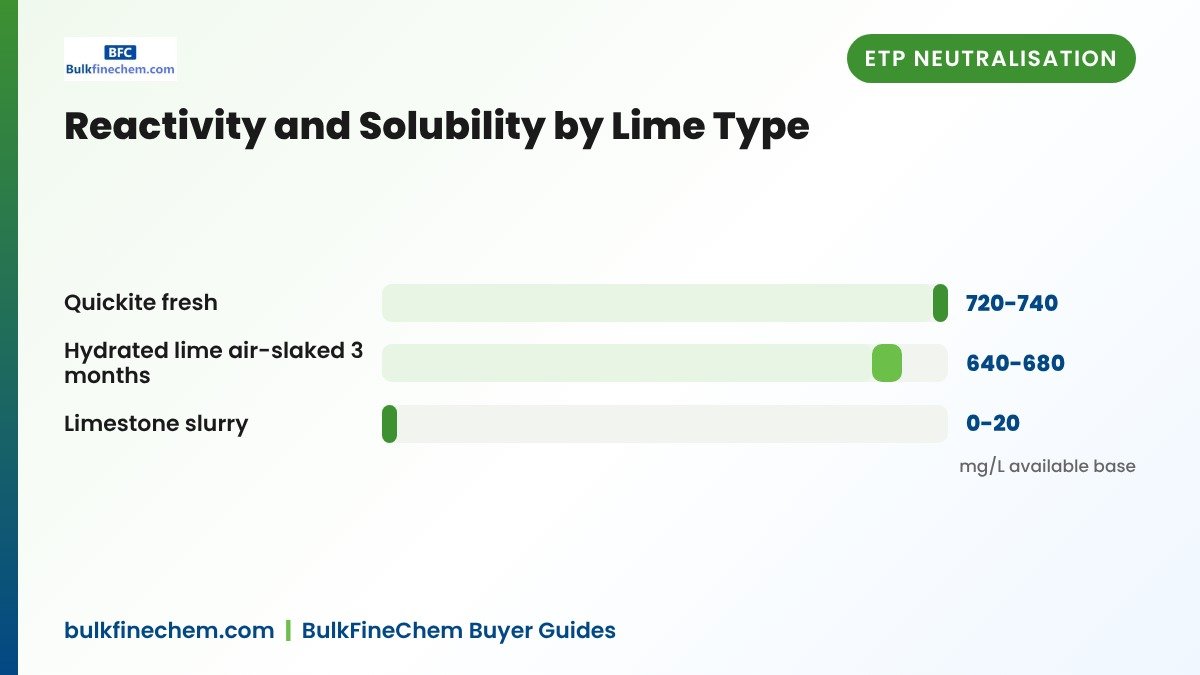
Expect roughly 1.3-1.8 kg of wet cake solids per kg of lime dosed, before polymer thickening, and more when metals are precipitating alongside. If your filter press runs on a fixed cycle, a lime switch is a press capacity question, not a chemical cost question.
A well-run lime line usually needs a light anionic or cationic polymer assist to keep the floc settleable. Match the polymer charge to the calcium-rich floc by beaker test rather than reusing the setting from your caustic days; the Anionic versus cationic polyelectrolyte guide covers how to pick that charge.
Where the stream is alkaline rather than acidic, lime is the wrong lever. In boiler and cooling circuits, hardness is handled differently, and the EDTA treatment of hard water in boilers and cooling towers explains the sequestration route. For boiler water conditioning with a phosphate rather than a hydroxide, Trisodium phosphate dosing and COA checks is the closer reference.
Safety and Handling
Treat hydrated lime as a corrosive alkaline solid, not as a harmless powder like lime in a sugar refinery story.
- Wear the right PPE. Nitrile or rubber gloves, goggles or a face shield over safety glasses, and a dust mask or half respirator when decanting or charging dry powder. Lime dust burns wet skin and eye tissue quickly.
- Never add water to a pile of quickite. If you slake quickite yourself, add the quickite to a moving water volume, never the reverse, and keep a clear area; the slaking heat can boil and spit.
- Store dry and off the floor. Keep bags on a pallet or rack in a covered, ventilated store, away from acids, aluminium powder and ammonium salts. Monsoon humidity in Gujarat and Maharashtra will harden an open bag into a brick within days.
- Close containers after every use. Hydrated lime absorbs carbon dioxide from air and turns into calcium carbonate, which is inert and stops neutralising. A bag that has been open a month has lost strength you cannot see.
- Clean spills with care. Sweep dry spills, do not hose them into a drain, and neutralise the residue only after collection. Spent lime slurry in a trench is both a slip hazard and a pH hazard.
- Follow the SDS and local rules. The product's Safety Data Sheet and your state pollution control board conditions override any general guidance here.
What to Check Before Buying in Bulk
Lime is cheap enough that buyers often skip the paperwork, and that is exactly how a weak lot reaches the dosing tank.
Ask for the Certificate of Analysis on the actual lot, not a generic one. The figures to read are available Ca(OH)2 content, usually 90-95% for a good hydrated lime, moisture, and the residue on a fine sieve. High moisture means the bag has already been sitting in humid air. A sieve residue tells you how much grit will end up in your tank bottom and your pump.
Then confirm the practical points before dispatch: particle fineness, since a fine hydrate slakes into milk faster; packing, normally 25-50 kg bags or bulk bags on a pallet, with inner lining; shelf life, and how the bags are stored at the warehouse; and the SDS and Technical Data Sheet with the order. Grade and specification should be confirmed in writing before dispatch, and the lot number on the COA should match the lot number on the bags you receive. If the paperwork habit is new with a supplier, this Guide to COA, SDS and TDS documents sets out what each one is supposed to prove, and How to read a COA before accepting a bulk order walks through the columns.
Run one trial lot before you switch the whole plant over. Slake a small batch, measure the milk density you can hold in suspension, and compare the dose per cubic metre against your current chemical. That single number settles the lime versus caustic argument faster than any datasheet.
Frequently Asked Questions
How much hydrated lime do I need to neutralise acid effluent?
Start a jar test at 400-1200 mg/L depending on strength, roughly 400-600 mg/L for light rinse water and 1000-1200 mg/L for a strong acid wash. Pure calcium hydroxide neutralises about 2.5 times its weight in sulphuric acid, so work up from the acid load in your sample and confirm with the jar test.
Can I dose hydrated lime as a dry powder straight into the sump?
Not into a dosing pump, and not into a small sump. Dry powder bridges in hoppers, wastes as dust, and forms local high-pH pockets. Make a 5-10% milk in a stirred tank and pump that, with a screen or recirculation loop ahead of the pump.
Why does my pH keep rising after the lime pump stops?
Undissolved lime in the sump keeps dissolving, so the reading climbs after the dose ends. This tail is normal. Use a wider dead band, longer control timing, and enough residence time, 10-20 minutes, between the mixing zone and the probe.
How long does an opened bag of hydrated lime last?
Use it within a few weeks of opening and keep the bag sealed. Hydrated lime absorbs carbon dioxide from air and converts to calcium carbonate, which will not neutralise acid. In monsoon humidity the change is faster, and a hardened bag has already lost strength.
Does lime add solids to my effluent?
Yes. Expect roughly 1.3-1.8 kg of wet cake per kg of lime dosed before thickening, and more when metals precipitate with it. Check your filter press or thickener capacity before switching from caustic to lime on a full stream.
Is hydrated lime safe to store next to caustic soda or acid drums?
No. Store it dry, on a pallet, in a covered ventilated area, separated from acids and from aluminium powder and ammonium salts. Keep it away from any area where water can splash onto bags.
What should I check on the COA before accepting a lime consignment?
Available Ca(OH)2 content, normally 90-95%, moisture, sieve residue, and the lot number matching the bags delivered. High moisture or heavy sieve residue points to weak milk and more grit in your slurry tank.
Conclusion
Hydrated lime for ETP neutralisation is the workhorse choice when the effluent is acidic and carries metals or phosphate, because it raises pH and drops solids in one step. The dose bracket is easy to start with and easy to correct, provided you slake properly, keep the milk moving, and let the pH loop run slow enough to catch the tail.
Need a quote? Send your requirement to the BulkFineChem team with grade, quantity and destination, or browse All products.
Disclaimer: This article is general technical and procurement information. Always follow the product's Safety Data Sheet, Technical Data Sheet and the regulations that apply to your industry, and confirm suitability with trials before full-scale use.