
A batch of effervescent tablets that fizzes flat in the glass almost always starts with a quiet argument in the stores: the citric acid is fine, the room humidity is fine, so it must be the bicarbonate. Potassium bicarbonate is the usual suspect in low sodium effervescent blends because it drinks moisture faster than most people expect, and a single pallet left against an outside wall can change how a whole lot behaves.
This guide covers the numbers that actually decide whether a lot works in an effervescent tablet or powder: assay, mesh, moisture, bulk density and how the potassium salt behaves differently from the sodium salt you may have used for years. It is written for purchase managers, R&D chemists and QC heads who buy in drums or bags and need the blend to fizz the same in March and in August.
What Potassium Bicarbonate Brings to an Effervescent Blend
Potassium bicarbonate (KHCO3) does the same job as sodium bicarbonate in a Potassium bicarbonate effervescent blend: it supplies the bicarbonate that reacts with a dry acid in water to release carbon dioxide. The difference is the counter ion. Potassium leaves you a sodium-free or low sodium declaration on the pack, which is the main reason effervescent brands have moved across.
The trade-off is handling. Potassium bicarbonate is more hygroscopic than the sodium salt, so it picks up atmospheric moisture at a lower relative humidity. A blend that sat happily for eighteen months on sodium bicarbonate can start caking in the hopper on the potassium salt unless you tighten moisture control and packing.
Molecular weight also matters in the formula. Potassium bicarbonate is heavier per mole than sodium bicarbonate, so a straight one-for-one swap by weight leaves the blend short of bicarbonate. You re-calculate the acid to base ratio on equivalents, not on kilograms.
Assay, Identity and Purity Numbers to Insist On
Food grade potassium bicarbonate is sold as potassium hydrogen carbonate, and the assay on the COA is the first line you check. Most food grade material lands between 99% and 100.5% on the dried basis, and a lot below 99% usually means either partial decomposition to carbonate during storage or a cheap industrial grade being pushed as food grade.
Carbonate content is the quiet specification. Bicarbonate slowly converts to potassium carbonate on warming or on repeated humidity swings, and carbonate fizzes differently, tastes more alkaline and raises the pH of the made-up drink. Ask for the carbonate limit as a number, not as a tick.
The rest of the identity panel is ordinary for a food ingredient: heavy metals within a low ppm limit, chloride and sulphate as traces, and a solution clarity test where a 10% solution in clear water should stay bright with no milky residue. Get these as actual figures on the COA against your own specification.
The assay range of 99 to 100.5% on a dried basis is the anchor figure. Loss on drying should sit between 0.2 and 0.5%, mesh retention on an 80 mesh sieve between 10 and 25%, and sodium as an impurity between 0.1 and 0.5% when the label carries a low sodium claim. Read more on how to weigh these columns in How to Read a Certificate of Analysis Before You Accept a Bulk Order.
Mesh Size and Bulk Density Decide the Fizz Curve
Two lots with identical assay can fizz completely differently because particle size controls how fast the acid and bicarbonate meet in water. Coarse granular material dissolves slowly, giving a long, steady fizz and a softer compact. Fine powder reacts on contact and gives a violent burst that is already over before the tablet reaches the bottom of the glass.
In a blend you usually want a mixed distribution: enough fines for an immediate visual fizz and enough coarse granules to carry the reaction for 30 to 60 seconds. Ask your supplier for the sieve analysis rather than a label like "fine powder", and keep the same distribution across lots so your compression settings do not drift.
Bulk density matters twice. It decides the fill volume of your sachet or tablet die, and it decides how much air is trapped when you blend. A lot that comes in at a lower tapped density than the last one will overfill sachets on the same machine setting and give you weight variation complaints.
Blend with the Acid at the Same Particle Size
Grinding only the bicarbonate is a common shortcut that backfires, because a fine acid against a coarse base gives a harsh, uneven reaction and a gritty finish in the drink. Match the two. If your citric acid is a coarse granular grade, ask for the bicarbonate in a comparable granulation and blend dry at low speed.
Potassium Bicarbonate vs Sodium Bicarbonate in the Same Formula
The swap question comes up every time a brand reformulates for sodium labelling, and the answer is not a straight substitution. On a molar basis, 100 kg of sodium bicarbonate is roughly equivalent to 134 kg of potassium bicarbonate, so the batch gets bigger and the acid side must be re-worked.
Taste changes too. Potassium gives a slightly saline, mineral edge that some flavourists mask with citrus or stevia, while sodium reads flatter. In practice most formulators keep a small sodium bicarbonate portion in the blend, which is why you will often see both salts in the same ingredient list.
| Property | Potassium Bicarbonate | Sodium Bicarbonate |
|---|---|---|
| CO2 per 100 kg | 54-55 | 52-53 |
| PH of 1% solution | 8.2-8.6 | 8.0-8.3 |
| Sodium contribution (mg per g) | 0-4 | 260-275 |
Per 100 kg the potassium salt yields about 54 to 55 kg of carbon dioxide against 52 to 53 kg for the sodium salt, a 1% solution reads pH 8.2 to 8.6 against 8.0 to 8.3, and the sodium contribution is under 4 mg per gram against 260 to 275 mg per gram, which is the number that drives the label claim. For the fuller side-by-side on function and cost in use, see Sodium vs Potassium Bicarbonate: Food Formulation Buyer Guide.
Setting the Acid to Base Ratio
Effervescent blends are usually dosed on a slight acid excess so that no bicarbonate taste is left in the drink. A common starting point is an acid to base ratio between 1.8:1 and 2.2:1 by weight when citric acid anhydrous is paired with a bicarbonate, then trimmed by taste.
Anhydrous citric acid and the monohydrate are not interchangeable here. The monohydrate carries water of crystallisation, which both lowers the effective acid and adds moisture to a system that cannot tolerate it. Most effervescent tablets use the anhydrous form for exactly that reason, and the difference is covered in Citric Acid Anhydrous vs Monohydrate: Which Should You Buy?.
In an effervescent blend, moisture is an ingredient you did not add, and it always shows up first as a slow fizz.
Binders and lubricants come last and in small amounts. PEG 6000 or a similar water-soluble lubricant is usual for effervescent tablets because ordinary stearates can leave a film that slows wetting. Add them after the acid and base are dry blended, never before.
A Trial Plan Before You Commit a Bulk Lot
- Record the numbers. Log assay, loss on drying, mesh distribution and bulk density from the COA against your own specification before the drums are opened.
- Run a 100 g fizz check. Drop a weighed sample into 200 mL of water at 25 degrees Celsius with your usual acid ratio and time it to the end of visible fizzing.
- Press a trial batch. Make 50 to 100 tablets at your target hardness and note the compression force needed; a lot needing a much higher force is usually too fine.
- Hold samples under stress. Keep tablets at 40 degrees Celsius and 75% relative humidity for three to seven days and check for swelling, mottling or early reaction.
- Taste the made-up drink. Compare against your retained standard at the same water temperature and pour ratio, because pH drift shows up on the palate first.
Keep the retained standard and the trial tablets. When a complaint arrives three months later, the comparison between the two lots tells you more than any document.
Safety and Handling
Potassium bicarbonate is a mild irritant rather than a hazardous material, but the dust from a bagging station irritates eyes and the nose. Wear safety glasses, a dust mask rated for nuisance dust and gloves when handling for long periods, and keep the room ventilated.
Store drums and bags off the floor on pallets, in a cool, dry, well ventilated store, tightly closed and away from acids, oxidisers and any spillage risk. Never store bicarbonate on the same rack as citric acid or other dry acids; a split bag in a humid store reacts on contact. Keep it away from strong alkalis such as Caustic soda flakes, which convert bicarbonate to carbonate on contact in the presence of moisture.
Spills are a housekeeping job: sweep, do not hose, and keep the dust out of drains where it will raise pH. Follow the product SDS and local rules for disposal and PPE.
What to Check Before Buying in Bulk
- Confirm the grade in writing. Food grade with a COA showing assay, loss on drying, heavy metals and carbonate, not a technical grade at a better rate.
- Ask for the sieve analysis. Fix the mesh distribution in the order so lot to lot fizz stays the same.
- Check packing and liners. Food grade material should come in poly-lined drums or bags with a sealed inner liner; loose-woven packing will not survive a Gujarat monsoon.
- Verify the shelf life and pack date. Bicarbonate loses potency in warm stores, so ask for the manufacturing date and keep FIFO rotation.
- Get the documents with the order. COA, SDS or MSDS and TDS, plus a GST invoice, with the grade and specification confirmed before dispatch.
For the wider paperwork side of any ingredient purchase, COA vs SDS vs TDS: Which Documents Do Buyers Need? sets out what each document actually proves. If you buy other hydrocolloids for the same blend, moisture behaves just as badly in Guar Gum in Frozen Foods: A Bulk Buyer's Specs Guide, and the mixing faults it causes are covered in Dry Blend Troubles: Moisture, Mesh and Static Checks.
Storing It Through a Gujarat Monsoon
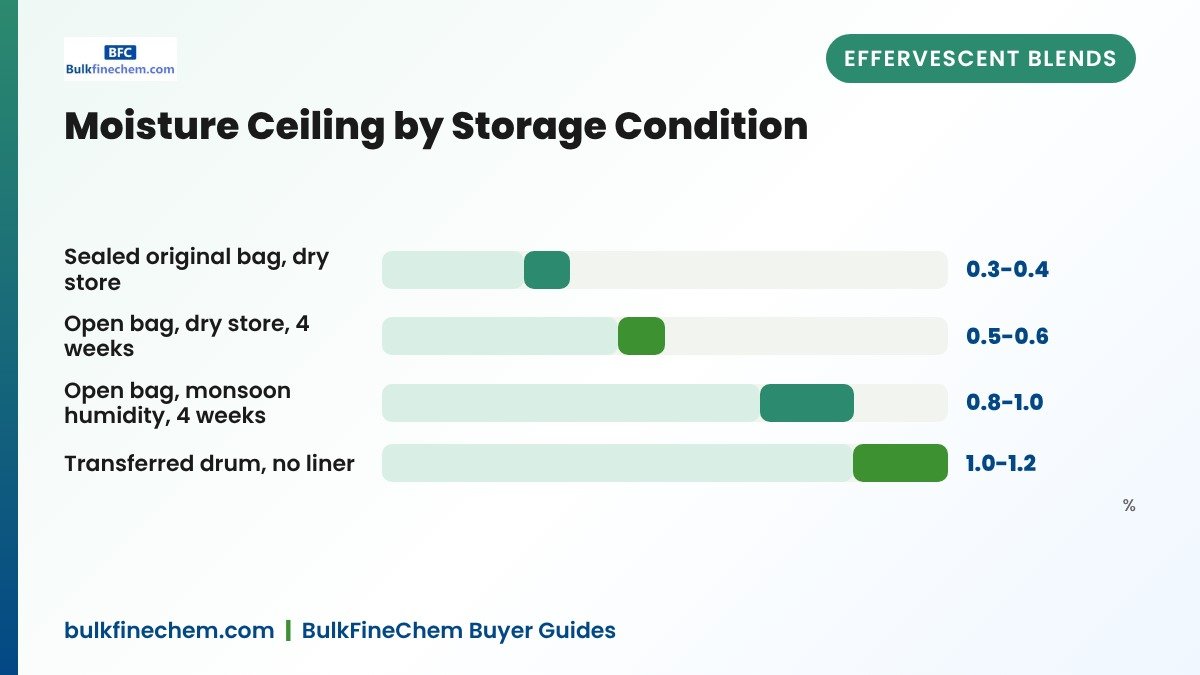
This is where most Indian buyers lose product rather than money. Bicarbonate in an open bag in a Vadodara July store climbs past 0.8% moisture inside a month, and that alone is enough to start a slow reaction with any acid dust in the room.
| Storage Condition | Moisture After 4 Weeks (%) |
|---|---|
| Sealed original bag, dry store | 0.3-0.4 |
| Open bag, dry store | 0.5-0.6 |
| Open bag, monsoon store | 0.8-1.0 |
| Transferred drum, no liner | 1.0-1.2 |
A sealed original bag in a dry store holds between 0.3 and 0.4% after four weeks. The same bag left open in a dry store reaches 0.5 to 0.6%, an open bag in a monsoon store 0.8 to 1.0%, and material transferred into an unlined drum 1.0 to 1.2%. Run a dehumidifier or at least forced ventilation in the blending room from June to September, keep drums closed within one hour of opening, and re-weigh and re-sieve any drum that has been open overnight before it goes into a blend.
Frequently Asked Questions
Can I replace sodium bicarbonate with potassium bicarbonate at the same weight in an effervescent formula?
Not directly. Potassium bicarbonate has a higher molecular weight, so about 134 kg is needed to match the carbon dioxide that 100 kg of sodium bicarbonate would give. Recalculate the acid to base ratio on equivalents and re-taste the blend.
What moisture level is acceptable in food grade potassium bicarbonate?
Most food grade lots come in at 0.2 to 0.5% loss on drying. Anything above 0.5% tends to cake in the drum and starts reacting early in the blend, so re-check the lot with a sieve and fizz test before releasing it.
Why do my effervescent tablets fizz too slowly?
The usual causes are a bicarbonate granulation that is too coarse, a blend that has picked up moisture and partially pre-reacted, or too much hydrophobic lubricant coating the particles. Check the sieve analysis and the loss on drying of both lots first.
Which citric acid should I use with potassium bicarbonate?
Anhydrous citric acid is the usual choice for tablets and powders because it adds no water of crystallisation to a moisture-sensitive system. The monohydrate can work in sachets with robust packing, but expect a shorter shelf life.
Is potassium bicarbonate suitable for a low sodium claim?
It contributes very little sodium compared with the sodium salt, which is why it is used in low sodium and sodium-free effervescent products. Confirm the final sodium figure of the finished product against your labelling rules with your regulatory team.
How should bulk potassium bicarbonate be packed and stored in humid climates?
In poly-lined drums or sealed bags with an intact inner liner, kept off the floor in a cool, dry, ventilated store away from acids. In monsoon months, close drums within an hour of opening and use forced ventilation or a dehumidifier in the blending room.
What documents should come with a bulk order?
A Certificate of Analysis with assay, loss on drying, heavy metals and carbonate figures, an SDS or MSDS, a Technical Data Sheet, and the packing list with batch and manufacturing date. Confirm the grade and specification in writing before dispatch.
Conclusion
Getting a Potassium bicarbonate effervescent blend to perform the same in every batch comes down to five numbers on the COA (assay, loss on drying, mesh, bulk density and carbonate), an acid to base ratio set on equivalents rather than weight, and a store that stays dry through the monsoon. Fix the specification and the storage, and the fizz stops being a surprise.
Need a quote? Send your requirement to the BulkFineChem team with grade, quantity and destination, or browse All products. We supply food grade Potassium Bicarbonate, Citric Acid Monohydrate and Sodium Bicarbonate Food Grade in bulk with COA and SDS on request.
Disclaimer: This article is general technical and procurement information. Always follow the product's Safety Data Sheet, Technical Data Sheet and the regulations that apply to your industry, and confirm suitability with trials before full-scale use.