
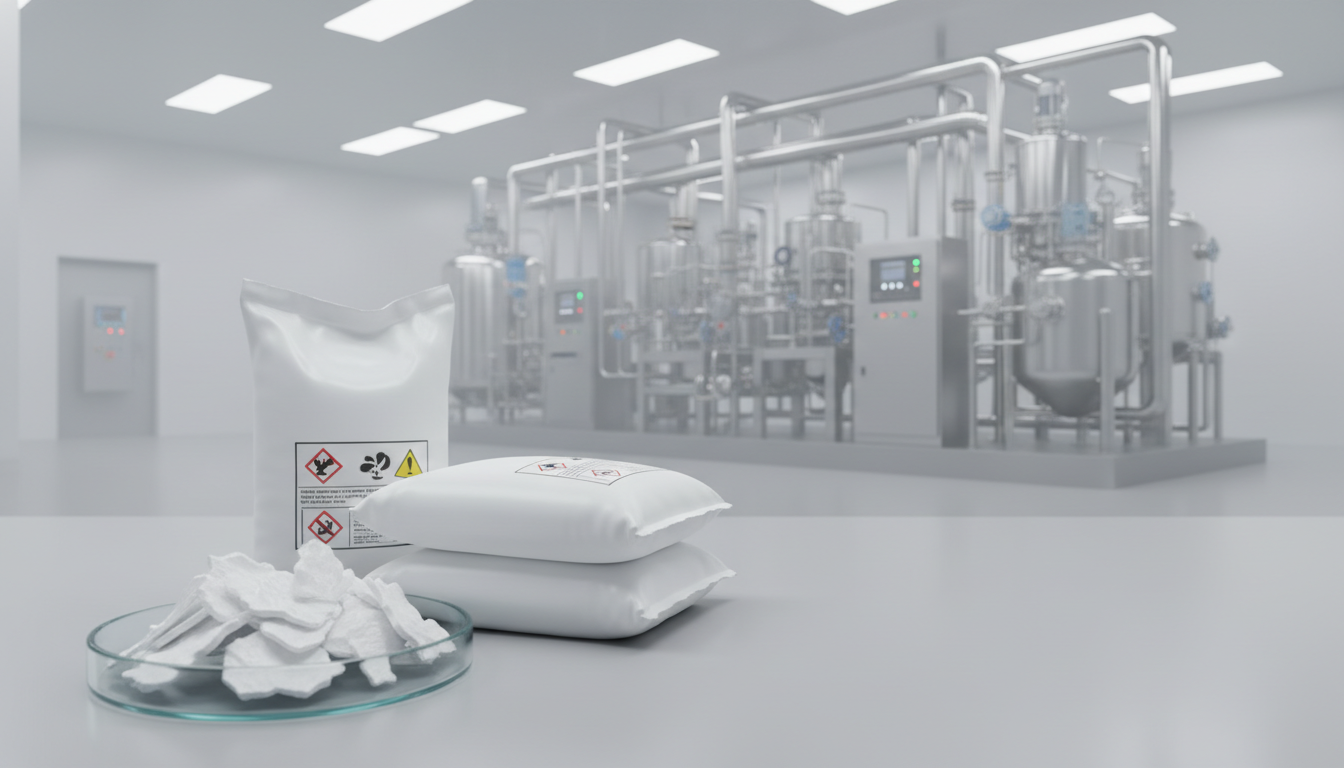
Ask ten manufacturing plants what chemical they can't run without, and caustic soda comes up more often than you'd expect. It's not glamorous. It doesn't get a product launch. But soap makers, paper mills, water treatment plants and textile units all keep it stocked because almost nothing else does its job as cheaply or as reliably.
If you're sourcing caustic soda flakes (sodium hydroxide, 98% purity) for the first time, or switching suppliers, this guide covers what it actually is, the grades you'll come across, where it's used, and how to buy it in bulk without the guesswork. You can see BulkFineChem's Caustic Soda Flakes – Sodium Hydroxide 98% listing alongside this if you want specifics while you read.
What Exactly Is Caustic Soda?
Caustic soda is the common industrial name for sodium hydroxide (NaOH) — a strong alkali (base) that's produced on a massive scale worldwide and used almost everywhere something needs to be dissolved, neutralized, or saponified. In its solid form, it shows up as flakes, pearls, or micro-prills; in liquid form, it's sold as a 32–50% solution, often called lye.
How It's Manufactured
Nearly all commercial caustic soda today comes from the chlor-alkali process, where brine (concentrated salt water) is electrolyzed. The reaction produces three things at once — sodium hydroxide, chlorine gas, and hydrogen — which is part of why caustic soda pricing tends to move with chlorine derivative demand, not just on its own.
- Membrane cell technology is the dominant modern method — cleaner and more energy-efficient than older mercury or diaphragm cells
- The resulting liquid caustic is roughly 32–35% NaOH, which is then either sold as-is or evaporated further
- Solid flakes are made by evaporating that liquid down to 98%+ concentration and flaking it on cooled rollers
- Pearls go through a similar concentration step but are formed as small beads instead of flakes
Flakes vs Pearls vs Liquid Lye
All three are the same chemical — the difference is handling, not chemistry. Flakes are the most common form for bulk B2B buyers because they're easy to bag, transport, and dose by weight.
- Flakes — irregular solid pieces, dissolve fast, standard for detergent and chemical plants
- Pearls — free-flowing beads, less dusty, popular where automated dosing systems are in use
- Liquid (32–50%) — skips the dissolving step entirely, but costs more to transport since you're shipping water too
- Micro-prills — a newer, even more dust-free format gaining ground in some detergent lines
Composition and Purity Grades
Not every batch of "caustic soda" sold in the market is the same. Grade matters more than most first-time buyers realize, and it directly affects what you can legally and safely use it for.
| Grade | Typical Purity | Common Use Case |
|---|---|---|
| Industrial / Technical | 96–99% NaOH | Pulp & paper, textiles, water treatment, general chemical manufacturing |
| Food Grade | ≥99%, tighter heavy-metal limits | Fruit and vegetable peeling, chocolate/cocoa processing, drinking water treatment |
| Laboratory / Reagent | ≥99%, ACS-level purity | Analytical testing, research, titrations |
| Specialty (low-chloride / low-sodium) | Custom | Processes sensitive to specific trace impurities |
For most B2B buyers — soap makers, effluent treatment plants, textile processors — industrial/technical grade at 96–99% NaOH is the right (and most economical) choice. Food-grade or reagent-grade only makes sense if your end product actually requires it; paying for pharma-level purity on a wastewater neutralization line is money down the drain, literally.
Where Caustic Soda Flakes Are Used
This is the part that surprises people outside the chemical industry — caustic soda's job list is genuinely long, and it cuts across sectors that otherwise have nothing in common.
Soap, Detergent and Personal Care
Saponification — the reaction that turns fats and oils into soap — needs a strong alkali, and caustic soda is the standard choice worldwide.
- Bar soap and liquid soap manufacturing
- Detergent powder and liquid formulation (pH adjustment)
- Surfactant intermediate production
- Cosmetic-grade fatty acid neutralization
Pulp, Paper and Textiles
Paper mills use it to break down lignin during pulping, and textile units rely on it for one of the oldest finishing processes in the book.
- Kraft pulping and pulp bleaching stages
- Mercerization of cotton fabric (improves strength and dye uptake)
- Fabric scouring and desizing
- Dye-bath pH control
Water and Effluent Treatment
If a plant's discharge water is too acidic, caustic soda is usually the fastest, cheapest way to bring it back into a dischargeable pH range.
- Municipal and industrial wastewater neutralization
- Drinking water pH correction
- Heavy-metal precipitation in effluent treatment plants (ETPs)
- Boiler water treatment
Chemical Manufacturing and Other Industrial Uses
Beyond these three big buckets, caustic soda quietly turns up in dozens of other processes.
- Alumina extraction (Bayer process) in the aluminium industry
- Petroleum refining — neutralizing acidic components in crude
- Manufacture of other sodium compounds (sodium hypochlorite, sodium phosphates)
- Drain and pipeline cleaning formulations
- Food processing — olive curing, pretzel and bagel glazing (food-grade only)
Specifications to Ask For Before You Buy
A supplier quoting "98% caustic soda flakes" without a spec sheet isn't giving you enough to work with. Ask for these numbers before you commit to an order.
| Parameter | Typical Industrial-Grade Value |
|---|---|
| NaOH content | 96–99% min |
| Sodium carbonate (Na₂CO₃) | ≤1.5% |
| Sodium chloride (NaCl) | ≤0.05–1%, depending on process |
| Iron (as Fe) | ≤0.005–0.01% |
| Appearance | White flakes, free-flowing |
| Moisture | ≤2% |
Every batch from a legitimate manufacturer should come with a Certificate of Analysis (CoA) covering these figures, plus a Safety Data Sheet (SDS) — caustic soda is a corrosive material and shipping/storage regulations expect that documentation to travel with the load.
Storage, Handling and Safety
Sodium hydroxide is highly corrosive to skin, eyes and metals like aluminium and zinc, and it's exothermic when dissolved in water — meaning it generates real heat, fast. None of this is a reason to avoid it; it's just a reason to handle it properly.
- Store in a cool, dry area away from moisture — flakes absorb atmospheric water and cake if left open
- Use HDPE-lined bags or drums; avoid aluminium, zinc, or tin containers
- Always add caustic to water, never water to caustic, when preparing solutions
- PPE (gloves, goggles, face shield) is non-negotiable when handling flakes or solutions
- Keep away from acids and organic materials during storage
How to Source Caustic Soda Flakes in Bulk from BulkFineChem
BulkFineChem sells caustic soda flakes and every other product on the platform strictly B2B — to manufacturers, brands, traders, distributors and institutional buyers, not to individual consumers. The process is enquiry-driven rather than a fixed price list, which keeps pricing accurate to current market rates and your actual order size.
- Send an enquiry for the quantity you need (kg, MT, or per your MOQ) via the Caustic Soda Flakes product page or Quick Order
- Receive a formal quotation covering price, packaging, and lead time for your specified quantity
- Confirm the order with advance payment — BulkFineChem's standard terms run 50–100% advance depending on order size
- Dispatch with full documentation — GST tax invoice, batch-wise Certificate of Analysis, and TDS/SDS on request; an e-way bill accompanies larger consignments, and delivery is available pan-India
Worth noting: because caustic soda is a hazardous-for-transport material, confirm your delivery location can legally receive it and that your storage area meets basic safety requirements before the shipment leaves the dock.
Frequently Asked Questions
What is the MOQ for caustic soda flakes on BulkFineChem?
MOQ varies by product and is confirmed at the quotation stage — reach out via the product page or Quick Order with your required quantity and it'll be confirmed in the formal quote.
Is caustic soda flakes the same as sodium hydroxide?
Yes. "Caustic soda" is the industrial trade name; sodium hydroxide (NaOH) is the chemical name. Flakes, pearls, and liquid lye are all the same compound in different physical forms.
What documents come with a bulk caustic soda order?
Every order ships with a GST tax invoice and a batch-wise Certificate of Analysis. Technical and Safety Data Sheets (TDS/SDS) are available on request, and an e-way bill is generated for larger consignments as required by law.
Can food-grade caustic soda be used for industrial applications?
Yes — food-grade exceeds the purity of standard industrial-grade, so it works for any industrial use. It's the reverse that's a problem: standard industrial-grade shouldn't be used where food-grade is legally required, since it may carry higher trace-impurity limits.
How should caustic soda flakes be stored to avoid caking?
Keep bags sealed and stored in a dry, moisture-controlled area. Sodium hydroxide is hygroscopic — it pulls moisture straight from the air — so an opened bag left in humid conditions will clump within days.
What packaging sizes are available for bulk orders?
Packaging is confirmed at the quotation stage based on order volume — typical formats across the industry range from 25–50 kg HDPE-lined bags up to bulk bags and tanker loads for liquid form. Share your required quantity when you enquire and it'll be matched accordingly.
The Bottom Line
Caustic soda flakes aren't complicated chemistry, but getting the grade, spec sheet, and documentation right matters more than most buyers assume going in. Whether you're running a saponification line, an ETP, or a textile finishing unit, the fundamentals stay the same: know your required purity, ask for the CoA before you pay, and work with a supplier who treats GST invoicing and TDS/SDS as standard, not an afterthought.
Ready to get pricing for your order quantity? Visit the Caustic Soda Flakes – Sodium Hydroxide 98% page or head straight to Quick Order to request a formal quote.