
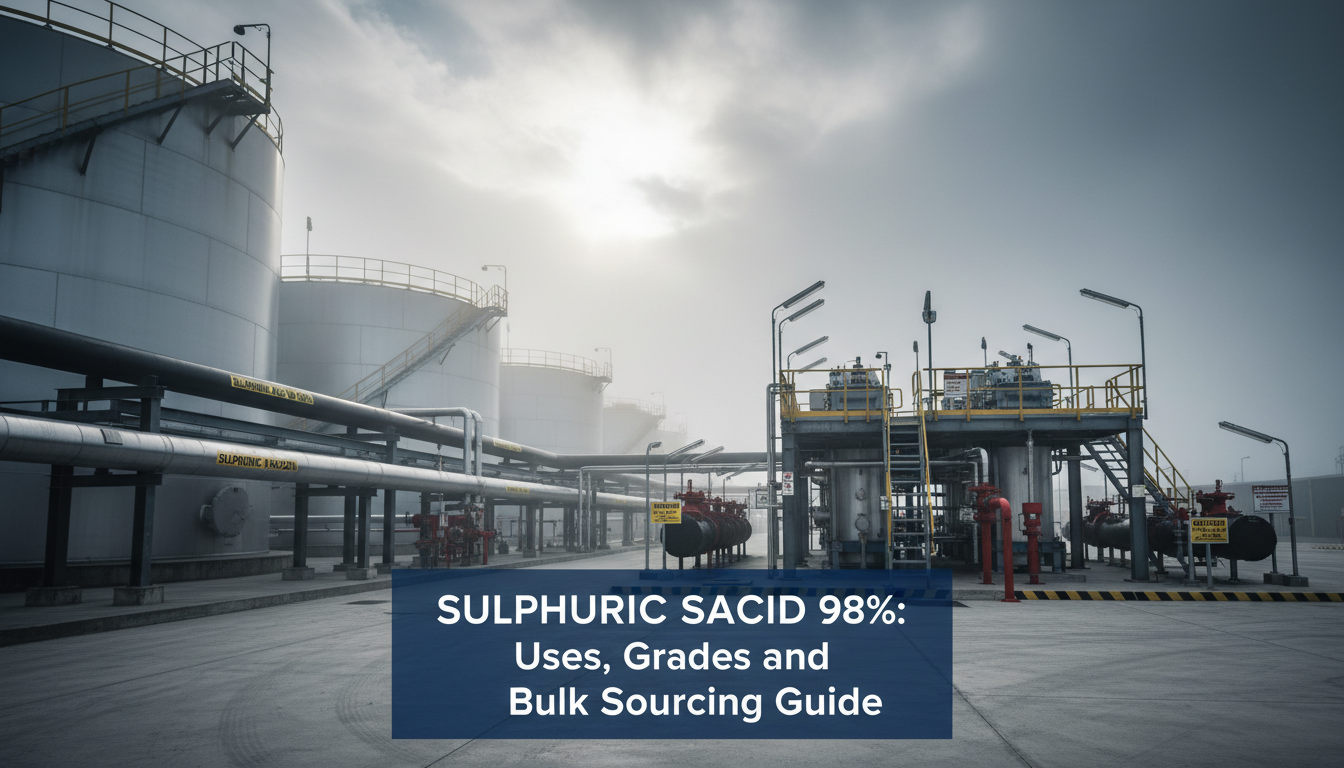
There's a reason sulphuric acid production volume is sometimes used as a rough proxy for a country's industrial output — it's that deeply embedded in manufacturing. Fertilizer plants, metal finishers, dye makers and refineries all draw from the same tanker trucks of 98% H₂SO₄, even though their end products couldn't look more different.
If you're buying sulphuric acid (98% commercial grade) in bulk for the first time, here's what actually matters — composition, the grade you need, safe handling, and how sourcing works when you're ordering by the drum or by the tonne. BulkFineChem's Sulphuric Acid – 98% Commercial Grade listing has current availability if you want to check specifics while reading.
What Is Sulphuric Acid, Exactly?
Sulphuric acid (H₂SO₄) is a strong mineral acid — dense, oily-looking, and highly corrosive in concentrated form. Commercial-grade sulphuric acid is typically supplied at 98% concentration, which is close to the practical maximum before it starts fuming and becomes harder to handle safely.
How It's Manufactured
Almost all industrial sulphuric acid today is made via the Contact Process, which oxidizes sulphur dioxide into sulphur trioxide over a vanadium pentoxide catalyst, then absorbs it into water (technically into existing acid, to avoid a dangerous mist).
- Sulphur is burned to produce sulphur dioxide (SO₂)
- SO₂ is catalytically oxidized to sulphur trioxide (SO₃)
- SO₃ is absorbed into concentrated sulphuric acid, not plain water, to control the reaction
- The result is diluted to the target commercial concentration — usually 98%
Battery Grade vs Commercial Grade
Not all 98% sulphuric acid is interchangeable, even at the same headline concentration. The difference is in trace impurities, not the main percentage figure.
- Commercial/technical grade — standard for fertilizer, chemical manufacturing, and metal processing
- Battery grade — tighter iron and heavy-metal limits, required for lead-acid battery electrolyte
- Reagent grade — laboratory-purity, used for analytical work, not bulk industrial buying
- Fuming/oleum — a different product entirely (SO₃ dissolved in H₂SO₄), used for specific sulfonation reactions
Composition and Key Specifications
Before placing a bulk order, get the numbers in writing — a verbal "98% pure" isn't a specification.
| Parameter | Typical Commercial-Grade Value |
|---|---|
| H₂SO₄ concentration | 98.0% min |
| Specific gravity | ~1.84 at 30°C |
| Iron (as Fe) | ≤0.05% max |
| Arsenic | ≤0.004% max |
| Color/appearance | Clear to slightly yellow, oily liquid |
| Residue on ignition | Low — batch-dependent, confirm via CoA |
These figures should always come backed by a Certificate of Analysis for the specific batch you're buying, not a generic product spec sheet. Iron content in particular matters a lot if the acid is going into a process sensitive to metal contamination, like dye manufacturing or certain pharma intermediates.
Where Sulphuric Acid Is Used
It's genuinely one of the most consumed industrial chemicals on the planet, and the reason is simple — it's a cheap, powerful acid and dehydrating agent that plenty of large-volume processes depend on.
Fertilizer Manufacturing
This is the single biggest end use worldwide, and it's not close.
- Phosphate fertilizer production (converting rock phosphate to superphosphate)
- Ammonium sulphate manufacturing
- Potassium sulphate production
- Zinc sulphate and other micronutrient fertilizers
Chemical and Petrochemical Manufacturing
As a catalyst and dehydrating agent, sulphuric acid shows up throughout organic chemical synthesis.
- Alkylation processes in petroleum refining
- Titanium dioxide pigment production
- Manufacture of other acids and sulphate salts
- Explosives and dye intermediate production
Metal Processing and Textiles
Its strength as an acid makes it useful anywhere metal surfaces or fibers need aggressive treatment.
- Pickling and de-scaling of steel before galvanizing or coating
- Non-ferrous metal plating and purification (copper, zinc electrolysis)
- Textile processing and mercerization support
- Battery acid production (battery-grade only)
Water and Effluent Treatment
On the flip side of caustic soda's role in raising pH, sulphuric acid is a standard tool for lowering it.
- pH correction of alkaline industrial effluent
- Cooling tower and boiler water treatment
- Ion-exchange resin regeneration in water softening plants
Storage, Handling and Safety
Concentrated sulphuric acid is a serious hazard — it's severely corrosive to skin and eyes, reacts violently with water if added in the wrong order, and can char organic material on contact. Respect for the chemical, not fear of it, is the right approach.
- Store in stainless steel or HDPE tanks/containers — never in plain carbon steel or aluminium below certain temperatures
- Keep bone dry — moisture ingress and dilution reactions generate significant heat
- Always add acid to water, never water to acid, when diluting
- Full PPE — acid-resistant gloves, goggles, face shield, apron — for any handling or transfer
- Segregate from organic materials, reducing agents, and most metals during storage
How to Source Sulphuric Acid in Bulk from BulkFineChem
Sulphuric acid moves through BulkFineChem's platform the same way every other product does — B2B only, enquiry to quotation to dispatch, with no fixed public price list because acid pricing tracks raw sulphur costs closely.
- Submit your enquiry with quantity (kg, MT, tanker load) through the Sulphuric Acid product page or Quick Order
- Get a formal quotation reflecting current market pricing, packaging format, and delivery timeline
- Confirm with advance payment per BulkFineChem's standard 50–100% advance terms
- Receive your shipment with a GST tax invoice, batch CoA, TDS/SDS on request, and an e-way bill for larger loads — delivered pan-India
Because sulphuric acid is classified as a hazardous material for transport, confirm your receiving facility has appropriate unloading infrastructure (for tanker or ISO tank deliveries) before the order is dispatched.
Frequently Asked Questions
What's the difference between commercial-grade and battery-grade sulphuric acid?
Both are typically ~98% H₂SO₄, but battery grade carries much tighter limits on iron and other trace metals, since those contaminants degrade battery performance. Commercial grade is standard for fertilizer, chemical manufacturing, and metal processing.
What is the MOQ for bulk sulphuric acid orders?
MOQ depends on packaging format (drums vs. tanker load) and is confirmed at the quotation stage — share your required quantity via the product page or Quick Order.
Does every order come with a Certificate of Analysis?
Yes — every batch ships with a CoA covering concentration, iron content, and other key parameters, alongside a GST tax invoice. TDS/SDS documents are available on request.
Why is sulphuric acid used in fertilizer production?
It's the acid used to convert insoluble rock phosphate into soluble phosphate forms plants can actually absorb — the basis of single superphosphate (SSP) and related fertilizers. It's also key to ammonium sulphate and potassium sulphate production.
Is sulphuric acid dangerous to transport?
Yes, it's classified as a corrosive hazardous material for transport, which is why an e-way bill and proper documentation accompany larger consignments, and why receiving facilities need appropriate handling infrastructure.
Can sulphuric acid be diluted on-site after delivery?
Yes, and it's common practice — but dilution must always be done by adding acid slowly to water, never the reverse, and with proper PPE, since the reaction is strongly exothermic.
The Bottom Line
Sulphuric acid is about as fundamental to industrial chemistry as it gets, but "98% acid" alone isn't a full spec — grade, iron content, and batch documentation are what actually determine whether it's fit for your process. Confirm the CoA, handle it with the respect it deserves, and work with a supplier that treats GST invoicing and e-way billing as routine.
Check current availability on the Sulphuric Acid – 98% Commercial Grade page, or go straight to Quick Order to request a formal quote.