
A drum of grapeseed oil arrives in July, seals intact, paperwork clean, and the batch still smells off by the time it reaches your compounding tank. Nothing on the delivery note told you it was already on its way to rancid. That is the gap Carrier oil oxidative stability is meant to close: it measures how long an oil resists oxidation before it starts to break down, and it is the number that predicts whether a drum will still be usable three months after it reaches your store.
Most Indian buyers specify the easy numbers, acid value, colour, odour, and stop there. Acid value tells you what has already happened to the oil. Stability tells you what is going to happen. This guide covers the tests that actually separate a stable lot from a tired one, the limits worth writing into your purchase order, and how the Gujarat summer and monsoon humidity change what you should accept.
What Oxidative Stability Means in a Fixed Oil
Oxidation in a carrier oil is a chain reaction at the double bonds of its fatty acids. Oxygen attacks, forms hydroperoxides, those split into aldehydes and ketones, and you get the paint-like or stale-nut smell that QC rejects. The reaction runs slowly at first and then fast, which is why a drum can pass on arrival and fail in the tank.
The useful idea is the induction period, the flat part of the curve before hydroperoxides pile up. A test that reports how many hours an oil stays inside that flat part tells you far more than a snapshot measurement of what is already in the sample. Two lots can have the same acid value and one may have weeks of life left while the other has days.
Natural antioxidants, mainly tocopherols and tocotrienols, decide how long that flat part lasts. Refining, deodorising and long storage strip them out. So does a high load of polyunsaturated fatty acids. Sunflower and grapeseed carry more of both risks than rice bran or sesame, and jojoba is a wax ester rather than a triglyceride, so it barely oxidises at all.
Why Acid Value Alone Is Not Enough
Acid value counts free fatty acids, which come from hydrolysis, the splitting of the triglyceride by water and heat. That is a different failure from oxidation. An oil can hold a low acid value while its hydroperoxides climb, because peroxides do not register as free acids.
The pattern to watch for in a COA set is a low acid value paired with a high peroxide value. That is a freshly refined oil from tired feedstock, the peroxides have not yet collapsed into secondary products. A high acid value with a low peroxide value usually means old oil where the peroxides already broke down. Both are problems, and neither shows up if you only test one of them.
Peroxide value is also a slow-moving target. It doubles in a half-open drum sitting under lights, so a result from a lab that received the sample late tells you about the courier, not the producer. The Peroxide value guide covers the sampling and titration side in more detail.
The Four Tests That Predict Shelf Life
A stability spec works best as a small set of numbers, each catching a different failure.
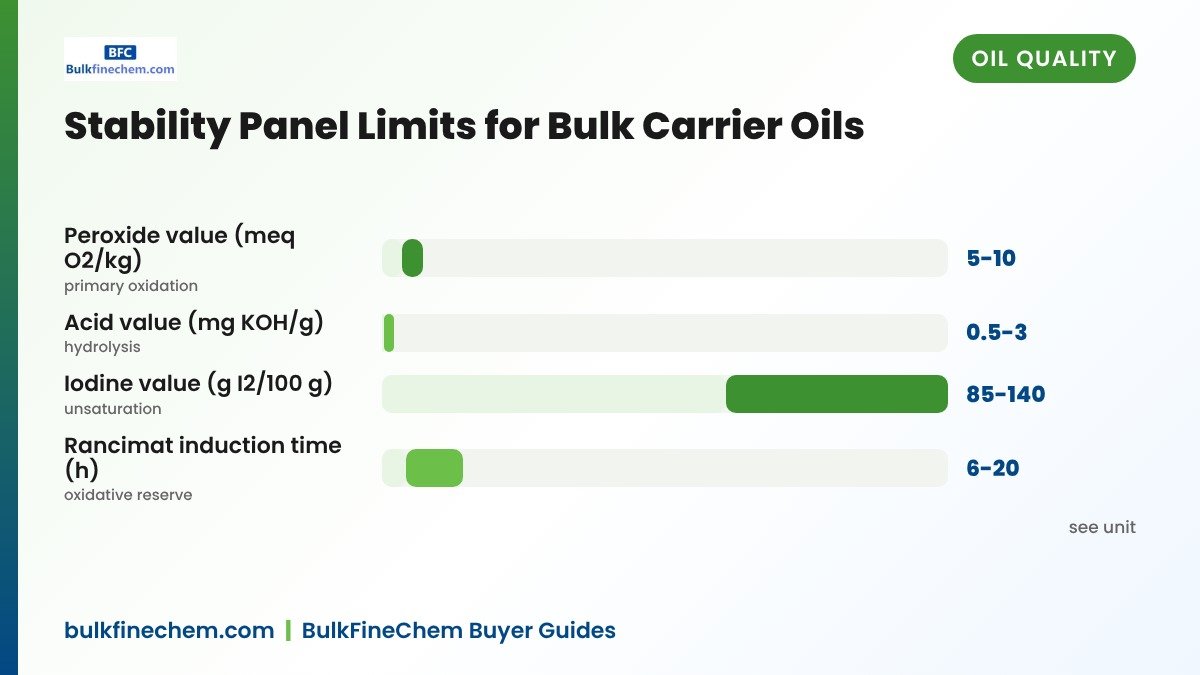
Peroxide value and acid value are the pair you test on every incoming lot. Iodine value is a fingerprint rather than a freshness reading, since it is fixed by the oil itself and mostly detects wrong species or adulteration. Rancimat induction time is the one that forecasts remaining life, and it is the number to ask for when you are qualifying a new source. Not every supplier lab runs Rancimat. A forced-storage stress test, described below, gives you most of the same information without the instrument.
Which Oils Are Stable and Which Are Not
Unsaturated fatty acid content drives most of the difference. The table below shows the usual range for common carrier oils and what to expect from a well-handled lot stored below 25 C in a sealed dark container.
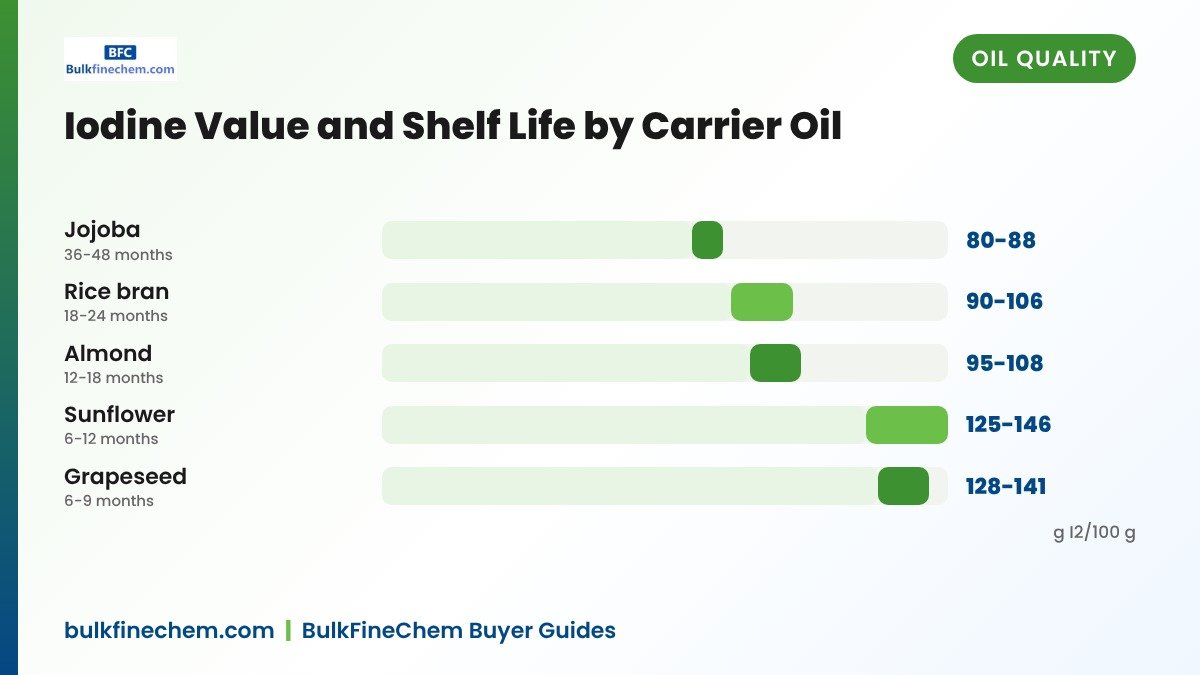
Jojoba sits at the top because its wax esters have few attackable sites. Rice bran keeps well for a different reason, its oryzanol and tocopherol content survives mild refining. Grapeseed and sunflower are the two that cause the most complaints on the shop floor: high linoleic load, often a light colour that hides early oxidation, and frequently sold in clear packs. If your formulation needs a light-feel oil and long life, the practical answer is to buy smaller lots more often rather than one large drum at a discount.
A Simple Receiving and Stress Test
You do not need an oxidative stability analyser to catch a bad lot. A small routine at the receiving bay catches most of them.
- Pull the sample correctly. Draw from a sealed original container, not from the drum you have already been decanting from, and fill the headspace of the sample bottle rather than leaving it half empty.
- Run the two quick tests. Acid value and peroxide value on the same day the sample arrives, against the limits on your purchase order.
- Set the stress jar. Put 50 mL in a clear glass bottle, cap it loosely and keep it on a shelf at ambient, around 30 to 35 C in most Indian plants, for four weeks.
- Score it at week two and week four. Note any paint, cardboard or stale-nut note against a fresh sample kept in the fridge; a change visible by week two means the lot has little reserve left.
- Record and quarantine. Any lot that fails either quick test or changes smell in the stress jar goes to quarantine, not to the dispensing line, pending the supplier's retest.
Acid value tells you what already happened to the oil. Stability tells you what will happen in your store.
Keep the stress jars as a reference set. After two quarters you will know which suppliers' lots hold and which ones you are buying on a short leash.
How Refining and Packing Change the Answer
The same seed can give an oil with double the shelf life depending on what happened after pressing. Cold-pressed oils keep tocopherols but also keep phospholipids, trace metals and moisture from the seed, all of which accelerate oxidation. Refined, bleached and deodorised oils lose most natural antioxidants but also lose the pro-oxidants, so they often arrive with a lower peroxide value and a shorter runway. The trade-off is covered in Cold pressed vs refined carrier oils.
Four things matter more than the label on the drum:
- Nitrogen blanketing. Headspace air in the drum at filling is the single largest driver of early peroxide rise.
- Container type. HDPE drums and lined steel with an inner film beat plain steel and clear plastic for anything over 90 days.
- Fill ratio. A 200 L drum holding 120 L oxidises faster than a full one; decant leftover stock into smaller containers.
- Store temperature. Peroxide formation roughly doubles for every 10 C rise, so a rooftop store in May is a different problem from a ground-level AC store.
For a cosmetic or nutraceutical base, ask your supplier to state the tocopherol level and whether the drum was nitrogen-filled. If a supplier cannot answer either question, treat the shelf life on the label as an estimate you have to verify.
Safety and Handling
Carrier oils are not hazardous goods in transport, but oxidised oil is a skin and eye irritant and rancid fumes in a closed compounding room are unpleasant to work around. Handle rancid stock with nitrile gloves and eye protection, and never smell a bottle directly; waft from a distance.
Spills of vegetable oil make floors slippery and should be absorbed with sand, vermiculite or an inert absorbent, then disposed of as per your site's waste rules. Do not pour oil down drains or into the ETP inlet, since it fouls the floatation unit. Store drums off the floor, away from direct sun, oxidising agents, strong alkalis and any heat source, and keep the area ventilated. Segregate oil stores from acids and hypochlorite. Always follow the product's Safety Data Sheet and your local pollution control board rules for disposal.
Heat and light are the practical enemies. Keep drums out of yard storage in March to June, and in June to September protect paper or cardboard outer packing from monsoon damp, since a wet label and a rusting chime usually come with a compromised seal.
What to Check Before Buying in Bulk
Set the specification before you ask for a price, and put the numbers on the purchase order.
- Ask for the full stability panel. Peroxide value, acid value, iodine value and, if the supplier runs it, induction time, all with the test method named.
- Check the batch identity. The COA lot number must match the drum markings, with the packing date printed, not just a best-before date.
- Confirm the packing details. Drum size, whether the headspace was nitrogen-filled and the inner liner type.
- Set a retest window. Agree in writing that peroxide value is rechecked at 3 and 6 months, and what happens if it crosses your limit.
- Verify the species. Iodine value and fatty acid profile together catch a cheap oil blended into an expensive one, as covered in the Fatty acid profile spec guide.
For pharma-facing work, the same logic applies with tighter document control; see IP vs BP vs USP grade oils. BulkFineChem supplies carrier oils such as Grapeseed Oil, Rice Bran style cold pressed bases and Wheatgerm Oil in bulk drums and carboys, with COA and SDS issued against the dispatched lot.
Frequently Asked Questions
What is a good peroxide value for a bulk carrier oil?
For cosmetic and pharma-facing bulk lots, most buyers set a receiving limit of 5 to 10 meq O2/kg and a production limit nearer 5. A rising trend across successive lots matters more than one reading, so log every result.
Why does my oil smell fine but still fail QC?
Early oxidation products are largely odourless. Hydroperoxides build up during the induction period without any smell, and only break down into smelly aldehydes once the oil is well into oxidation. A peroxide value test catches this stage; the nose does not.
What is Rancimat induction time?
It is a forced-oxidation test where the oil is heated, usually around 110 C, with air bubbled through and the conductivity of the trap monitored. The hours before the conductivity curve turns sharply upward is the induction time, a measure of the oil's remaining antioxidant reserve.
Does iodine value tell me if an oil is fresh?
No. Iodine value is set by the fatty acid composition and stays broadly constant for a given species. It is used to confirm the oil is what the label claims and to flag a blend with a cheaper oil, not to judge freshness.
How should bulk carrier oil drums be stored in India?
Off the floor, out of direct sun, below 25 C where possible, with the drum headspace minimised after opening. Keep them away from oxidising agents and alkalis. In summer, avoid rooftop or yard storage, and in monsoon keep cardboard outer packing dry.
Can I bring a rancid oil batch back down?
You can lower free fatty acids by refining, but secondary oxidation products cannot be removed without stripping colour and odour that then show up in your finished product. In practice a lot that has crossed your peroxide limit should be rejected or moved to a non-skin-contact use.
How long does cold pressed oil last compared with refined oil?
Refined oils usually arrive with lower peroxide values and fewer pro-oxidants, so they can look more stable on day one, but they have lost most natural tocopherols and often decline faster after opening. Cold pressed oils keep antioxidants but carry more seed impurities, so both need the same stability spec on the purchase order.
Conclusion
Oxidative stability is the number that decides whether a bulk oil lot stays usable through your production cycle or ends up in the reject bay. Pair peroxide value and acid value on every delivery, hold iodine value as a species check, and use induction time or a four-week stress jar when you qualify a new source. Choose the oil for your shelf life, jojoba or rice bran for long-life products, sunflower and grapeseed for fast-moving batches.
Need a quote? Send your requirement to the BulkFineChem team with grade, quantity and destination, or browse All products.
Disclaimer: This article is general technical and procurement information. Always follow the product's Safety Data Sheet, Technical Data Sheet and the regulations that apply to your industry, and confirm suitability with trials before full-scale use.